

Crypto Salary Benchmarks 2026: What to Pay Every Web3 Role
Setting web3 compensation in 2026? Base ranges by role, how token grants should be structured and where hiring teams most often get it wrong.

TL;DR
- Crypto salary benchmarks for 2026: senior Solidity around $187K base.
- Token grants add 30 to 100% on top of base at most protocols.
- Standard vesting is four years with a one year cliff.
- Underpaying on security is the most expensive mistake teams make.
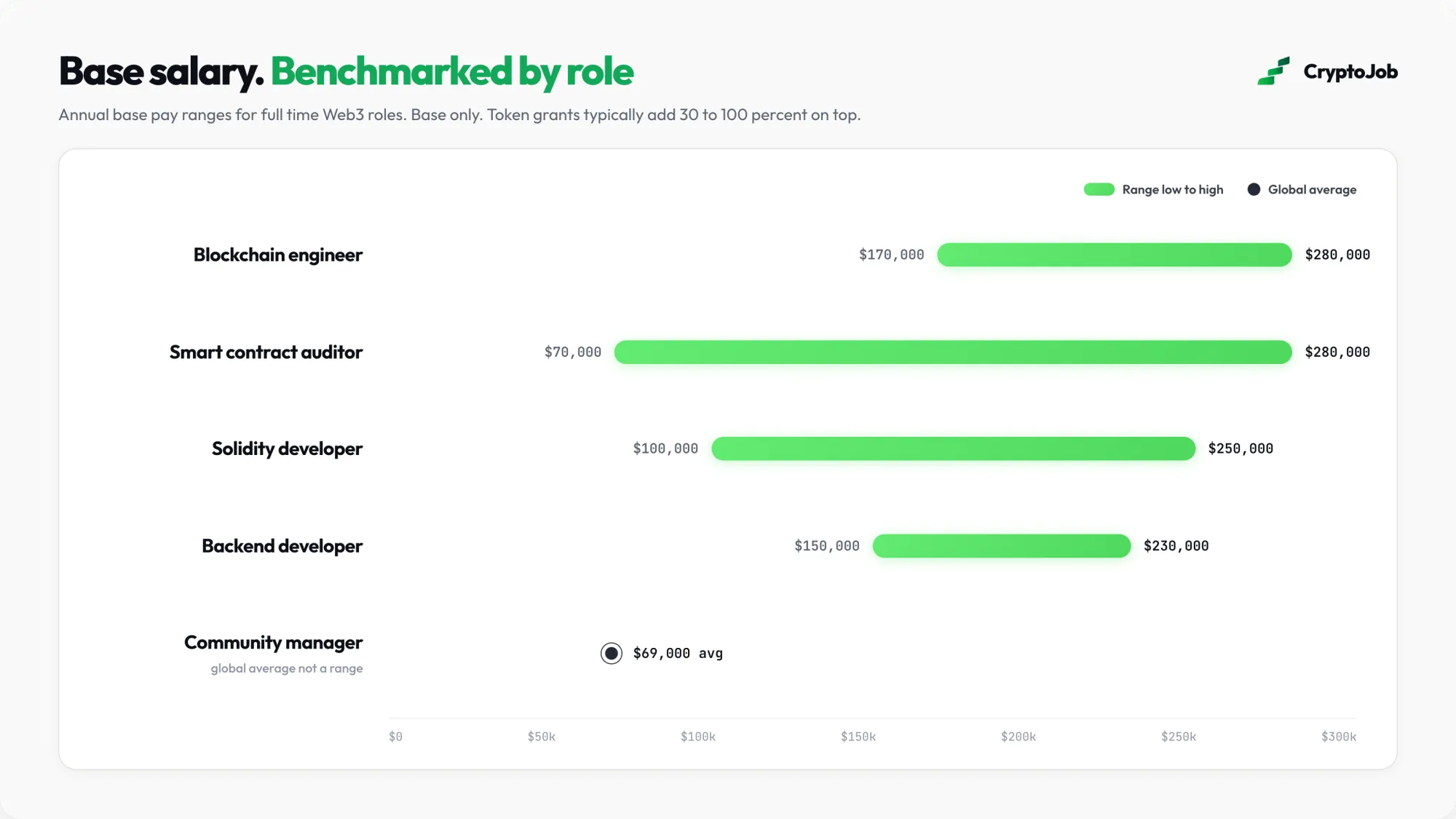
If you are setting compensation for a web3 team in 2026, the headline crypto salary benchmarks are these: senior Solidity engineers command roughly $187,000 base worldwide, blockchain engineers span $170,000 to $280,000, and non technical roles sit far lower than most founders expect.
The harder question is not what to pay but how to structure it, because base salary is only part of what a candidate is comparing.
Hiring now? Browse web3 jobs to see what your competitors are advertising before you set your bands.
1. What are the crypto salary benchmarks by role in 2026?
These are base ranges. Token compensation sits on top and is covered further down.
| Role | Base range (USD) | Notes |
|---|---|---|
| Solidity developer | $100K to $250K | Median near $150K; juniors start $80K to $100K |
| Blockchain engineer | $170K to $280K | Widest band on this table |
| Smart contract auditor | $70K to $280K | Scarcest talent pool; do not economise here |
| Backend developer | $150K to $230K | Comparable to web2 at senior level |
| Community manager | ~$69K average | Global average, wide regional spread |
The global average across all web3 roles lands around $79,000 to $84,000, but that figure is close to useless for setting bands. It blends senior US engineers with entry level remote contributors across dozens of markets.
2. How much should token compensation add on top?
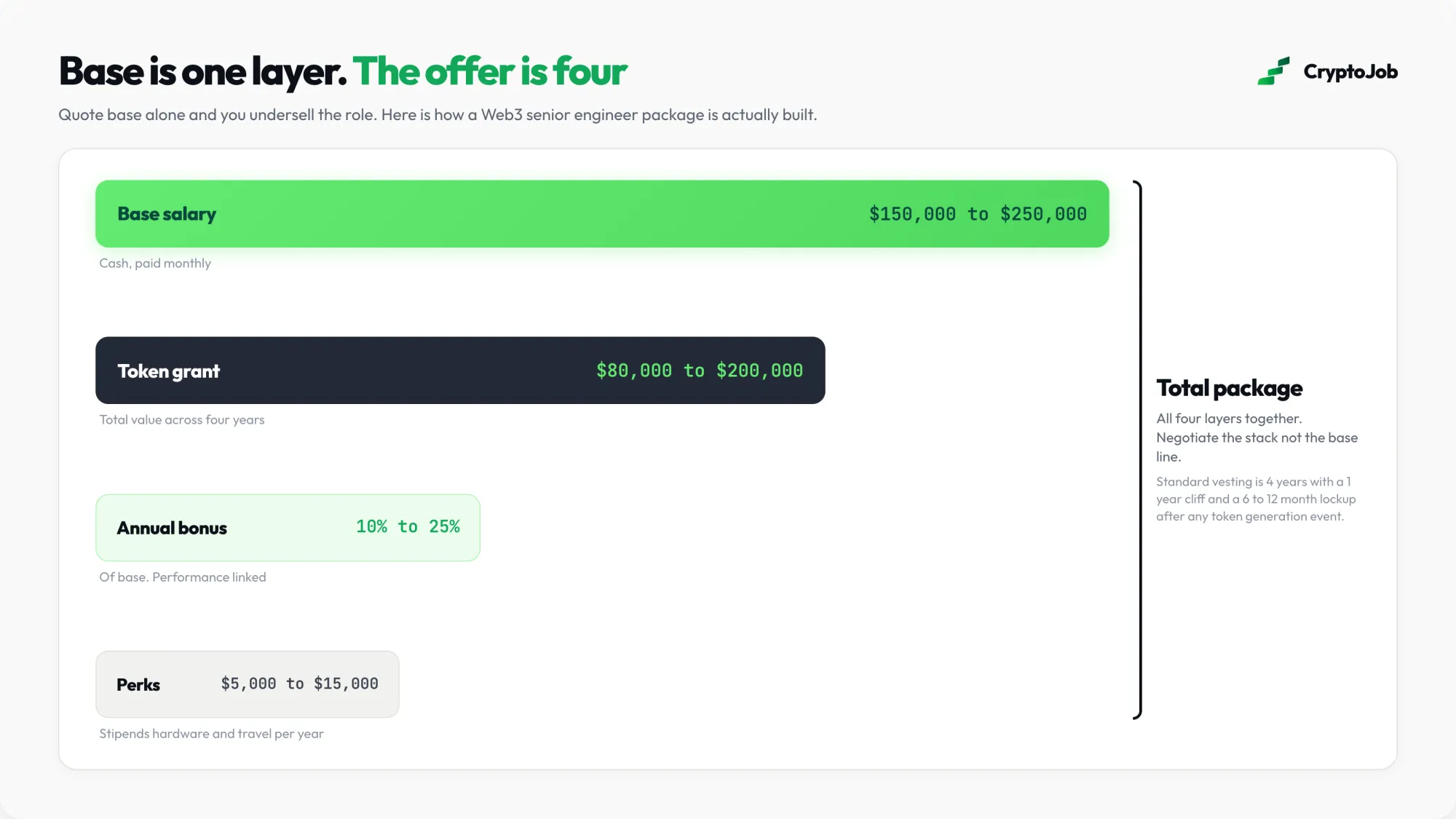
At most protocols, token grants add 30% to 100% on top of base. Senior engineers at established protocols typically see $150,000 to $250,000 base plus $80,000 to $200,000 in tokens vesting across four years.
The market standard structure is a four year vest with a one year cliff, plus a six to twelve month hard lockup after any token generation event.
One warning worth internalising: the era of paying mostly in tokens has closed. Candidates now discount token components heavily, and a package that looks generous on paper will lose to a competitor offering more cash.
3. What else belongs in a competitive package?
Base and tokens get the attention, but the surrounding components are where mid size teams win candidates from better funded ones.
| Component | Typical range |
|---|---|
| Signing bonus | $10K to $100K |
| Annual bonus | 10 to 25% of base |
| Company equity (senior) | 0.1% to 2% |
| Relocation | $5K to $50K |
| Equipment stipend | $2K to $5K, then ~$1K yearly |
| Learning budget | $1K to $5K per year |
| Coworking stipend | $200 to $500 per month |
Signing bonuses do specific work: they offset unvested RSUs a candidate is walking away from. If you are recruiting out of big tech, budget for this or expect to lose the candidate at offer stage.
4. How much does location change what you should pay?
North American employers set the top of the market. European and Singapore based firms follow closely, and remote global roles have compressed the gap significantly.
Some US banded protocols now pay near parity globally regardless of candidate location. That is a deliberate strategy, it removes salary arbitrage as a reason for your best people to leave.
If you band by geography instead, be prepared to defend it. Candidates compare offers publicly now, and inconsistent geographic banding surfaces quickly.
5. Where do teams most often get this wrong?
5.1 Underpaying for security
Audit and security engineers sit near the top of the pay chart for good reason. Immutable code holding real value cannot be patched after deployment, and the cost of one missed critical vulnerability dwarfs any salary saving.
5.2 Treating "blockchain developer" as one role
The same two words describe someone who connected a wallet UI to an existing chain and someone responsible for hundreds of millions in locked value. Paying those two the same is an expensive mistake in one direction or the other.
5.3 Overweighting the token component
A package that is 70% tokens reads as risk transfer to the candidate. Experienced hires discount it accordingly, and you end up losing people you could have afforded.
Frequently asked questions
What is the average crypto salary in 2026?
Around $79,000 to $84,000 globally across all roles, though that average blends markets and seniority levels so widely that it should not be used to set bands for a specific role.
Should we pay in stablecoins or fiat?
Most teams pay base in fiat or stablecoins and reserve tokens for long term incentives. Stablecoin payroll is increasingly common but creates tax and accounting complexity that varies by jurisdiction.
What is a standard token vesting schedule?
Four years with a one year cliff is the market standard, usually with an additional six to twelve month lockup after any token generation event.
How much equity should senior hires get?
Typically 0.1% to 2% of the company entity for senior roles at funded companies, separate from any token allocation.
Do we need to match big tech salaries?
Not always on base, but you should budget a signing bonus to offset unvested equity candidates forfeit when leaving. That is usually the deciding factor rather than base alone.
Where to go from here
Compensation benchmarks age quickly in this market, so treat these as a starting point and check live postings before finalising an offer.
To see what comparable companies are advertising right now, browse web3 jobs.