
October 7, 2026
7 mins
Read more



October 30, 2025
October 30, 2025
The United Kingdom has one of the most comprehensive regulatory frameworks for cryptocurrency, and understanding crypto tax in the UK is key for both individuals and businesses.
Crypto is treated as an asset, which means that individuals pay tax both on income earned in crypto and on capital gains made when disposing of it. These crypto tax rates vary depending on how the income or gain is classified by HMRC.
For businesses, crypto transactions are also subject to corporate or trading taxes, depending on their structure.
This system is designed to encourage proper reporting and responsible disposal of digital assets, helping to protect the value of the pound in an ever-evolving market and maintaining confidence in one of the world’s leading economies.
In the United Kingdom, you need to pay taxes on your cryptocurrency. The crypto tax rate you pay depends on whether your activity counts as income or a capital gain.
For tax purposes, crypto is treated as property, not as legal tender.
This means that if you’re an individual, you pay taxes depending on what you do with your crypto.
The government office responsible for enforcing these rules is His Majesty’s Revenue and Customs (HMRC). HMRC has even created a Cryptoassets Manual, available for free on their website, which explains how different digital assets are categorised. The main categories are exchange tokens, utility tokens, security tokens, and stablecoins.
If you’re a UK resident, you must pay tax on your worldwide income, and that includes any income or gains from crypto. Residency is determined through the Statutory Residence Test (SRT).
In most cases, you are considered a resident if you spend 183 days or more in the UK during a tax year. Remember that a UK tax year runs from 6 April to 5 April of the following year.
It’s important to understand the difference between property and legal tender.
Legal tender means money that must be accepted if offered to settle a debt, such as Bank of England banknotes, which are valid in England and Wales, or UK coins.
In contrast, crypto is not legal tender. You can choose to pay someone with crypto, but they are not legally required to accept it as payment. This distinction is crucial, especially if you use crypto for transactions or to repay debts in the UK.
Yes, you need to pay taxes on your crypto if you are a UK resident. If you are not a resident, you might still need to pay tax on crypto connected to your trade activity in the UK.
In the United Kingdom, you pay Income Tax on your crypto if you earn it.
Earning crypto means you have received it as part of your income, for example:
These activities count as earning. When that happens, the government sees the crypto as income, just as if you had been paid in pounds. You must report the fair market value in GBP on the day you receive it and pay Income Tax according to your tax band and applicable crypto tax rates for your total income.
The rates below determine how much tax you owe on all your income, including crypto earnings:
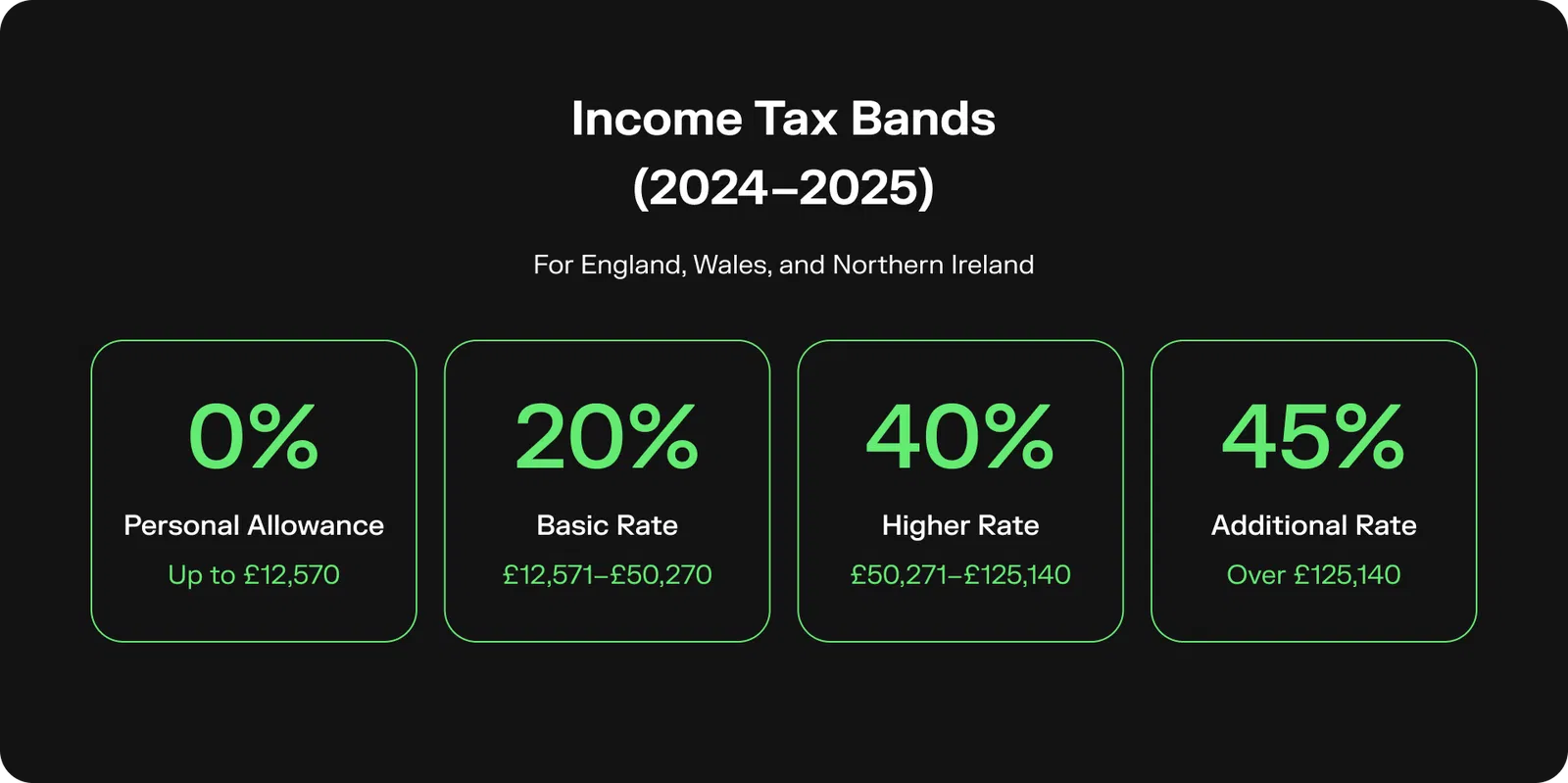
These amounts and rates are subject to change; for the most up-to-date information, visit the official UK government Income Tax rates and allowances page.
If your crypto activity is casual or occasional, HMRC considers you an individual.
If you are mining, trading, or operating in a structured, profit-driven way, you may be treated as a business. This means paying Corporation Tax or Income Tax on trading profits, depending on how you’re registered.
The line between individual and business is determined by HMRC’s “badges of trade.” They assess:
If your crypto activity resembles a trade, with regular exchanges, accounting, or clients, it will likely be taxed as such.
In both cases, it’s important to keep clear records:
HMRC expects this information to be included when you complete your annual Self Assessment.
Yes. If you are a UK resident, you need to pay Capital Gains Tax (CGT) when you dispose of crypto.
This means that if you sell, trade, or gift your crypto, you may owe tax on the profit you made from it.
CGT is charged on your capital gain, not on the total value of the crypto. In other words, you’re taxed on the difference between what you paid for the asset and what you received when you disposed of it.
Every individual in the UK has a tax-free annual allowance of £3,000 (for the 2024–2025 tax year). Beyond this threshold, HMRC applies specific crypto tax rates based on your income bracket and total gains.
-If your total gains are below that amount, you don’t pay any CGT.
-If your gains are above £3,000, you pay 10% or 20%, depending on your income bracket.
These rates can change, so for the most up-to-date information, visit the official HMRC page on CGT.
Below are some of the most common questions UK taxpayers ask when reporting or managing their crypto disposals.
No. It doesn’t matter whether you use a centralized exchange like Binance or a decentralized one like Uniswap.
What matters is whether you’ve given up ownership of your asset. Once you dispose of it, the transaction becomes taxable.
No. Transferring crypto between wallets you own is not taxable, because ownership hasn’t changed.
No. Simply holding crypto long term, without selling or exchanging it, is not a disposal.
If you receive crypto, it’s not a capital gain either; it’s income, and you’ll pay Income Tax, not CGT. HMRC only taxes disposals where ownership changes or a gain is realised.
No. Unfortunately, in the UK, paying for goods or services with crypto is considered a taxable disposal.
For example, if you pay a web designer 0.05 BTC worth £1,500, that £1,500 counts as your disposable value. You’ll owe CGT if your Bitcoin was worth less when you bought it.
Meanwhile, the designer will pay Income Tax on that £1,500 as part of their earnings.
You can’t reduce your tax bill simply by paying with crypto; HMRC treats it as a taxable event for both sides.
-If you gift crypto to your spouse or civil partner, it’s tax-free, and the cost basis transfers to them.
-If you gift crypto to anyone else, HMRC treats it as a disposal at the crypto’s market value on that day. You may owe CGT if your asset has increased in value.
The person receiving the gift doesn’t pay tax when receiving it, but they’ll owe CGT if they later sell or trade that crypto.
Your cost basis is the price you originally paid for the crypto in pounds when you acquired it.
It also includes transaction fees, also known as gas fees. This ensures your taxable gain reflects only your real profit.
Always keep detailed records of every transaction, the date, amount, GBP value, and any associated fees, to stay compliant with HMRC rules.
How you calculate your crypto tax in the UK depends on whether you are an individual or a business, since each follows different crypto tax rates and reporting methods.
As an individual, you may be required to pay two types of taxes depending on your activity:
- Income Tax, when you earn crypto (for example, through salary, mining, staking, or airdrops). The amount you pay depends on your income tax bracket.
-Capital Gains Tax (CGT), when you dispose of crypto (by selling, trading, or gifting it). The amount you pay depends on your cost basis and the annual CGT allowance, which is £3,000 for the 2024–2025 tax year.
If you operate as a business, you may need to pay Corporation Tax or Income Tax on trading profits, depending on your registration.
In short, crypto taxation in the UK depends on how you use it:
-If you earn crypto, Income Tax applies.
-If you sell or trade crypto, capital gains tax applies.
-If you run a business using crypto, Corporation or trading tax applies.
All UK residents must pay tax on their crypto income and gains, whether as individuals or businesses.
Tax residency is determined by the Statutory Residence Test (SRT).
Generally, you are considered a UK resident if you:
-Spend 183 days or more in the UK during a tax year, or
-Have strong ties to the UK (home, work, or family connections).
If you are a non-resident, you may still owe UK tax if your crypto activity is connected to a UK-based business.
You file your crypto tax returns in the UK through HMRC’s Self Assessment system.
You must report if you earn crypto income or make capital gains above the annual tax-free allowance.
You can do this online or by sending paper forms:
-SA100 – your main tax return.
-SA108 – for reporting capital gains.
For more detailed guidance, it’s always best to consult a tax adviser who understands how to report crypto accurately.
On your end, keep records for at least five years, including wallet addresses, transaction history, and GBP values for each transaction.
You can also use tax software such as Koinly or CoinTracker to simplify calculations and automatically import data.
There are no special tax breaks for cryptocurrency in the United Kingdom.
However, every individual has a tax-free capital gains allowance of £3,000 per year (for the 2024–2025 tax year).
What’s most interesting about the UK system is how allowable costs and losses work.
You can use losses to reduce your overall gains when reporting your taxes.
See the examples below:
You made two crypto disposals this year:
-You gained £5,000 by selling Ethereum.
-You lost £2,000 when selling Solana.
When you report your taxes, you can subtract your £2,000 loss from your £5,000 gain.
Your net gain is £3,000, exactly the amount of the annual tax-free allowance.
Result: no Capital Gains Tax is due.
You made a £6,000 loss this year and didn’t have any gains to offset it against. You report that loss to HMRC.
Next year, you make a £10,000 gain from selling Bitcoin. You can use your £6,000 loss from the previous year to reduce your taxable gain:
£10,000 – £6,000 = £4,000 taxable gain.
Then you can apply the annual CGT allowance (for example, £3,000), leaving only £1,000 subject to Capital Gains Tax.
This year you gained £12,000 and lost £9,000.
You use £9,000 of losses to offset the £12,000, leaving a £3,000 net gain (tax-free).
If you had another £2,000 in older unused losses, you can carry them forward again to use in the next tax year.
If you have already completed a Self Assessment, simply include your loss on your tax return under the Capital Gains Summary (SA108) form. If you’ve never made a gain and don’t use Self Assessment, you can instead write to HMRC to register the loss.
You don’t have to report losses immediately; you have up to four years after the end of the tax year in which the loss occurred.
For example, a loss made in July 2025 (within the 2025–2026 tax year) must be reported by 5 April 2030.
This system encourages you to report your losses because they can be used to offset future gains. It’s one of the main ways the UK system balances taxable profits against the pound value of assets over time.
How you calculate your crypto tax depends on whether you are an individual or a business.
As an individual, you may pay either Income Tax or Capital Gains Tax (CGT). Income Tax depends on your tax bracket, which is based on your total annual income, while Capital Gains Tax depends on the profit (gain) you make when disposing of crypto, minus any allowable costs and losses.
If you operate as a business, you pay Corporation Tax or Income Tax on trading profits, depending on your registration structure.
To calculate your capital gain, use the following formula:
Gain = Disposal value – (Cost basis + Allowable costs)
-Cost basis is the value of the crypto in GBP when you acquired it, this becomes your reference point.
-Allowable costs include transaction fees, gas fees, advertising, and legal expenses linked directly to the disposal.
-You cannot deduct the cost of mining equipment, electricity, or other expenses already used for Income Tax purposes.
The fair market value is the price of the crypto asset at the time of each transaction, converted into GBP.
You pay Capital Gains Tax on the profit above your cost basis, after subtracting any losses from the same or previous tax years.
Always consult a specialised accountant or tax adviser who is familiar with crypto reporting to make sure your calculations are accurate.
You pay crypto taxes on the same schedule as your regular UK taxes.
-Tax year: 6 April to 5 April of the following year.
-Paper filing deadline: 31 October after the end of the tax year.
-Online filing deadline: 31 January after the end of the tax year.
-Payment deadline: also 31 January.
If you miss these dates, HMRC can charge late filing penalties starting from £100, plus daily fines after three months.
Crypto tax rates in the United Kingdom can feel complex, but the system is designed to encourage honest reporting and transparency.
By declaring your gains and losses, you not only reduce your tax liability but also contribute to the stability of the pound’s value in a fast-changing market.
Always keep detailed records of your transactions, and when in doubt, consult a qualified accountant who understands digital assets.
At CoinTerminal, our mission is to make Web3 investment simple and accessible. You can explore a curated list of vetted, early-stage Web3 projects without needing KYC, token staking, or token gating. Just connect your wallet or your email account, and you’re ready to participate.
We also host a monthly crypto lottery and continuously work to make crypto participation easier for everyone. You can browse our active projects here.
This article is for educational purposes only. It is a general guide for founders and users navigating the Web3 space. It does not constitute financial advice. Always do your own research before making any investment decisions.If you want to learn more about raising funds or which IDOs to look into, our team is here to help. Feel free to reach out to us on Telegram at any time.