

Binance Just Bought $100 Million of Circle. It Once Converted Everyone's USDC Into BUSD.
Four years ago Binance automatically converted its users' USDC into its own stablecoin. In September it bought $100 million of Circle and agreed to promote USDC for five years.

TLDR
Binance bought $100 million of Circle stock and signed a deal to push USDC for five years.
Four years ago the same exchange converted its users' USDC balances into BUSD.
Circle now pays its old rival every month to distribute USDC, and both sides needed it.
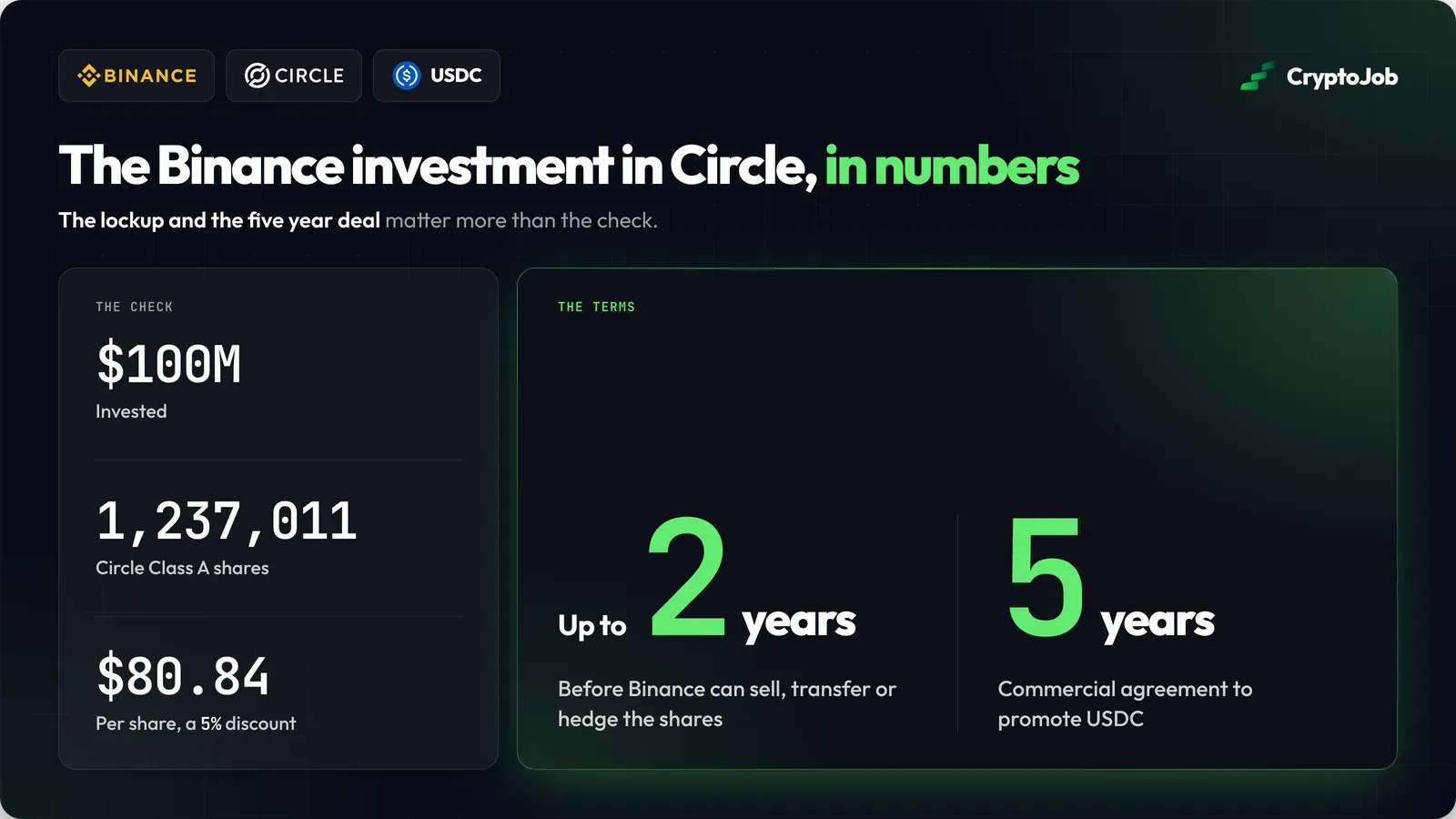
On Tuesday, September 22, in New York, Circle filed an 8-K with the Securities and Exchange Commission. It said that five days earlier it had sold 1,237,011 shares of its Class A common stock to Binance at $80.84 each, for $100 million. The two companies had also signed a new commercial agreement lasting five years.
The same morning, the press releases went out. Binance became a part owner of the company behind USDC, and Circle agreed to pay Binance a monthly fee to promote its stablecoin, with a focus on emerging markets. If you want to see which teams this kind of deal creates on both sides, browse web3 jobs under stablecoins and partnerships.
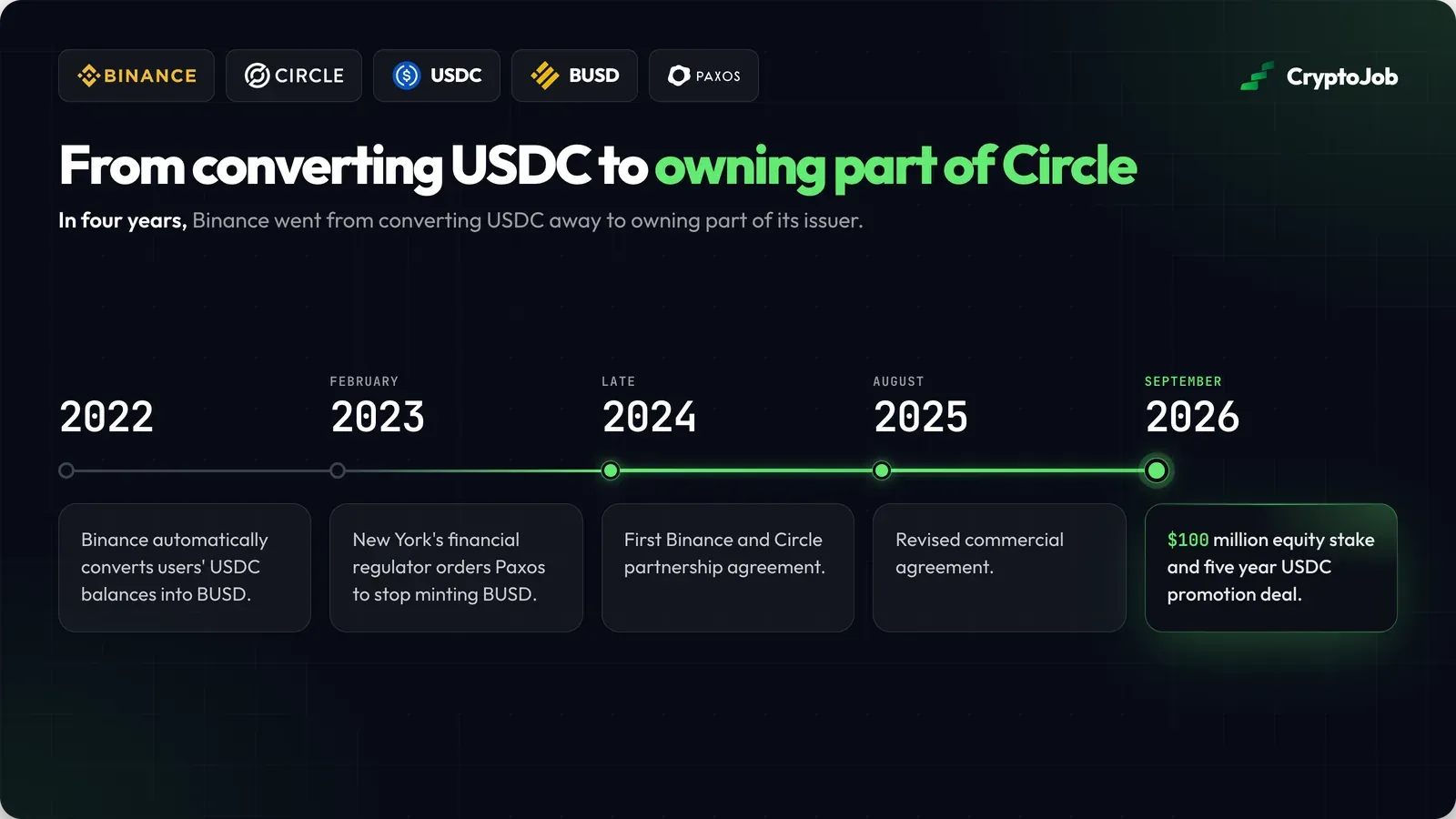
The Binance Circle investment reads like a routine strategic stake until you remember the history. In 2022, Binance automatically converted its customers' USDC balances into BUSD, its own branded stablecoin. Circle publicly questioned the move at the time.
1. What the Binance Circle investment actually buys
The deal has two parts, and the second one matters more. The first is a private placement: new Circle shares sold directly to Binance, rather than bought on the open market, at a price the company said reflected a 5% discount to market value.
Binance agreed not to sell, transfer or hedge the shares for up to two years, with some exceptions. It keeps its voting rights. For a $100 million check into a company with a public market price, that lockup marks this as a relationship stake Binance means to hold.
The second part is the commercial agreement. Circle will pay Binance a monthly incentive fee tied to USDC held through Circle's wallet infrastructure, and Binance will expand promotion, awareness and integration of USDC across its platform. It is the third version of the companies' partnership in under two years, replacing agreements from late 2024 and August 2025.
The dates in the filing sit close together. The placement closed on September 17, one day after Circle opened Arc's public mainnet, and was disclosed five days later. Binance's stake was priced and locked while Circle's newest product was still in its first week.
2. How it works inside the partnership
The mechanics are simple enough to draw on a napkin, and the napkin explains the jobs. Money flows one way at signing and the other way every month after.
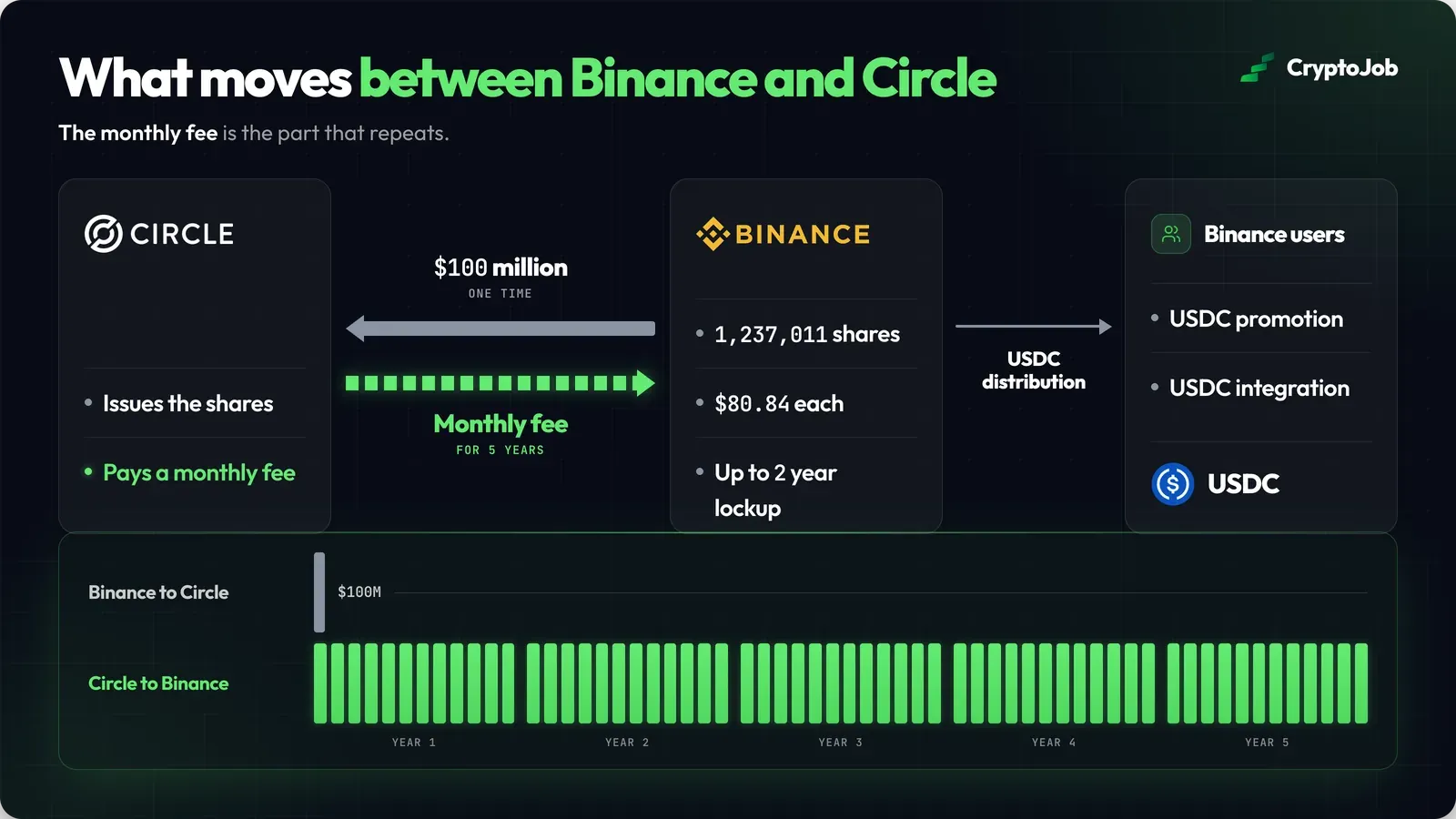
On Circle's side, the deal lands on the teams that sell USDC to platforms. That means partnerships and business development for exchanges and wallets. It also means product teams that build the wallet rails the fee depends on and treasury operations that reconcile balances for the fee.
On Binance's side, the work sits with the people who decide what users see. That covers product placement, regional marketing in emerging markets and the listings and earn products that make one stablecoin more convenient than another. Promotion is a job description, and the contract commits Binance to five years of it.
The context is Circle's own push beyond its home market. USDC has around $74 billion in circulation, and CNBC framed the deal as part of an effort to expand USDC beyond its historical US base and compete more directly with Tether abroad. A week earlier, Circle had launched Arc as its own layer 1 and minted 10 billion ARC tokens while saying that was not a commitment to launch one publicly.
3. What people who work there say
The executives were on the record, and both chose their words carefully.
"Circle has earned its place as one of the most credible issuers in the world." Richard Teng, Binance's joint CEO, in Circle's announcement
Jeremy Allaire, Circle's cofounder and CEO, described Binance in the release as having become the most widely used wallet in the world for dollar stablecoins. Four years after the BUSD conversion, that sentence is its own kind of history lesson.
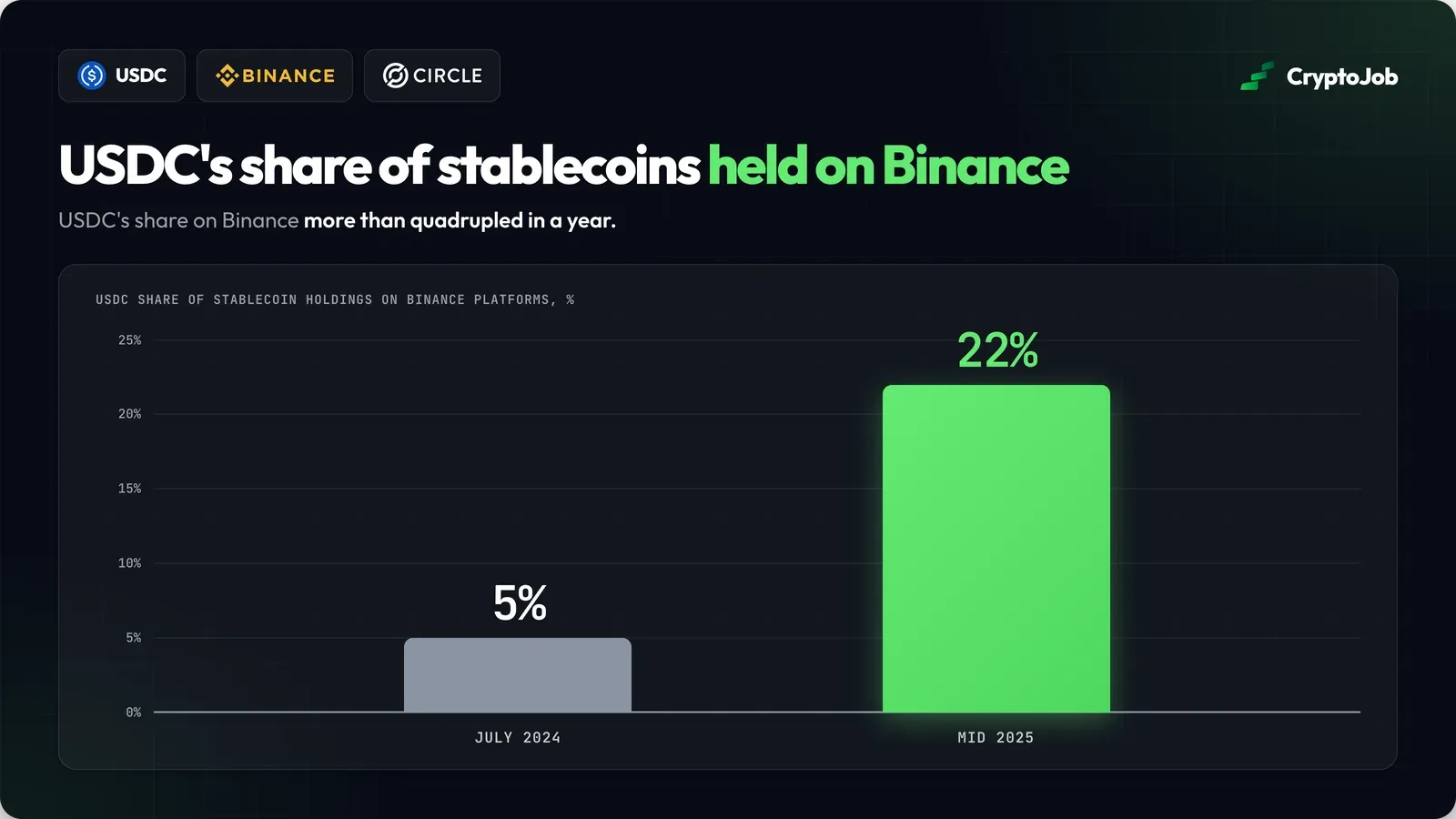
Employee sourcing is thin for this story, and we will not pretend otherwise. What the public record does show is the direction of travel inside Binance. According to Circle's filings, USDC's share of stablecoin holdings on Binance platforms rose from 5% in July 2024 to 22% by the middle of 2025.
4. Who bought into whom in 2026
The Binance Circle investment is the latest in a year of established players buying stakes in crypto firms. The pattern is consistent. Each is a minority stake bundled with a distribution or technology agreement, and none is an acquisition.
| Buyer | Target | Date | Size | What came with it |
|---|---|---|---|---|
| ICE, owner of the NYSE | OKX | March 2026 | Stake at a $25 billion valuation | Board seat, NYSE tokenized equities for OKX accounts |
| Deutsche Börse | Payward, Kraken's parent | April 2026 | $200 million for about 1.5% | Access to securities products built on blockchains |
| Nasdaq Ventures | Payward | September 10, 2026 | $100 million at a reported $21 billion | Tokenized stock distribution, surveillance technology |
| Binance | Circle | Closed September 17, announced September 22 | $100 million | USDC promotion agreement for five years, monthly fee |
The Deutsche Börse percentage rests on Bloomberg's calculation of the implied valuation, which neither company disclosed. The Nasdaq valuation was reported by Bloomberg ahead of the announcement and not confirmed in Nasdaq's release.
5. Why the BUSD history still matters
In 2022, Binance converted customers' USDC into BUSD automatically, consolidating its stablecoin liquidity around a token that carried its own brand. Circle initially questioned the decision in public, and Allaire later downplayed its effects.
BUSD did not last. After New York's financial regulator ordered its issuer, Paxos, to stop minting it in February 2023, the product wound down. The exchange that tried to own its dollar ended up needing someone else's.
Under the $100 million, Binance is paying to align itself with a regulated US issuer, and Circle is paying Binance to reach users it cannot reach from New York. Each side is buying what the other has, which makes the partnership sturdier than the history suggests.
For job seekers, the history carries a practical lesson. Stablecoin distribution is now a negotiated, paid relationship between issuers and venues, which makes partnerships and business development in stablecoins a real career track with its own revenue line.
6. What Circle looks like now
The Circle that Binance bought into is a different company from the one it undercut in 2022. It went public on the New York Stock Exchange in June 2025. On July 10, 2026, the OCC granted final approval for its national trust bank, which does business as Circle National Trust.
In September it added a layer 1 blockchain with BlackRock, Visa and DTCC among its founding validators, and then a shareholder that runs the world's largest crypto exchange. Each step makes USDC look more like regulated financial plumbing and less like a crypto token, which is exactly what an exchange wants to hold when regulators are watching.
That shift changes who Circle hires. Compliance, treasury, risk and audit roles of the kind a bank would staff now sit alongside the protocol engineers who built Arc, and the partnerships team gets the biggest distributor in the industry under contract for five years.
7. Who is hiring because of it
Circle has been hiring like a regulated financial company since it went public, with senior engineering pay between $205K and $454K by level, according to our Circle jobs guide. The distribution deal runs five years and focuses on emerging markets, which adds demand for regional partnerships, localization and compliance people who know those markets.
Binance's side of the deal is promotion and integration at scale, and its open roles span product, marketing and compliance. The company screens hard, as our Binance jobs guide explains. Regional marketing and growth roles in emerging markets are the seats this agreement touches most directly, because promotion across those markets is now a contractual obligation for the next five years.
The broader signal is for anyone in payments. Stablecoin companies kept hiring in 2026 while other parts of crypto cut, and payments experience beats crypto tenure for most of those seats.
The verdict
This is the most rational deal Binance and Circle have signed, because each side is paying for the thing it cannot build, Circle for distribution and Binance for a regulated dollar. Read against the BUSD episode, it is both companies accepting what the market decided in 2023.
It is right for payments and partnerships people who want a stablecoin career with real revenue behind it, so browse web3 jobs at issuers and exchanges now, with nearly five years left on the contract.
FAQ
How much did Binance invest in Circle?
Binance paid $100 million for 1,237,011 Circle Class A shares at $80.84 each. The private placement closed on September 17, 2026, and was disclosed on September 22.
Can Binance sell its Circle shares?
Not for up to two years, with some exceptions, under the terms of the placement. Binance keeps voting rights on the shares during that period.
What does Circle pay Binance?
A monthly incentive fee tied to USDC held through Circle's wallet infrastructure, under a new commercial agreement that runs five years and focuses on emerging markets.