

Zcash Rallied 2,496%. Privacy Engineers Are Crypto's New Bottleneck.
In early September, privacy was the only crypto sector above its level at bitcoin's October 2025 peak, led by a 2,496% Zcash rally. The people who can build shielded systems are much scarcer than the buyers.

TLDR
- Role: privacy engineer on shielded protocols, wallets and proving systems, with Zcash as the largest employer of the skill set
- Stack: Rust, Halo 2, the Orchard shielded pool, Zebra, librustzcash, lightwalletd and the ZIP process
- Pay: $140K to $193K to start and $255K to $320K senior for zero knowledge engineers, per our ZK engineer guide
- The filter: "In a shielded pool, how would you know someone minted counterfeit coins?"
- Verdict: yes, if you like math that has to be right the first time
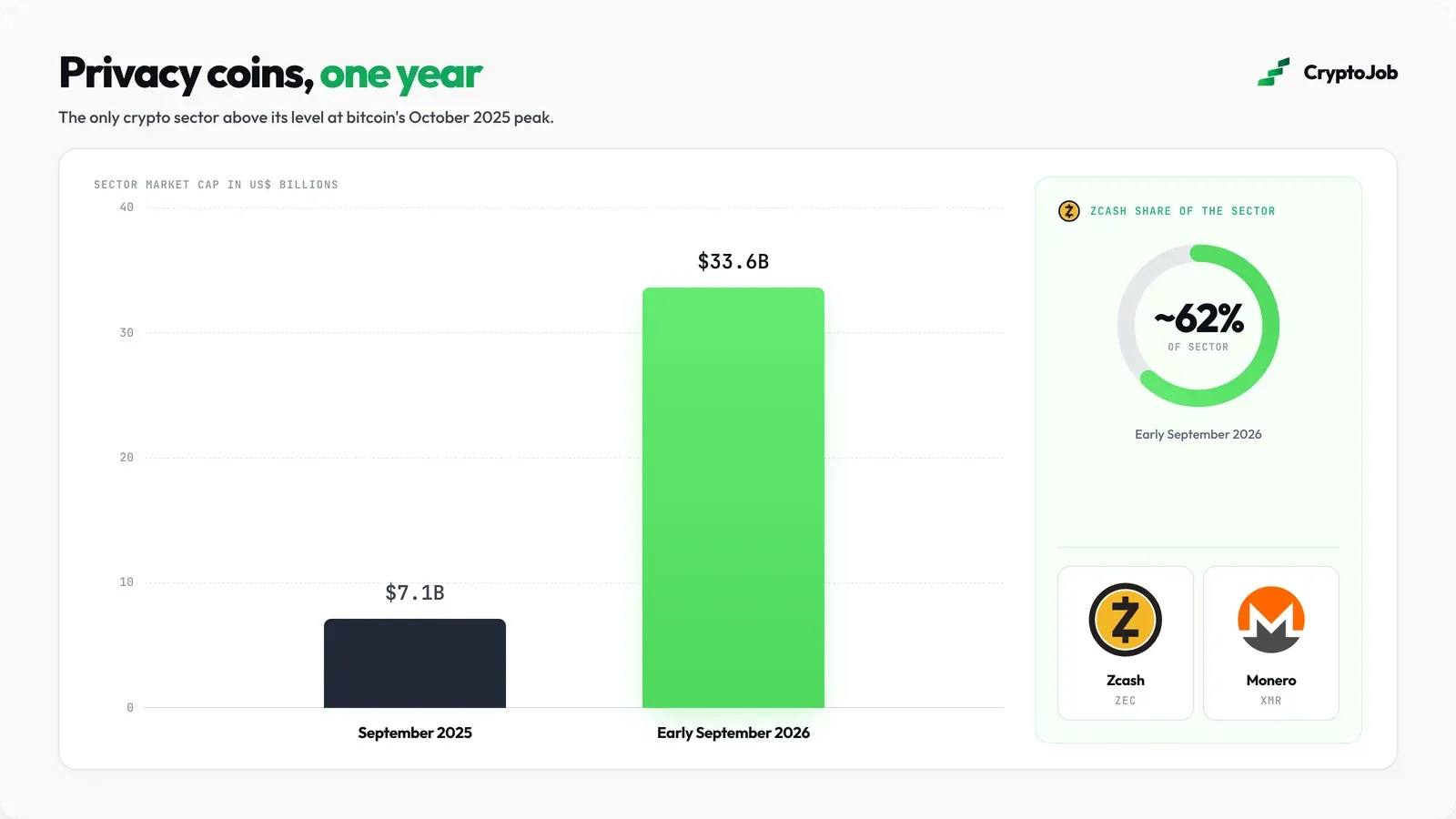
Zcash rose about 2,496% over the year to early September, per Glassnode. I say about because it depends which day you start counting. That rally took privacy coins from $7.1 billion to $33.6 billion and made privacy the only crypto sector trading above its level at bitcoin's October 2025 peak.
The buyers showed up fast. The engineers didn't, because there aren't many people alive who can safely change a shielded protocol. If you're one of them, or want to be, browse web3 jobs under zero knowledge and privacy.
1. Tuesday
It's 10am and I'm reviewing a pull request against a wallet's note scanning code. A shielded wallet has to run trial decryption on outputs to find the user's notes, and this change makes scanning faster by skipping work. Faster is good, but skipping the wrong thing means a user's funds silently don't show up.
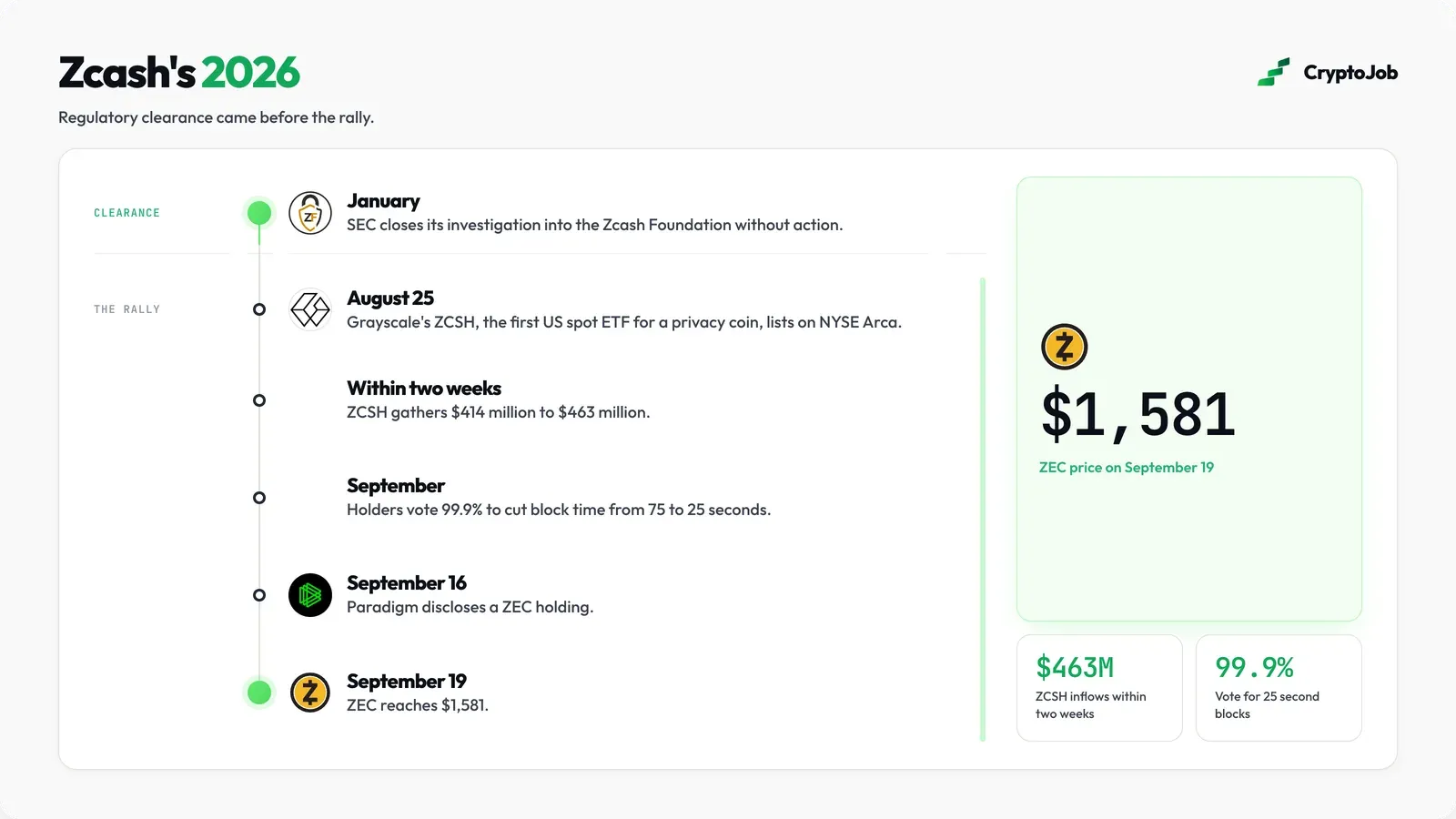
Late morning is a ZIP discussion. Zcash changes go through written proposals, and in September holders voted 99.9% in favor of cutting block time from 75 seconds to 25. Somebody has to work out what that does to wallet sync and fee estimation, and every assumption downstream that depended on 75 needs checking too.
The afternoon is proofs. I'm benchmarking a Halo 2 circuit change and writing a test that should fail, because in privacy engineering the most important tests prove that invalid spends are rejected. Privacy engineer jobs are mostly careful changes to code whose failures you can't see on a block explorer.
2. Why privacy became the trade of the year
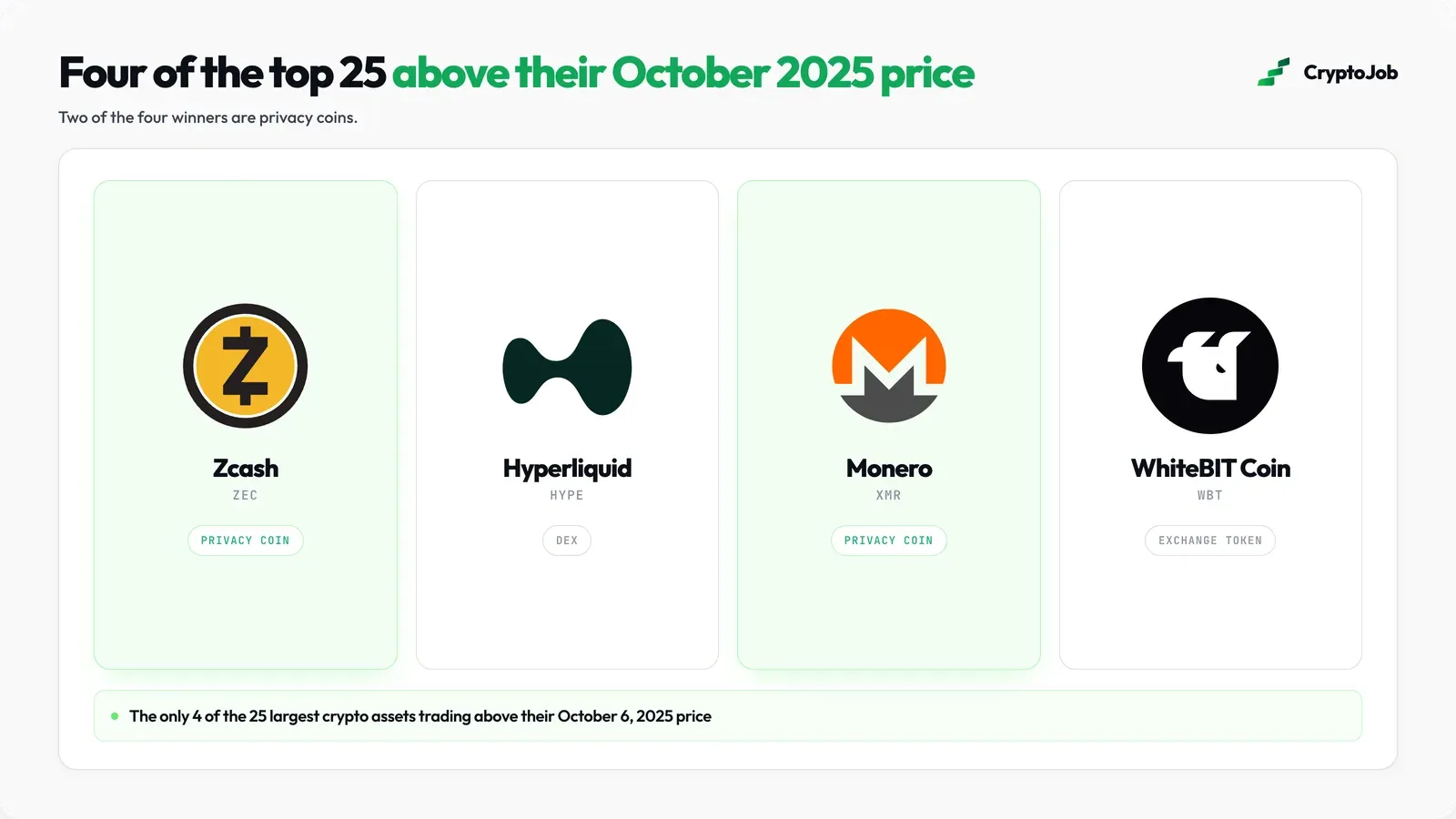
The numbers are unusual. Glassnode's privacy basket more than tripled from bitcoin's October 2025 peak and gained 90% in the month to early September, per Bitfinex's summary. Of the 25 largest crypto assets, only four traded above their October 6, 2025 price, and two of them were Zcash and Monero.
The catalysts were structural. Grayscale converted its Zcash trust into the first US spot ETF for a privacy coin, ZCSH, on NYSE Arca on August 25, and it gathered $414 million to $463 million within two weeks, per DailyCoin. The SEC had already closed its investigation into the Zcash Foundation without action in January.
Then the venture money spoke up. On September 16, Paradigm cofounder Matt Huang said the firm holds ZEC and has invested in the Zcash Open Development Lab, calling Zcash "a private complement to Bitcoin," per 24/7 Wall St. ZEC went from $1,337 that day to a high of $1,581 by September 19.
3. The bottleneck is engineers
Buying ZEC takes a brokerage account. Changing Zcash takes someone who understands zk-SNARK soundness, note commitments, nullifiers and the wallet code that has to stay correct around them. That's a very small hiring pool, and most of it is already employed.
Most of the people who can do it learned on the job at a handful of organizations over the last decade. The knowledge is spread across specs, ZIPs, audits and forum threads. No course or bootcamp turns out someone ready to review a change to a shielded pool.
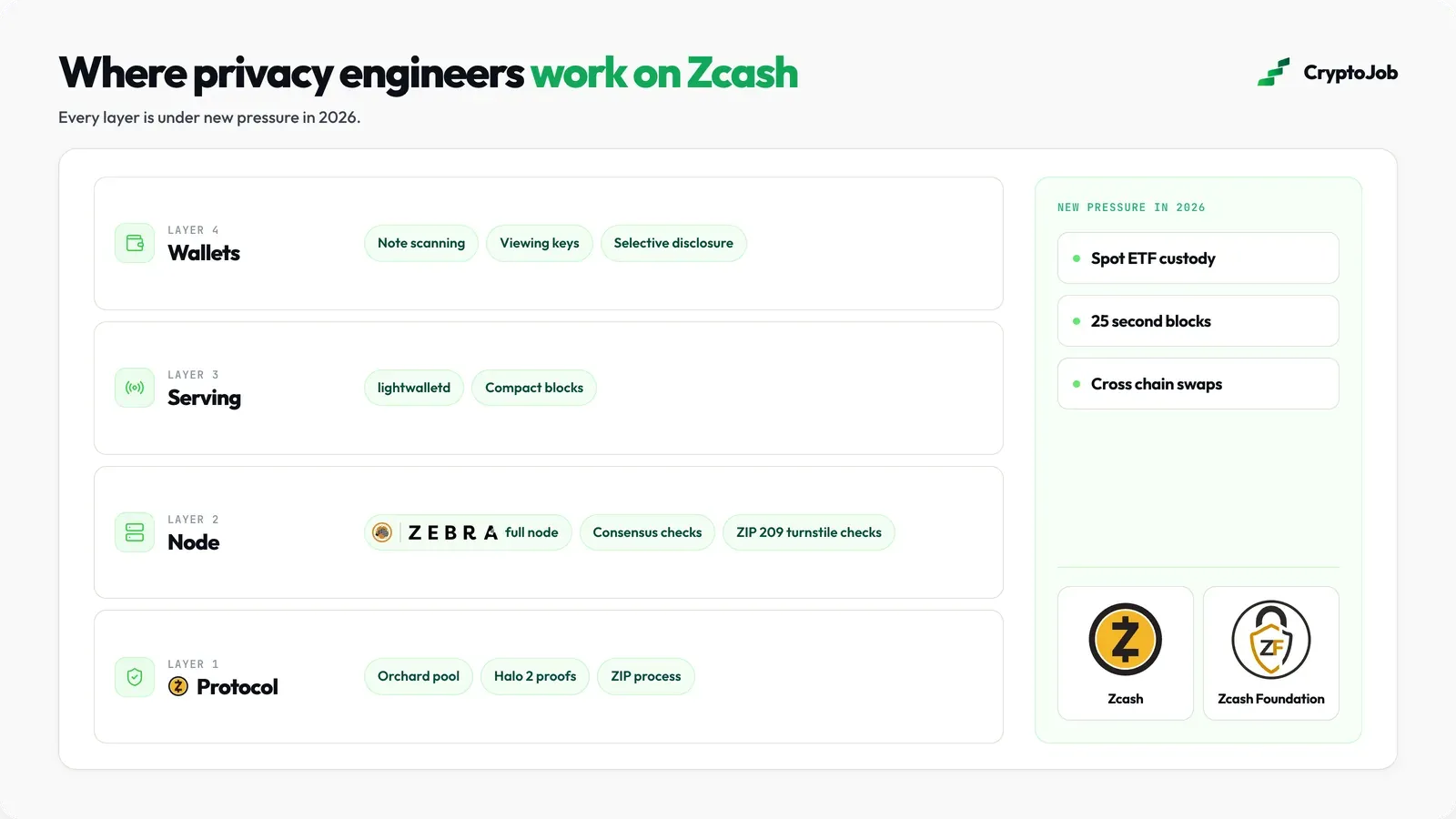
The pressure on that pool keeps rising. A spot ETF means custodians and market makers now hold ZEC under regulatory scrutiny, and wallets and infrastructure have to be retuned for the shorter block time. Native swaps through THORChain for ZEC and XMR add crosschain code that touches shielded funds.
There's a darker side, and it's part of the job. Monero rallied in the same weeks that hackers tried to extort Revolut for a ransom demanded in XMR, per Startup Fortune. Privacy engineers work on tools that criminals also want, which is why good teams take compliance design, like viewing keys and selective disclosure, as seriously as cryptography.
4. What actually broke
In February 2019, Electric Coin Company disclosed a counterfeiting vulnerability in the zk-SNARK construction behind Zcash's original Sprout shielded pool, tracked as CVE-2019-7167. It had been found internally in March 2018 and fixed in the Sapling upgrade that October. A flaw in the proving system's setup parameters would have let an attacker create shielded coins from nothing, and inside the shielded pool nobody would have seen it.
The disclosure itself reads like a playbook. The team fixed the flaw inside a scheduled upgrade without flagging it and waited until the vulnerable pool's exposure was addressed. Only then did it publish, because announcing a live counterfeiting bug in a shielded pool invites the attack.
Electric Coin Company said it found no evidence the bug was exploited, and the wording matters. In a transparent chain, inflation shows up on an explorer. In a shielded pool, you need other mechanisms to know.
The mechanism Zcash adopted is turnstile accounting, specified in ZIP 209, which forbids the chain value of a shielded pool from going negative. Coins can only leave a pool if they went in. Privacy engineers design checks like that and keep auditing them, because soundness bugs don't announce themselves.
5. What the stack actually is
| Tool | What it's for in this role | How deep you need to be |
|---|---|---|
| Rust | Everything from the node to the proving system | Could debug it at 3am |
| Halo 2 | The proving system behind Zcash's Orchard pool, no trusted setup | Shipped with it |
| Orchard | Zcash's current shielded pool design | Could debug it at 3am |
| Zebra | The Zcash Foundation's Rust full node | Shipped with it |
| librustzcash | Shared Rust libraries for wallets and nodes | Shipped with it |
| lightwalletd | Serving compact blocks to light wallets | Used it |
| proptest and cargo-fuzz | Property and fuzz testing for parsers and circuits | Used it |
The repos are public: ZcashFoundation/zebra, zcash/librustzcash, zcash/halo2 and zcash/orchard. Reading the Orchard spec alongside the orchard crate is the fastest way to find out whether this job is for you.
6. The question that filters people
The question: "In a shielded pool, how would you know someone minted counterfeit coins?"
The weak answer is "we'd see it on the explorer" or "the proof wouldn't verify." The first misses the point of shielding. The second assumes the proving system is sound, which is exactly the assumption the 2019 bug broke.
The strong answer is layered, starting with soundness of the proving system and its setup, then value commitments and binding signatures that make balances add up. The last layer is turnstile accounting per ZIP 209, so any counterfeit has to show up as a pool going negative when funds try to leave. Bonus points for mentioning that Halo 2 removes the trusted setup that caused the original problem.
7. Build this before you apply
Write a Halo 2 circuit that proves membership of a note commitment in a Merkle tree and reveals a nullifier, without revealing which leaf. Keep it small, with a tree of fixed depth and one spend.
Then write the tests that matter. A valid witness must prove, a wrong path must fail, a reused nullifier must be caught by your verifier logic and a fuzzed witness should never produce a verifying proof. Benchmark proving time on a laptop and write down what dominated it.
Put it in a repo with a README that explains the soundness argument in plain language. A reviewer is looking for the failing tests and the explanation more than the benchmark.
8. Where the privacy engineer jobs are
The core Zcash organizations hire first. The Zcash Foundation maintains Zebra, and the Zcash Open Development Lab has backing from Paradigm. Wallet teams building apps that are shielded by default need people who understand note scanning and key management.
The newer demand is institutional. An ETF needs custody, and custodians and market makers holding ZEC need engineers who can explain how shielded balances are verified. Privacy features are also spreading to other chains, and the same Halo 2 and zk-SNARK skills transfer.
For pay, zero knowledge engineering remains the best paid entry point in crypto, at $140K to $193K to start and $255K to $320K senior per our ZK guide, and Rust depth adds to it, as our Rust developer guide shows.
Would I take it
Yes, if you like math that has to be right the first time and code whose bugs you may never see. The rally will cool, but the shortage of people who can safely change shielded systems won't fix itself this cycle. If that's you, browse web3 jobs under zero knowledge and start with Zebra's issue tracker.
FAQ
1. What proving system does Zcash use today?
Zcash's Orchard shielded pool uses Halo 2, which needs no trusted setup. Earlier pools used proving systems that did, which is how the 2019 counterfeiting flaw became possible.
2. What is ZIP 209?
A Zcash improvement proposal that forbids a shielded pool's total chain value from going negative, so counterfeit funds can't leave a pool without exposing themselves.
3. Do privacy engineer jobs require a cryptography PhD?
No. They do require working knowledge of zk-SNARK soundness, commitments and nullifiers, plus strong Rust. A public Halo 2 circuit with serious tests is worth more than a credential.