

Kraken's Parent Wants to Bring Hyperliquid to US Traders. HYPE Hit Three Record Highs in a Week.
Kraken's parent wants a regulated door into Hyperliquid's order book. HYPE hit three records in a week on the news, though the plan still needs a regulator's yes.

TLDR
Kraken's parent proposed US access to Hyperliquid perps through its regulated Bitnomial stack.
HYPE set three record highs in a week, though the plan needs regulatory approval first.
The durable story is the compliance plumbing around an onchain order book.
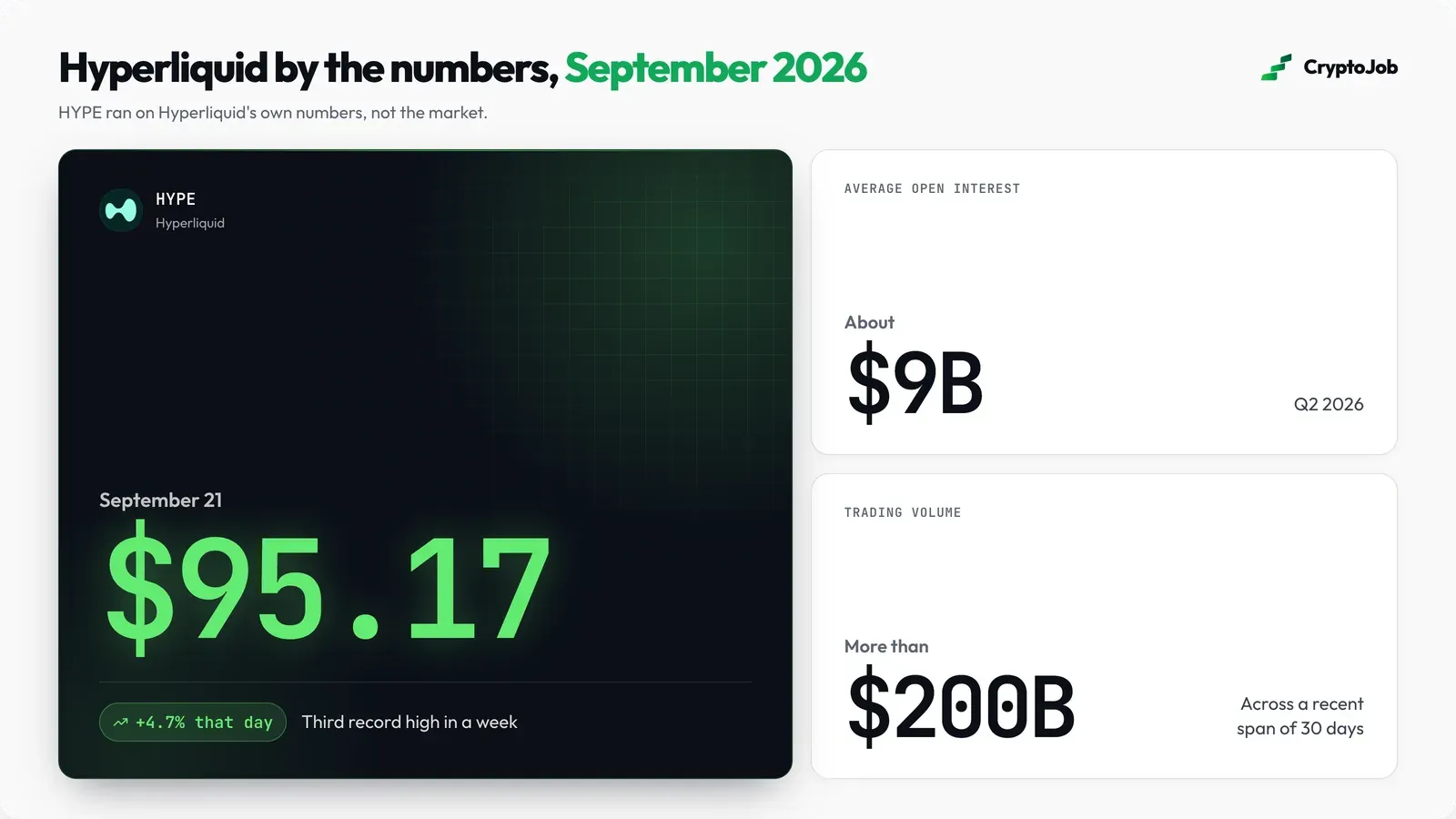
On September 21, HYPE traded at $95.17 on Hyperliquid's own order book. It was the token's third record high in a single week, up 4.7% on the day, and the move had very little to do with the rest of the market.
The trigger was five days old. On Wednesday, September 16, Payward, the parent company of Kraken, said it planned to offer US clients access to onchain perpetual futures, starting with Hyperliquid's HIP-3 markets, subject to regulatory approval. If you want to see who staffs a plan like that, browse web3 jobs under derivatives and compliance.
Hyperliquid US perpetuals would be a first. According to Arjun Sethi, Payward's joint CEO, no registered US exchange or clearinghouse has deployed Hyperliquid markets before. The structure Payward described explains why it took a regulated derivatives group to try.
1. What Payward actually proposed
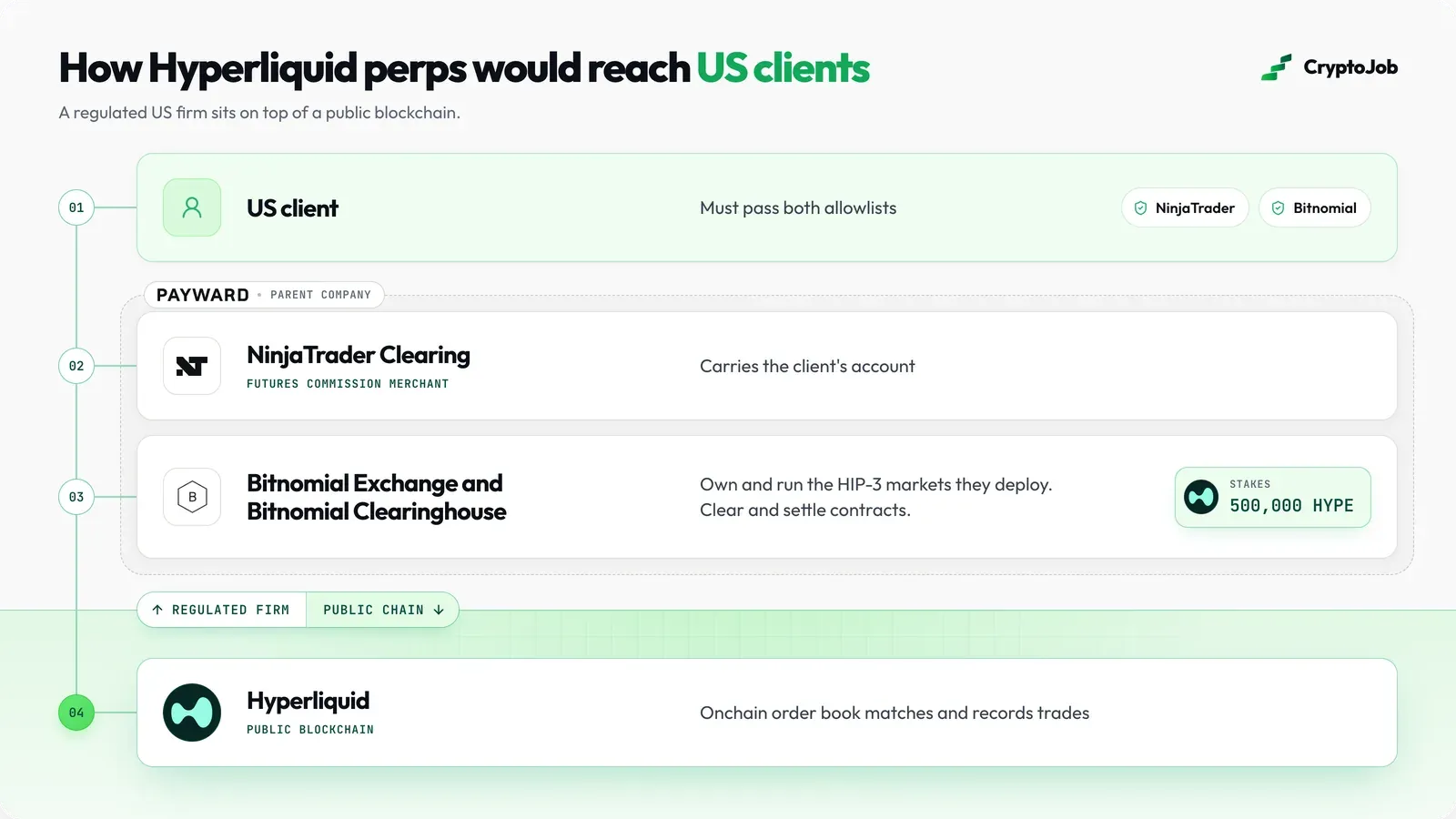
Payward's plan uses three companies it already owns.
Bitnomial Exchange, a contract market designated by the CFTC, would deploy, own and administer the markets. Bitnomial Clearinghouse, a registered derivatives clearing organization, would clear and settle the contracts. NinjaTrader Clearing, a registered futures commission merchant, would carry client accounts.
The trading itself would happen on Hyperliquid's public blockchain, where the onchain order book matches and records trades. Clients would need approval on both the NinjaTrader and Bitnomial allowlists. Payward gave no further detail on how that approval works or how long it takes.
What the announcement did not include matters as much. It gave no launch date or fee schedule and projected no trading volume. Bloomberg reported on August 31 that Payward had already presented an outline of the Bitnomial structure to the CFTC, and the September statement did not say whether that review had advanced.
Payward is not starting from zero. It closed its acquisition of Bitnomial on May 1 for up to $550 million, and it has offered perpetual futures regulated by the CFTC to eligible US clients on Kraken Pro through Bitnomial since June 15. The Hyperliquid plan would sit alongside that book.
2. How it works inside HIP-3
HIP-3 is Hyperliquid's framework for perpetual markets deployed by builders, live since October 2025. A deployer defines its markets, manages the oracles, sets leverage limits and runs its own margining and order books on Hyperliquid's infrastructure. Additional listings go through a shared Dutch auction.
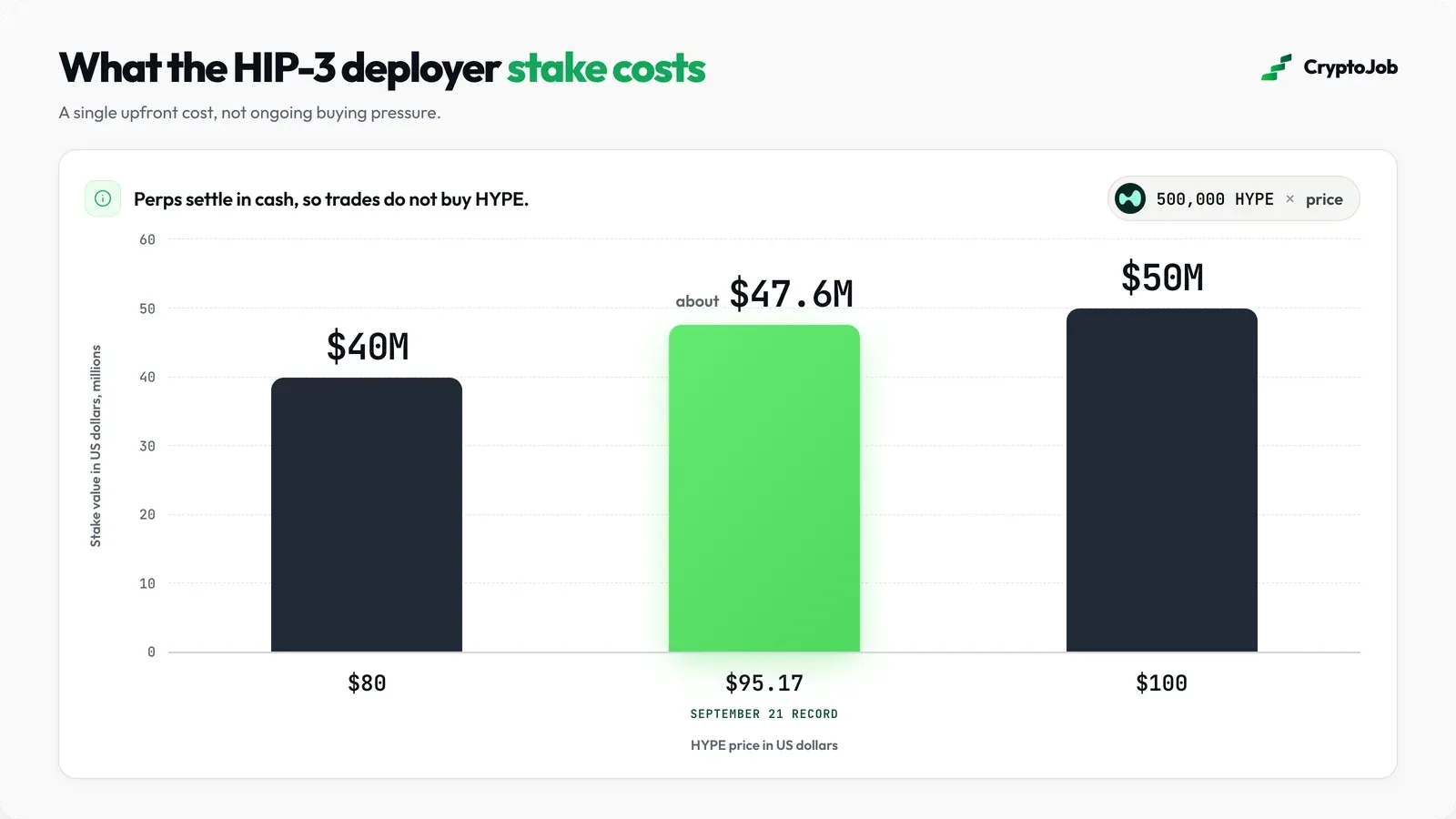
The price of admission is a stake. Each HIP-3 deployer must stake 500,000 HYPE on mainnet. In Payward's design, Bitnomial would be the deployer, which means an exchange registered with the CFTC would hold the stake and carry the responsibilities that come with defining the markets.
The offshore version of HIP-3 has been more adventurous. Deployers there have listed exotic markets, including commodities and companies still ahead of their IPOs, with leverage that the structure Payward described would not carry. A US deployer inherits the framework without inheriting that menu.
Each of those duties is a role. One team has to run the oracles for markets that US clients will trade, and another has to set leverage limits that a US regulator will accept. Margining is a third job, since positions would clear through a registered clearinghouse while matching on a public chain.
The venue underneath already runs at scale. Hyperliquid averaged about $9 billion in open interest during the second quarter of 2026, according to Grayscale Research. DeFiLlama data showed more than $200 billion in trading volume over a recent window of 30 days.
3. Why HYPE ran, and why that may be the wrong read
The simple story is that a regulated US exchange needs to buy 500,000 HYPE. At about $95, the stake works out to roughly $48 million, a figure that circulated widely as the token climbed.
The more careful read came quickly. One analysis published on Yahoo Finance pointed out that perpetuals settled in cash route no dollars into HYPE spot, which makes the listing a business win for Payward more than a demand engine for the token. The deployer puts up the stake once, and it does not grow with volume.
Bitnomial's connection to Hyperliquid also predates the September plan. On April 22, Bitnomial filed with the CFTC to list a HYPEUSD spot contract, with an intended trade date on or after April 24. The two efforts are separate products, but together they show a regulated exchange building a relationship with one onchain venue in steps.
There was also supply on the calendar. On September 6, 9.92 million HYPE unlocked for core contributors, a tranche valued at about $797 million at the time, although Tokenomist noted that Hyperliquid has historically claimed far fewer tokens than its projected unlocks.
4. What people who work there say
Executives and research desks went on the record. Staff did not, and the sourcing on internal views at Hyperliquid or Bitnomial is thin.
Sethi's framing was about precedent. He said Payward already offers US perpetual futures through its existing infrastructure, and that no registered US exchange or clearinghouse had deployed Hyperliquid markets before.
"Hyperliquid is coming to the US." Grayscale Research, as reported by The Crypto Times
The Crypto Times added the necessary caveat in the same report. The structure would still require regulatory approval, and it would not make Hyperliquid itself an exchange regulated in the US.
5. The US routes to perpetual futures, compared
Two years ago, a US trader who wanted a crypto perpetual had to leave the country, in the legal sense. In 2026 there are two regulated routes, with Payward's Hyperliquid plan proposed as a third.
| Route | Status | Who runs the regulated pieces | Where trades match |
|---|---|---|---|
| Coinbase perpetual futures | CFTC approval announced June 11, 2026 | Coinbase | Coinbase |
| Kraken Pro via Bitnomial | Live since June 15, 2026 | Bitnomial, owned by Payward | Bitnomial |
| Payward Hyperliquid HIP-3 plan | Proposed September 16, 2026, pending approval | Bitnomial and NinjaTrader Clearing | Hyperliquid public blockchain |
| Hyperliquid directly | Offshore, blocks US users | None in the US | Hyperliquid |
The demand behind all four is not in question. CoinGecko counted more than $85 trillion in global perpetual futures trading during 2025, and it ranked Hyperliquid as the most active onchain perpetuals venue that year. Almost none of that volume came from US accounts, which is exactly the gap the three US routes are trying to fill.
The last column is the new part. Every other US route matches trades on a company's own engine. Payward's plan would put markets run by a regulated US firm on a public blockchain's order book, which is a new kind of job for the people who supervise it.
6. The jobs this creates
A regulated deployer on a public chain needs people who understand both worlds. The compliance side needs derivatives specialists who know what a DCM, a DCO and an FCM each owe the CFTC. The engineering side needs people who can run oracles and margin logic for markets they do not fully control.
The allowlist is a job too. Every US client would have to clear NinjaTrader's onboarding and then Bitnomial's, which means account operations, identity checks and suitability reviews at a futures commission merchant that suddenly carries clients into an onchain market.
Risk is the obvious hiring line. When we broke down a single memecoin futures day in September, the liquidation, risk and surveillance desks behind it paid $60K to $250K by seniority and venue, according to our derivatives jobs analysis.
Oracles are the most technical seat in the plan. A deployer that defines markets for US clients has to decide which price feeds settle them, how often they update and what happens when a feed fails, and a regulator will want to see those decisions written down before launch.
Payward itself is a more conventional employer than Hyperliquid, with 6.6 million funded accounts as of June 30 and proof of reserves above 100%, according to its own reporting. Our Kraken jobs guide covers how it hires, and the Bitnomial and NinjaTrader teams are where this particular plan lives.
The verdict
HYPE's rally priced a story about token demand that the structure does not support, and missed the bigger story about US firms learning to supervise markets on a public chain. Whatever the token does next, the job of running regulated markets on an onchain order book is new, and Payward has the regulated pieces to staff it.
It is right for derivatives compliance people and risk engineers who want to be first in line for a new kind of market, so browse web3 jobs under derivatives before approval turns this into a crowded field.
FAQ
Can US traders use Hyperliquid today?
No. Hyperliquid blocks US users. Payward's proposal would create a permissioned route through Bitnomial and NinjaTrader, subject to regulatory approval, with no launch date disclosed.
What is HIP-3?
Hyperliquid's framework for perpetual markets deployed by builders. A deployer defines markets, manages oracles, sets leverage limits and runs margining. It must also stake 500,000 HYPE on mainnet.
Does Kraken already offer perpetual futures in the US?
Yes. Payward has offered perpetual futures regulated by the CFTC to eligible US clients on Kraken Pro through Bitnomial since June 15, 2026.