

Web3 Jobs in 2026: Complete Guide to Roles, Pay and Hiring
What web3 jobs pay in 2026, which skills companies actually shortlist for and how the hiring process works. Real salary ranges, no filler.

TL;DR
Web3 jobs pay $60k to $250k+ US base and most are remote
- Top earners: security auditors and protocol engineers at $200k to $300k senior
- No degree needed, shipped work beats resumes
- Hiring takes 2 to 4 weeks, expect a take-home
- Offers mix fiat base with tokens vesting 2 to 4 years
Web3 jobs in 2026 span far more than coding. Companies are hiring smart contract developers, security auditors, protocol engineers, community managers, marketers and BD leads, with US base salaries running from around $60k for entry-level non-technical roles to $250k+ for senior engineers. Most roles are remote-first, and pay often mixes fiat or stablecoins with token grants.
This guide breaks down which roles are in demand, what they actually pay, the skills that get you shortlisted and how the hiring process works. If you want to skip straight to open roles, you can browse web3 jobs on CryptoJob right now.
1. What Web3 Jobs Are Companies Hiring for in 2026?
The generalist "blockchain developer" posting is fading. Hiring in 2026 is specialized, and that specialization is where the pay premium sits.
On the technical side, the most posted roles are smart contract developers (Solidity, Rust), protocol and infrastructure engineers, security auditors, full-stack dApp developers and on-chain data analysts. Security is the standout. After billions in exploit losses across 2025, auditors and security engineers are among the hardest hires in the industry.
Non-technical hiring is real and growing. Exchanges, L2s and DeFi protocols hire community managers, content and growth marketers, BD and partnerships leads, product managers, compliance officers and support staff. Roughly a third of listings on major web3 job boards are non-technical, though this varies month to month.
1.1 Who is actually hiring?
Four broad employer types dominate: established exchanges and custodians (Coinbase, Kraken, Binance), protocol teams and L2s (Optimism, Arbitrum, Solana ecosystem teams), infrastructure and tooling companies (Alchemy, Chainlink) and traditional finance firms building tokenization and custody products. That last group barely existed at scale in 2023 and now competes hard for compliance and engineering talent.
2. Which Web3 Jobs Pay the Most in 2026?
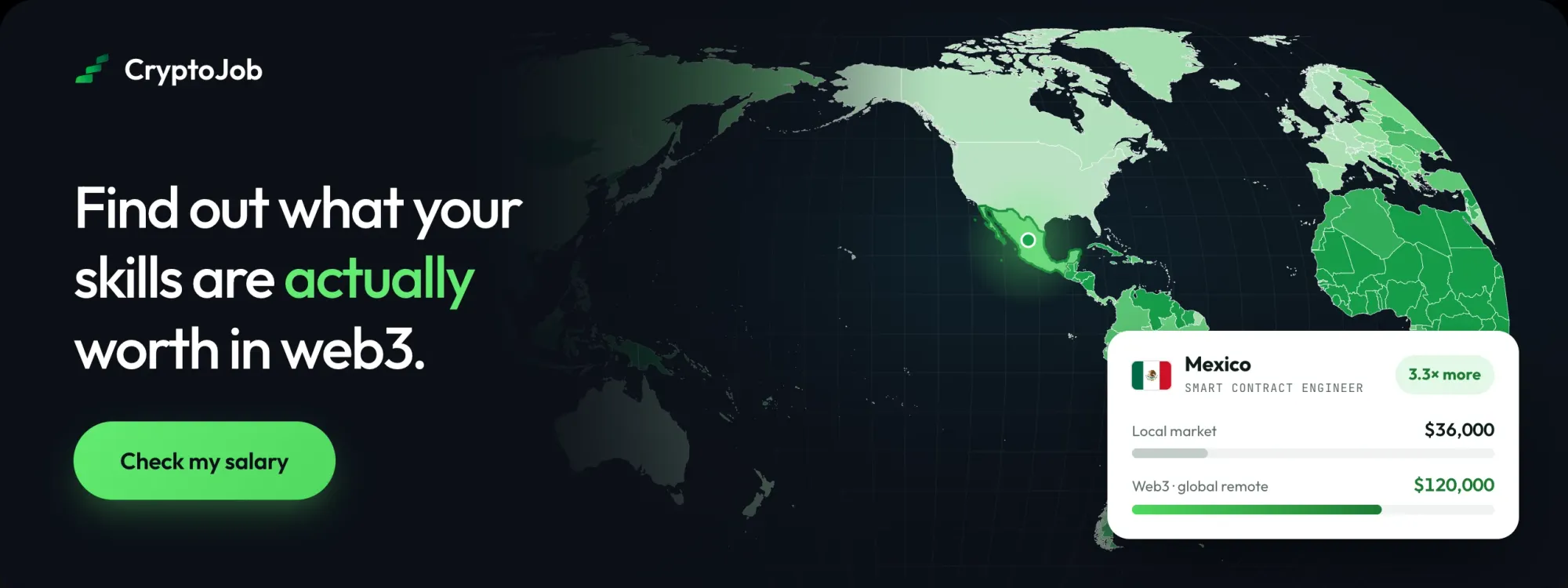
Engineering and security lead, but the gap between crypto and traditional tech pay is what pulls people in. Web3 roles commonly pay 10 to 30 percent above equivalent Web2 positions at the same seniority, before tokens.
Typical US-market base salary ranges look like this. Remote-global roles usually land 10 to 40 percent lower depending on region, and token grants can add 30 to 100 percent on top.
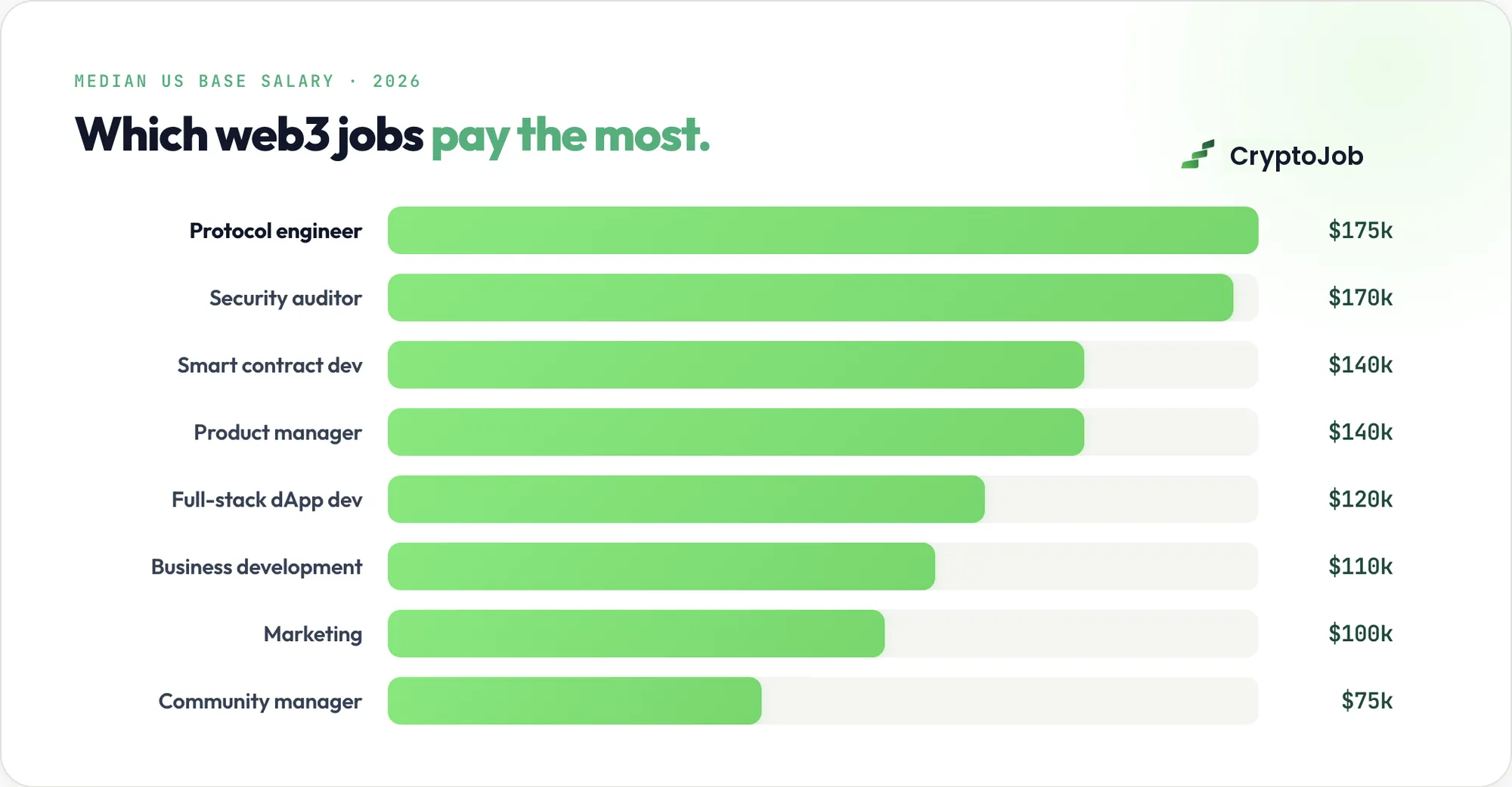
| Role | Junior | Mid-level | Senior |
|---|---|---|---|
| Smart contract developer | $80k to $100k | $120k to $160k | $180k to $250k+ |
| Protocol / infra engineer | $100k to $130k | $150k to $200k | $200k to $300k |
| Security auditor | $90k to $120k | $140k to $200k | $200k to $300k+ |
| Full-stack / frontend dApp dev | $70k to $90k | $100k to $140k | $150k to $200k |
| Product manager | $80k to $110k | $120k to $160k | $170k to $220k |
| Marketing / growth | $50k to $70k | $80k to $120k | $130k to $180k |
| BD / partnerships | $60k to $80k | $90k to $130k | $140k to $200k+ commission |
| Community manager | $40k to $60k | $60k to $90k | $90k to $130k |
Two caveats. Averages across all global submissions on community salary trackers sit far lower, around $80k, because they include junior and non-US roles. And a bear market can compress these ranges quickly, so treat them as a mid-2026 snapshot.
2.1 How does token compensation work?
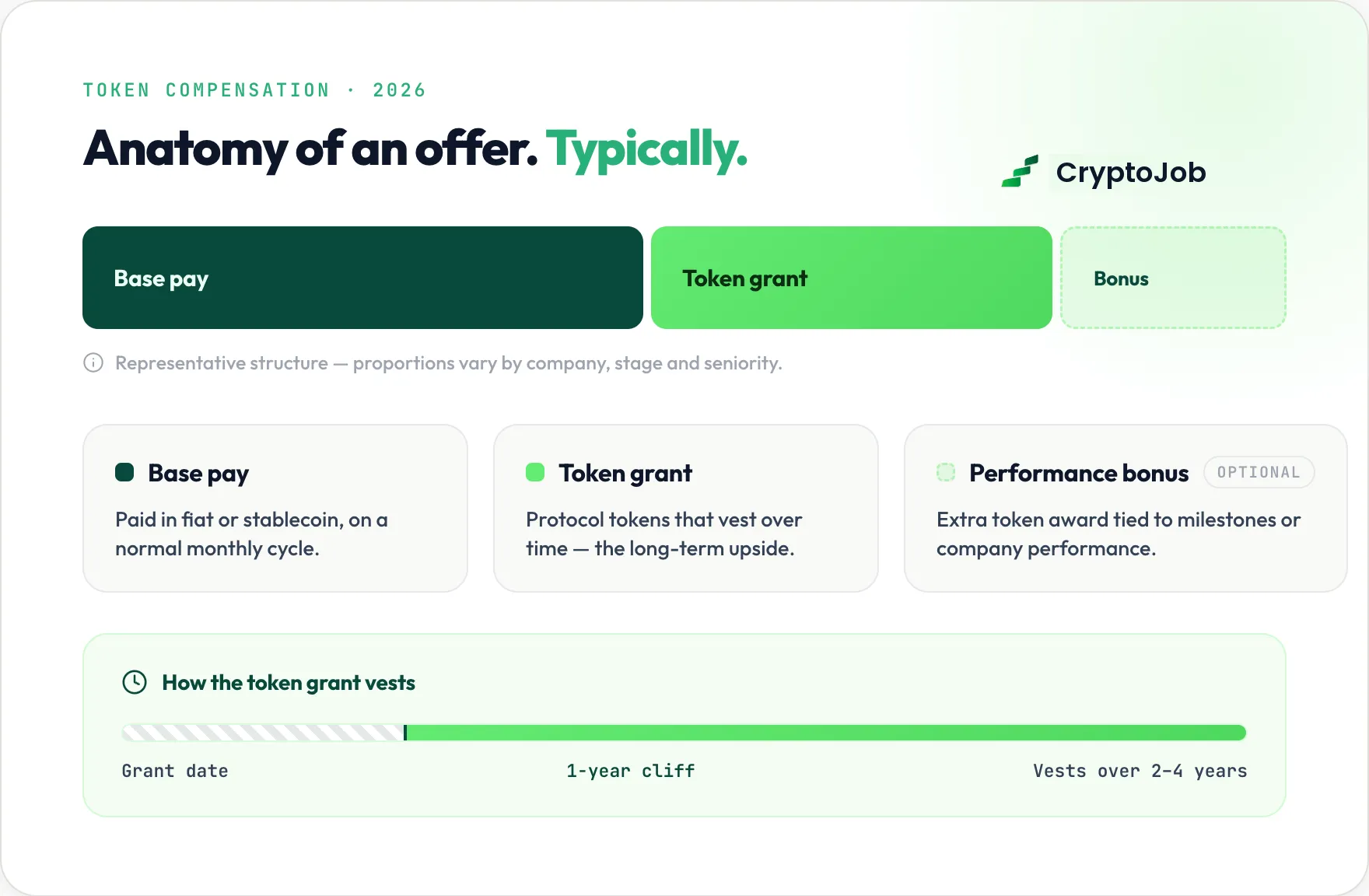
Most funded companies pay base salary in fiat or stablecoins and add token grants that vest over 2 to 4 years, often with a 1-year cliff. Some DAOs pay entirely in tokens via streaming tools.
Always ask three questions before signing: what is the vesting schedule, is the token liquid today and what happens to unvested tokens if you leave. A grant in an illiquid token with a long lockup is a lottery ticket, not salary.
3. How Do You Start a Web3 Career With No Experience?
Portfolios beat resumes in this industry. A junior who has shipped something on-chain regularly out-competes a mid-level Web2 engineer with zero crypto footprint.
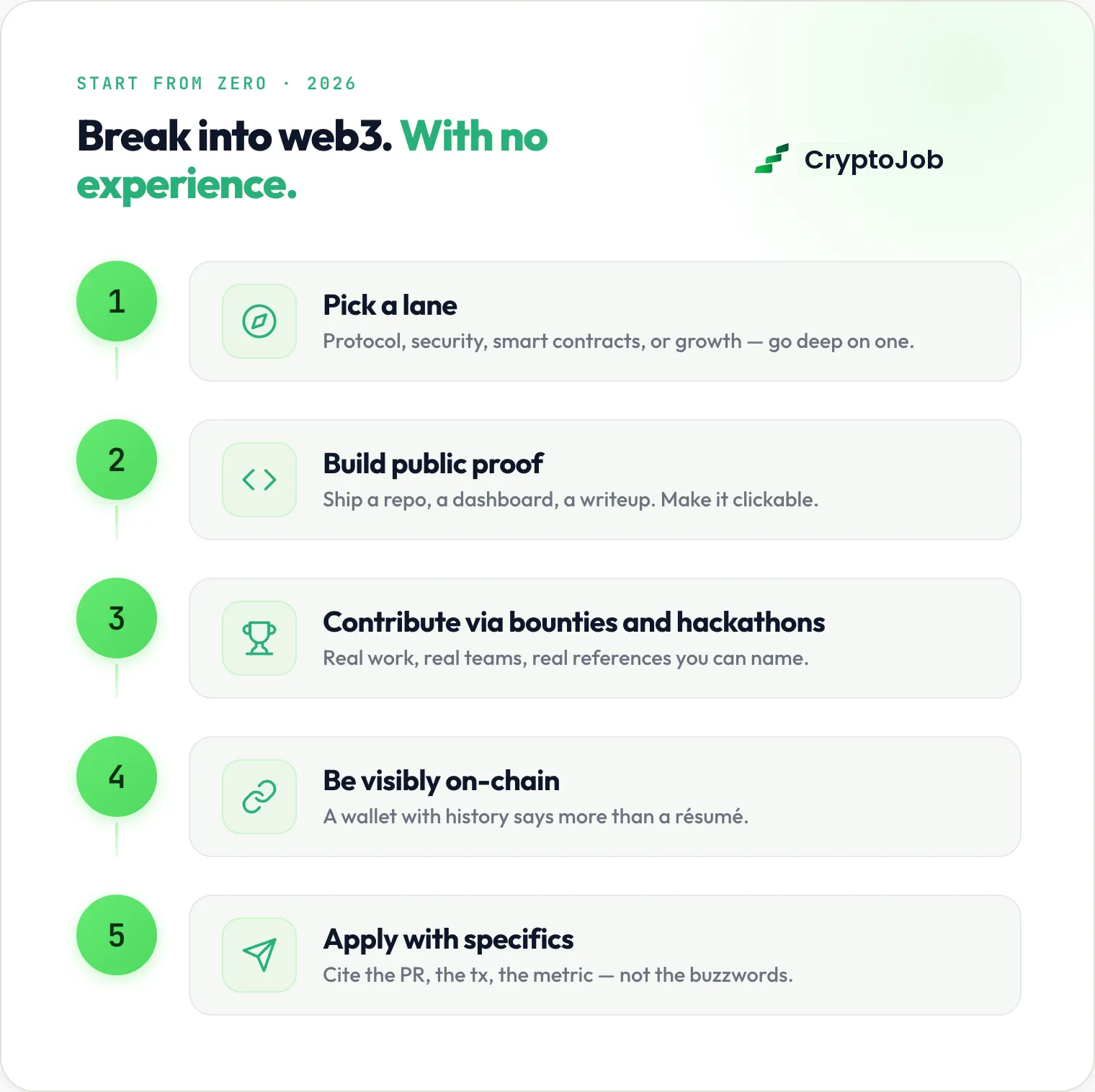
A realistic 5-step path looks like this:
- Pick a lane. Solidity/EVM, Rust/Solana, security, data or a non-technical track like community or growth. Depth beats breadth.
- Build public proof. Deploy 2 or 3 small projects to a testnet or mainnet or for non-technical roles, run a community, write research or grow an audience.
- Contribute where hirers look. Open-source repos, bug bounties on platforms like Immunefi, Gitcoin-style bounties and hackathons. Hackathon wins are a known hiring signal.
- Be visibly on-chain. An active GitHub, a wallet with real activity and a presence in 1 or 2 project Discords matter more than certificates.
- Apply with specifics. Reference the protocol's actual codebase or community in your application. Generic applications get ignored fast.
For non-technical entrants, the fastest doors in are community moderation, content and support. These roles hire on demonstrated hustle rather than credentials and internal moves into marketing, BD or product are common within a year or two.
3.1 Do you need a degree?
No. Plenty of working smart contract developers are self-taught or came through bootcamps. What matters is shipped work, security awareness and the ability to explain your decisions in an interview.
4. What Should You Expect From Web3 Hiring in 2026?
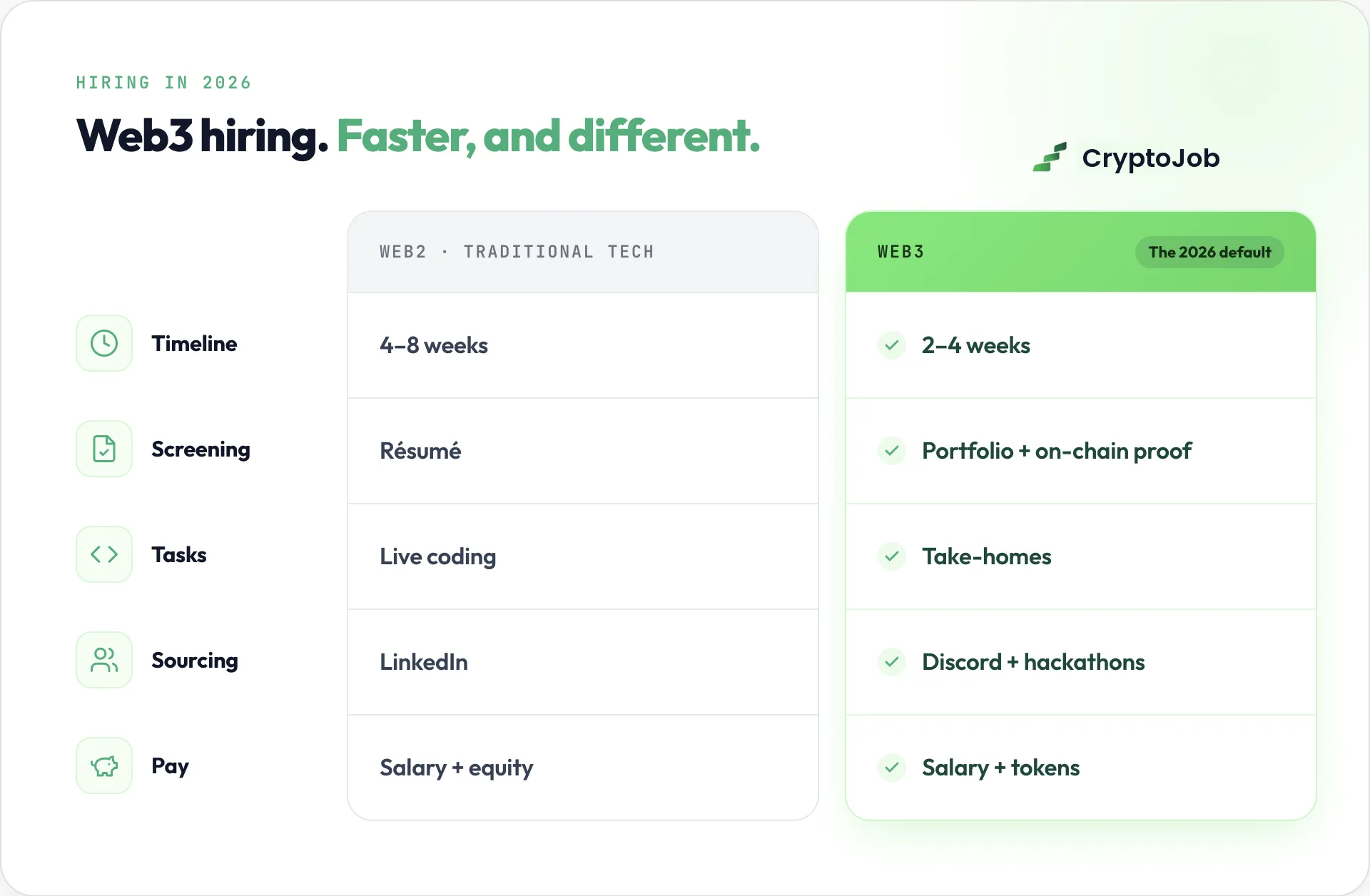
Web3 hiring moves faster than traditional tech but tests harder in the middle. A typical process runs 2 to 4 weeks: application, a short screen, a paid or unpaid take-home, a technical or case interview and a culture chat, often with the founders directly.
Differences from Web2 hiring worth knowing:
- Take-homes are standard. Engineers get contract audits or small builds, marketers get channel plans. Push for paid trials on anything over a few hours.
- Community is a channel. Many roles are filled from Discord contributors and hackathon winners before a listing ever goes public.
- Interviews probe conviction. Expect questions about why crypto, which chains you use and your take on the space. "I just want a job" answers fail here.
- Offers move fast. Good candidates get offers in days, and exploding deadlines are common. Have your comp questions ready.
Watch for red flags too. Unpaid multi-week trials, all-token pay from unfunded teams, anonymous founders with no track record and pressure to start before a contract is signed are all reasons to walk.
4.1 Is web3 hiring remote?
Overwhelmingly yes. The majority of listings are remote-first, and many companies hire globally with location-adjusted pay. Hubs like New York, Miami, London, Berlin, Singapore and Dubai still host the highest-paying on-site and hybrid roles, especially in compliance and institutional-facing positions.
5. Are Web3 Jobs Worth It in 2026?
If you can tolerate volatility, the math is attractive. Pay runs ahead of Web2, remote work is the default, talent supply still lags demand in security and protocol engineering and token upside can meaningfully outrun salary.
The trade-offs are real though. Hiring freezes track crypto prices, some companies fail fast and token compensation can go to zero. Treat tokens as upside, negotiate a base you can live on and keep your skills portable.
The practical takeaway: specialize, build public proof of work and apply where the demand is deepest, which right now means security, infrastructure and compliance-adjacent roles. When you're ready, browse web3 jobs on CryptoJob to see who's hiring this week.
FAQ
Do web3 jobs pay in crypto?
Usually partially. Most funded companies pay base salary in fiat or stablecoins like USDC, with token grants on a 2 to 4 year vesting schedule as upside. Fully token-paid roles exist, mostly at DAOs and carry more risk.
Can I get a web3 job without coding?
Yes. Community management, marketing, content, BD, support, operations, legal and compliance make up a large share of open roles. Community and support are the most common entry points without prior crypto experience.
How much do entry-level web3 jobs pay?
Roughly $40k to $60k for junior non-technical roles and $80k to $115k for junior developers in the US market, with remote-global roles often lower. Ranges vary a lot by region and company stage.
How long does it take to get hired in web3?
Most processes take 2 to 4 weeks from application to offer, which is faster than typical Web2 timelines. Expect a take-home task in almost every process, technical or not.
Are web3 jobs stable?
Less stable than traditional tech. Hiring and layoffs follow market cycles, so favor companies with recent funding or real revenue and never rely on unvested tokens for your budget.
6. Explore the web3 careers series
Ready to go deeper? These guides cover every step of the journey, from first application to signed offer.
- How to Get a Web3 Job With No Experience
- Web3 Developer Salary Guide 2026
- Highest Paying Web3 Jobs in 2026
- Web3 Jobs Without Coding: 12 Non-Technical Blockchain Careers
- Remote Web3 Jobs: How to Find Legit Flexible Roles
- Is Web3 a Good Career in 2026?
- Entry Level Crypto Jobs: 10 Roles That Hire Beginners
- Web3 Marketing Jobs: Roles, Salaries and How to Get Hired
- How to Get a Job at a Crypto Exchange
- Smart Contract Developer Jobs: Skills, Salary and How to Apply
- Web3 Internships: How to Land Your First Blockchain Role
- Web3 vs Traditional Tech Jobs: Salary, Perks and Work-Life Balance
Related reading: Crypto Jobs vs Web3 Jobs.