May 12, 2026
13 mins
Read more



April 13, 2026
April 13, 2026
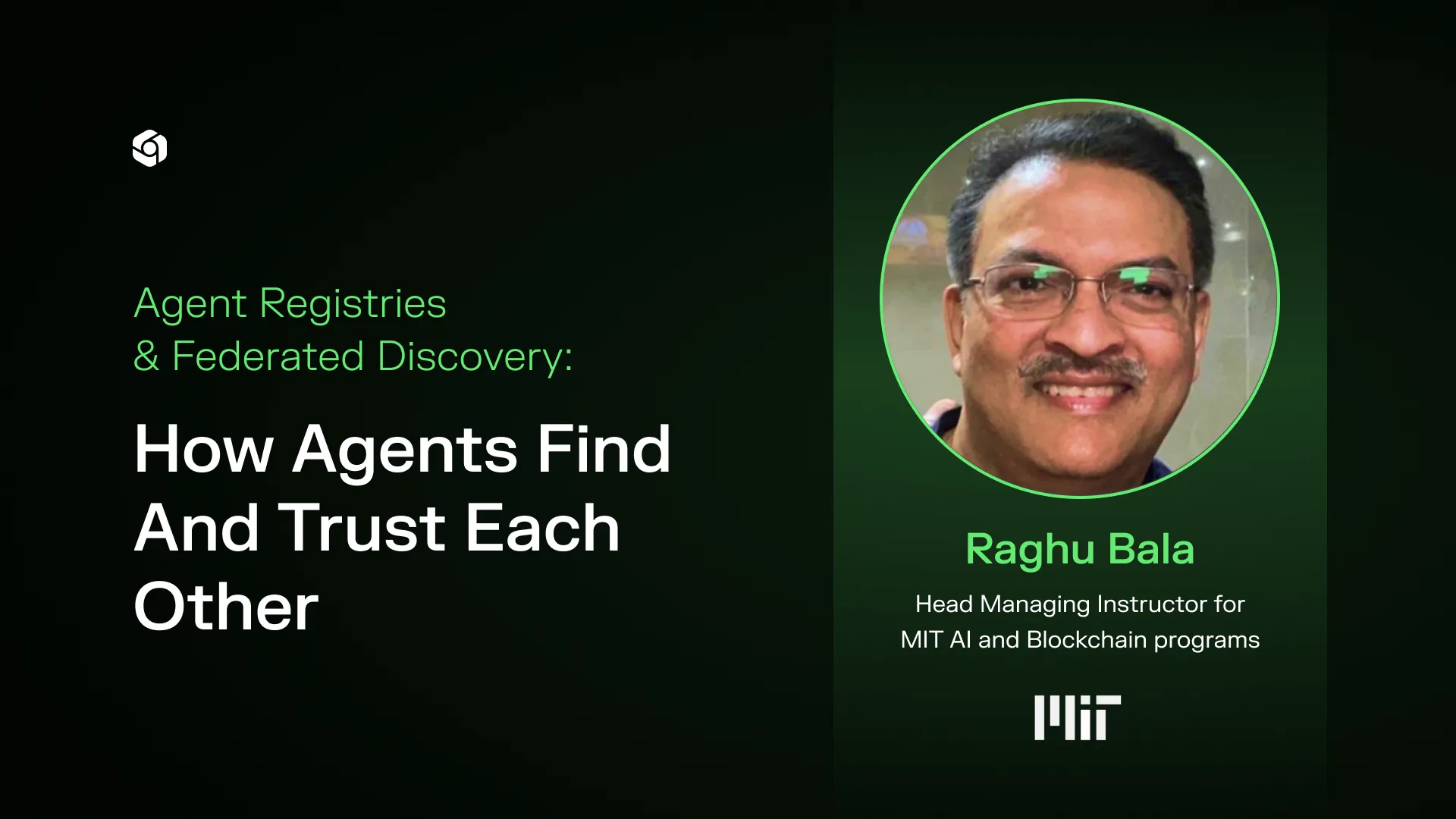
In the previous article in this series, I discussed Agent Identity as the foundational layer of trust in the emerging Agent Economy. However, identity on its own is not sufficient. An identity must exist within a system where it can be discovered, verified, and trusted by others. Without such a system, identity remains theoretical rather than functional. This is where Agent Registries become essential, serving as the backbone that transforms identity into something usable in a global, autonomous ecosystem.
As we move from isolated enterprise-bound agents toward a world of interoperable, internet-scale agents, the challenge shifts from identity creation to identity resolution. Where does an agent exist? How does another agent find it? How can one agent trust another without prior interaction? These are not trivial questions. They define the difference between isolated automation systems and a true Agent Economy.
At scale, the problem becomes even more complex. Projections suggest that the number of autonomous agents could reach into the trillions over the coming decade.¹ In such an environment, a single centralized registry is neither practical nor desirable. Instead, the future will be shaped by a federated model of registries, similar to how the Domain Name System enables global name resolution without a central controlling authority.²
This article explores how agent registries enable discovery, why federation is necessary for scale, and how trust is established through mechanisms such as Know Your Agent, reputation systems, and scoring models. I will also outline the Synergetics vision for registry infrastructure as a foundational layer that enables agents to discover, verify, and transact with one another across the global internet.
The idea of a registry is fundamental to any large-scale distributed system. The internet itself would not function without DNS2, which allows users and systems to resolve human-readable names into machine-level addresses. Similarly, enterprise systems rely on identity directories to authenticate users and services within controlled environments. The Agent Economy introduces a new dimension to this paradigm by requiring identity systems that operate across organizational and technological boundaries.
Once an agent is assigned a decentralized identity, that identity must be anchored in a system that allows others to locate and verify it. Without a registry, identities remain disconnected from the broader ecosystem. A registry transforms identity into a usable construct by enabling discovery, verification, and contextual understanding of the agent’s capabilities and trustworthiness. This is why registries are not an optional enhancement but a foundational requirement for any functioning agent ecosystem.
The need for decentralization in registries arises from both technical and governance considerations. Centralized registries introduce single points of failure and control, which can limit participation and create systemic risk. In contrast, decentralized registries leverage distributed ledger technologies to ensure transparency, resilience, and neutrality. The W3C’s work on decentralized identifiers explicitly highlights the importance of identity systems that are not dependent on centralized authorities, particularly in open and interoperable environments.³
However, decentralization introduces fragmentation. If multiple registries exist, which is inevitable in a global system, then agents registered in different registries must still be able to discover and trust each other. This creates a fundamental challenge. Without interoperability, the ecosystem fragments into isolated silos, each with its own trust boundaries.
The solution to this problem lies in federation. Federated registries allow independent systems to interoperate through shared protocols and trust frameworks. Instead of relying on a single global registry, the ecosystem evolves into a network of registries that can communicate and resolve identities across domains. This model closely mirrors DNSsystem.²2, where multiple distributed servers collectively provide a unified resolution
Initiatives such as Project NANDAtrust.¹ In such a system, an agent does not need to maintain direct relationships with every other agent it may encounter. Instead, it relies on the registry network to resolve identities dynamically and verify trust when needed.1 from MIT Media Lab are exploring exactly this concept, proposing federated architectures that enable cross-registry discovery and
The technical implications of this shift are profound. Without registries, agents would need to establish peer-to-peer trust relationships, leading to a quadratic growth in connections as the number of agents increases. This is fundamentally unscalable. With registries, the system moves toward a model where each agent registers once and becomes globally discoverable, reducing the complexity of interaction to manageable levels.
Trust within this system is layered. Identity provides the foundation, but it must be supplemented by additional mechanisms. Know Your Agent serves as the gatekeeping layer, ensuring that only verified agents are allowed to enter the ecosystem. Reputation systems capture the historical behavior of agents, while ratings provide feedback from counterparties. Scoring models aggregate these signals into a quantitative measure of trustworthiness.
Each of these components addresses a different aspect of trust. Identity establishes who the agent is. KYA ensures that the agent is legitimate at the point of entry. Reputation reflects how the agent has behaved over time. Scoring provides a standardized way to interpret these signals. Together, they form a comprehensive trust framework.
One of the challenges in reputation systems is the potential for manipulation. Simple rating systems can be gamed through coordinated attacks or malicious behavior. To address this, mechanisms such as stake-based voting can be introduced, where participants must commit resources to provide feedback. This creates economic incentives for honest behavior and discourages malicious actions.
The Synergetics Registry integrates these concepts into a unified platform. By combining decentralized identity, KYA validation, federated discovery, and advanced reputation models, it provides the infrastructure necessary for scalable and trustworthy agent interactions. This approach is not just about building a registry but about enabling a global discovery and trust layer for the Agent Economy.
In my view, the industry is currently over-focused on building more capable agents while underestimating the importance of discovery and trust infrastructure. Intelligence alone does not create an economy. For agents to participate meaningfully in an economic system, they must be discoverable and trustworthy.
Most agents today are still confined within enterprise environments. They operate under internal identity systems and are limited to predefined workflows. While this is useful for automation, it does not unlock the full potential of the Agent Economy. The real transformation occurs when agents can operate across boundaries, interacting with other agents, systems, and users in a dynamic and decentralized manner.
The analogy to DNSusers and systems to find each other reliably. The same principle applies to the Agent Economy. Without a robust discovery layer, even the most advanced agents remain isolated.2 is particularly relevant here. The internet did not scale because of better websites alone. It scaled because of standardized resolution systems that allowed
KYA represents a critical innovation in this context. While KYC and KYB are well-established in financial systems, the concept of verifying autonomous agents is still emerging. KYA ensures that agents entering the ecosystem are legitimate, compliant, and trustworthy. This is not just a compliance requirement but a foundational element of trust.
Reputation systems add another dimension to this framework. Trust is not static. It evolves based on behavior and interactions. By capturing these dynamics, we can create more nuanced and reliable trust models. However, these systems must be designed carefully to prevent manipulation and ensure fairness.
The combination of decentralized identity, federated registries, KYA, and reputation systems represents a comprehensive approach to building trust in the Agent Economy. These components work together to enable scalable and sustainable interaction between autonomous agents.
The importance of registries and federated discovery becomes clear when we consider the scale of the Agent Economy. As the number of agents grows, the ability to find and trust other agents becomes a critical bottleneck. Without effective discovery mechanisms, the ecosystem risks fragmenting into isolated silos.
For enterprises, this means rethinking how they design and deploy agents. Instead of focusing solely on internal use cases, they must consider how their agents will interact with external systems and partners. This requires adopting interoperable identity and registry frameworks.
For policymakers, the rise of agent ecosystems introduces new challenges related to governance and accountability. Ensuring that agents act responsibly and can be held accountable will require new regulatory frameworks and standards. KYA will likely play a central role in this process.
Looking ahead, we can expect continued innovation in registry architectures, federation protocols, and trust models. Projects like NANDA will shape the theoretical foundations, while companies like Synergetics will build practical implementations that bring these concepts to life.
Ultimately, the success of the Agent Economy will depend on our ability to build trust at scale. Registries, federation, and KYA are not optional components. They are essential infrastructure for enabling a global network of autonomous agents.
Agent registries are the backbone of the Agent Economy, transforming identity into a discoverable and verifiable construct. Federation enables these registries to interoperate, ensuring scalability and preventing fragmentation. Together, they create a global resolution layer that allows agents to find and trust one another.
KYA ensures that only legitimate agents enter the ecosystem, providing a critical layer of trust at the point of entry. Reputation and scoring systems build on this foundation, capturing the behavior of agents over time and enabling more nuanced trust assessments.
The combination of these elements forms a comprehensive trust stack that enables scalable and secure interaction between autonomous agents. Without this stack, agents remain isolated tools. With it, they become participants in a global economic system.
The Agent Economy will ultimately be defined not by the intelligence of individual agents but by the strength and trustworthiness of the networks they operate within.
References
This article is for educational purposes only. It is a general guide for founders and users navigating the Web3 space. It does not constitute financial advice. Always do your own research before making any investment decisions.If you want to learn more about raising funds or which IDOs to look into, our team is here to help. Feel free to reach out to us on Telegram at any time.