
October 7, 2026
7 mins
Read more



November 2, 2025
November 2, 2025
If you’re wondering whether you need to pay taxes on your crypto assets in the United States, the short answer is yes.
If you are a U.S. resident, your crypto is subject to taxation. And if you are in the U.S. on a work visa or even as a tourist who meets the required number of days to qualify as a tax resident, the answer is still yes: you are required to pay taxes on your crypto holdings and income.
The tax system in the United States is built around protecting the value of the U.S. dollar, which is why it enforces strict rules on how and when to pay taxes on digital assets.
In the guide below, you’ll learn how crypto is treated under U.S. tax law, what institutions regulate it, and what you need to know about reporting your crypto gains and losses.
The United States taxes cryptocurrency under property law, not as foreign currency. The Internal Revenue Service (IRS), the federal agency responsible for collecting taxes and enforcing tax law, classifies digital assets such as Bitcoin, Ether, and stablecoins as property for federal income-tax purposes.
This classification originates from IRS Notice 2014-21, 2014-16 I.R.B. 938, which states:
“Virtual currency is treated as property for U.S. federal income tax purposes. General tax principles applicable to property transactions apply to transactions using virtual currency.”
The same notice defines virtual currency as:
“A digital representation of value that functions as a unit of account, a store of value, and a medium of exchange, other than a representation of the U.S. dollar or a foreign currency. (...) Regardless of the label applied, if a particular asset has the characteristics of a virtual currency, it will be treated as virtual currency for federal income-tax purposes.”
In practice, this means that every time a person sells, exchanges, or spends crypto, the IRS views that event through the capital-gains lens. Gains or losses must be reported as part of the taxpayer’s federal income return, and the tax owed depends on the holding period (short-term or long-term), total income, and the type of transaction involved.
In the United States, the amount of tax you pay depends on your income level, which is classified through tax brackets. Tax brackets determine how much tax you owe based on your taxable income for the year. The U.S. tax system is progressive, meaning that the higher your income, the higher the percentage of tax you pay.
These brackets are set at the federal level by the Internal Revenue Service (IRS), the government agency responsible for collecting taxes and enforcing tax laws. In addition to federal tax, each state can apply its own tax rates, which vary by jurisdiction.
When it comes to cryptocurrency, tax brackets matter because crypto is treated as property. As property, every time you sell, trade, or spend crypto, you must report the gain or loss from that transaction. The amount you gain (or lose) is added to your taxable income. The tax rate applied depends on two main factors:
There are two main categories of crypto gains:
-Short-term capital gains:
If you held the asset for less than 12 months before selling, your profit is taxed as ordinary income, using the same tax brackets that apply to your salary or wages. For high earners, this rate can reach up to 37%.
-Long-term capital gains:
If you held the asset for 12 months or more, you benefit from preferential tax rates that reward long-term holding. As of 2025, the brackets for single filers are:
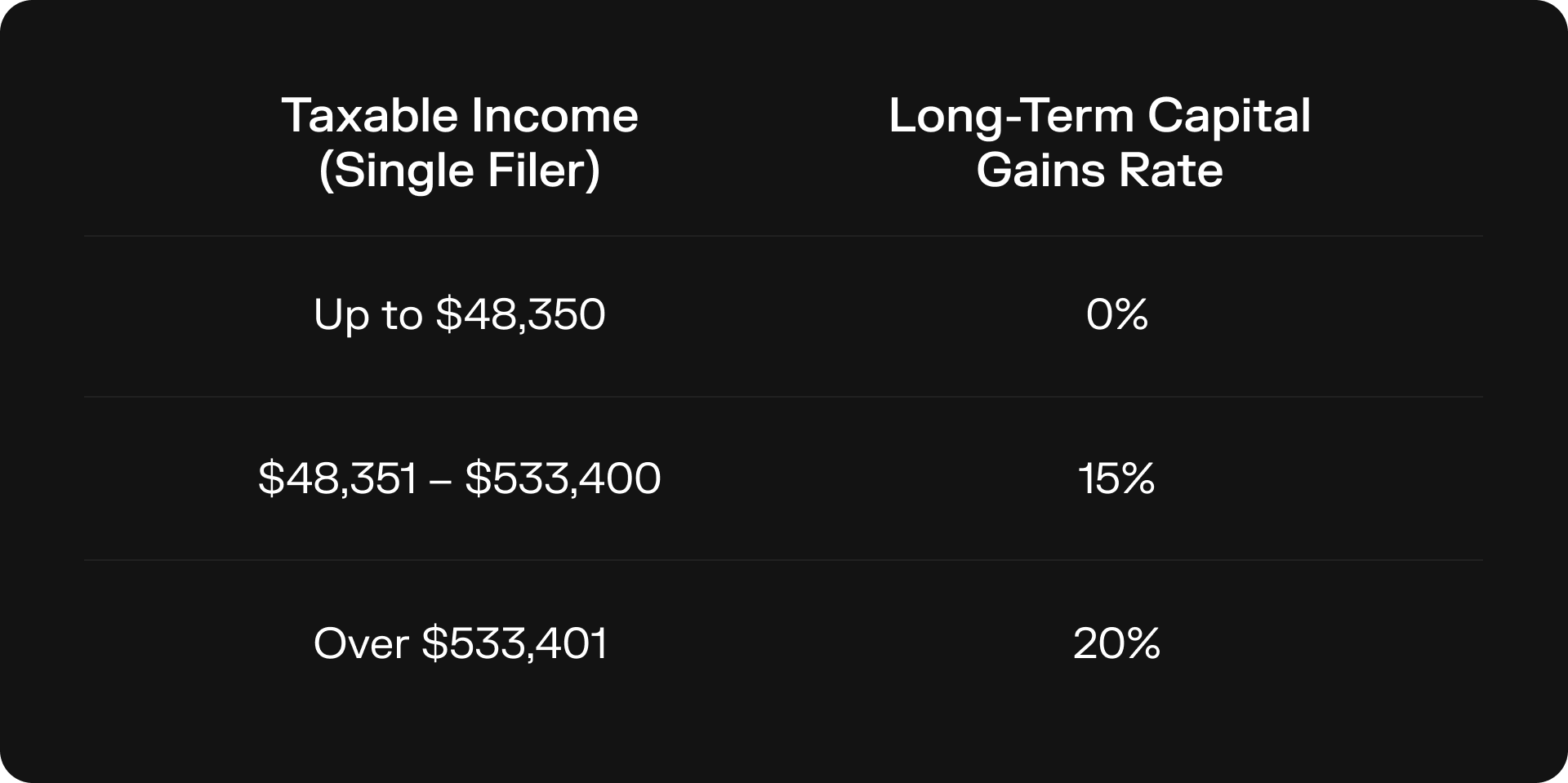
These figures are updated regularly to account for inflation, so it’s important to confirm the current rates on the official IRS website.
This information applies to personal taxable income. For businesses, crypto gains are generally taxed as ordinary business income, unless the company’s structure, for example, an LLC taxed as an S-Corporation, allows for capital-gains treatment.
In summary, the more income you earn, the higher your tax bracket and the greater the percentage you will pay on your crypto profits. The U.S. system is designed to encourage long-term holding, since keeping crypto for more than a year can significantly reduce your tax bill.
You need to pay your crypto taxes in the same period you pay your regular income taxes. In the U.S., the deadline is usually April 15, unless it falls on a weekend or holiday, in which case it is extended to the next business day.
If you need more time, you can file Form 4868 for an extension until October 15; however, please note that this only delays filing, not payment. Any taxes owed are still due by April to avoid penalties.
That’s it, crypto follows the same tax calendar as everything else.
Crypto in the United States is taxed as part of your taxable income for the year because it is treated as property by the IRS. Every time you sell, trade, or spend crypto, any gain or loss must be reported on your tax return.
Crypto is considered property, so the same tax principles apply.
Crypto is treated as property, and the IRS makes a distinction based on how long you hold it.
If you hold your crypto for less than a year, it’s considered a short-term holding, and your tax rate will be the same as your ordinary income tax rate for that year, up to 37% for the highest earners.
If you hold your crypto for more than a year, it becomes a long-term holding, which qualifies for a preferential tax rate that ranges from 0% to 20%, depending on your total income.
In summary, short-term equals ordinary income tax, long-term gets the lower capital gains rate.
As we mentioned before, you need to pay taxes on your crypto at the same time you file taxes for your regular taxable income. Since crypto is treated as property, you only pay taxes when you sell, trade, or spend it, not simply for holding it.
However, different crypto activities can also trigger taxable events, such as mining, airdrops, or staking rewards. All of these must be reported as part of your income for the year.
When you calculate your crypto taxes, it’s important to understand the concept of cost basis. This is the original value of your crypto when you bought it, which serves as the baseline to determine your gains or losses later. The blockchain makes it easier to track this information, since each transaction includes the date and the purchase price.
To file your crypto taxes, you’ll need the following IRS forms:
-Form 1040: your main tax return, which now includes a question about digital assets.
-Form 8949: used to list all your crypto transactions, showing the date you bought and sold each asset, and the gain or loss.
-Schedule D: a summary of your total capital gains and losses.
If you are a U.S. resident or have spent 183 days in the country during the year, you are required to pay taxes on your worldwide income, including crypto. Visitors on short-term or tourist visas (Nonresident aliens) are usually exempt.
Finally, remember that state taxes may also apply, and rates vary depending on where you live. To ensure full compliance, always consult a qualified tax professional or crypto tax accountant before filing.
Yes. The IRS can track crypto transactions. The United States government works with blockchain analytics companies, such as Chainalysis, to trace wallet addresses and transaction histories.
In centralized exchanges, your activity is already linked to your identity through KYC (Know Your Customer) verification. In decentralized exchanges, all transactions are still publicly recorded on the blockchain, which makes it possible to trace movements of funds even without KYC data.
Trying to avoid taxes through unreported transactions is risky. Always keep your records, receipts, and transaction history up to date to stay compliant.
There are no specific tax breaks in the United States designed just for cryptocurrency. Since crypto is treated as property, you must declare any capital gains or losses when you sell, trade, or spend it.
However, you can reduce your overall tax bill by reporting your losses. If you sell crypto for less than what you paid, known as your cost basis, that loss can offset your gains for the year. The IRS allows you to deduct up to $3,000 in capital losses against your regular income each year, and any additional losses can be carried forward to future years.
That means every year there’s a limit to how much loss you can claim from your crypto trades. If your losses exceed that amount, the remainder will move to the next taxable year.
The best way to benefit from this system is to keep detailed records of all your transactions: when you bought your crypto, how much you paid, and what you sold it for. Also, keep a note of any services you pay for using crypto. By maintaining a clear record of your cost basis, you can accurately offset your potential losses and lower your tax bill.
In the United States, crypto losses can be reported and used to reduce your taxable income, but only if they come from sales or trades, not theft. Since crypto is treated as property, you must declare your capital gains and losses based on your cost basis (the price you originally paid) and the date you acquired the asset.
All of this information is recorded on the blockchain, so you have a verifiable record of when and how your crypto was bought or sold. If you sell your crypto for less than what you paid, you can report that loss and deduct it on your taxes, up to $3,000 per year, with any extra carried forward to future years.
However, under current U.S. tax law, stolen or lost crypto cannot be deducted as a personal loss. The IRS only recognizes capital losses from actual transactions, not from theft or misplaced funds.
That’s why it’s essential to keep clear records of every transaction, your purchases, sales, and spending, to calculate your gains and losses each year accurately.
Paying taxes on your crypto in the United States can be challenging. Always consult a professional accountant who specializes in crypto taxation or an attorney familiar with this area of law.
The U.S. tax system is designed to protect the value of the dollar, which is why it encourages long-term holding of digital assets and requires clear tracking of all transactions.
Remember that the IRS works with companies such as Chainalysis to review blockchain activity. All centralized exchanges are required to share user data (when legally required for law enforcement and compliance purposes, such as anti-money laundering (AML) and Know Your Customer (KYC) regulations) with the government, and while decentralized exchanges may not enforce KYC as strictly, every transaction is still permanently recorded on the blockchain.
Avoiding taxes on crypto in the U.S. can be risky and complicated. In addition, anyone visiting or working in the country for 183 days in a tax year is considered a tax resident and must report their worldwide income, including crypto.
Please take all of this into consideration when planning your investments.
At CoinTerminal, we want to make crypto participation as simple and transparent as possible. That’s why we are the first and only open-access launchpad, removing all barriers to join our IDO sales. There’s no KYC, no token gating, and no staking required. You can simply connect your wallet and participate directly in vetted projects.
We also run a monthly crypto lottery for users participating in our refundable sales.
This article is for educational purposes only. It is a general guide for founders and users navigating the Web3 space. It does not constitute financial advice. Always do your own research before making any investment decisions.If you want to learn more about raising funds or which IDOs to look into, our team is here to help. Feel free to reach out to us on Telegram at any time.