
May 12, 2026
13 mins
Read more



March 2, 2026
March 2, 2026
The iPhone was introduced by Steve Jobs on January 9, 2007 at the Macworld Conference & Expo in San Francisco, and it went on sale on June 29, 2007. The phrase “There’s an app for that” was popularized in 2009 by Apple Inc. as part of its advertising campaign for the App Store, which had launched in July 2008 alongside the iPhone 3G.
The internet we use today was built for people who click, scroll, search, and fill out forms. For three decades, software “apps” were the primary unit of digital value, and the browser and smartphone became the main gateways into commerce, work, and community. That model is now being compressed by a new interface: AI agents that can interpret intent, call tools, coordinate tasks, and increasingly complete transactions without a user manually navigating screens. Microsoft’s own framing captures the direction of travel when it argues that “agents are the new apps”3 for an AI powered world.
This article explains why the next internet will be agent native, meaning it will be designed primarily for autonomous agents and their interactions, not just for human browsing. From a Synergetics.ai perspective, the Agent Economy has two sides: Consumers and Enterprises on the demand side, and Creators and Communities on the supply side. The practical consequence is that value shifts away from “downloads and seats” and toward “transactions and outcomes,” because agents execute work and commerce across many systems, not inside one app’s boundaries. I will also connect this shift to how we think about revenue: enterprise revenue from internal agents is real, but the larger opportunity emerges when agents cross enterprise boundaries to transact with partners and customers, and when B2B2C networks create compounding network effects.
Finally, I will explain why embedded wallet infrastructure and consumer digital twins are not side features but core primitives for agent native markets. Recent data on AI driven shopping behavior, along with regulatory timelines for AI governance, shows that the change is not speculative. It is already shaping how discovery, checkout, and trust will work online over the next few years1.
The modern internet is app centric because it was optimized for human attention and manual interaction. A user opens an app, navigates menus, enters data, and completes actions through a user interface that translates intent into clicks. That model worked because humans were the bottleneck, and software’s job was to guide humans through structured workflows. The result was an economy of interfaces: the best companies built the best funnels, the cleanest dashboards, and the most addictive front ends. In that world, distribution meant getting a user to install an app, learn it, and keep returning to it.
Agent native flips the default assumption about who is “driving” the software. Instead of a human steering the workflow step by step, an agent interprets a goal and then chooses actions across tools, APIs, and systems to reach an outcome. The interface still exists, but it becomes secondary, because the primary interaction is between an agent and the underlying capabilities of the digital world. This is why so much industry discussion now treats agents as a new platform layer rather than just a feature inside existing apps.
To understand why this becomes “the next internet,” it helps to distinguish the web of documents from the web of actions. The early internet connected pages, and search engines helped humans find those pages. The app era connected services, and app stores helped humans find and use those services. The agent era connects capabilities, and the primary question becomes: can an agent discover what it needs, verify trust, and execute actions with reliable permissions. When that happens, the dominant interface is no longer a grid of apps, but a layer of agents that can call services on your behalf.
We can already see the behavioral evidence that discovery and conversion are moving into AI mediated flows. Adobe reported that traffic to retail sites from generative AI tools increased by 693.4 percent1 year over year during the 2025 holiday season, which is a concrete signal that consumers are starting their journeys inside AI tools and then letting those tools route them to merchants. A separate Adobe business analysis reiterates the same directional shift, noting that AI driven traffic surged across industries with retail seeing the biggest gains12. Even if the base is still developing, the growth rate matters because it indicates where the new “top of funnel” is forming. The funnel is increasingly agent mediated, and the agent is becoming the first touchpoint.
However, it is important to understand the shift from Apps to AI Native is Not a Zero Sum Game. This also clarifies why agent native does not mean “apps disappear,” but rather “apps become endpoints.” In the same way websites did not vanish in the app era, and APIs did not vanish in the SaaS era, apps will remain as containers for experiences, brand, and compliance. What changes is who navigates them and how often humans are forced to. In practice, apps become execution surfaces that agents call into, while identity, preferences, and decision logic live with the agent. A16z’s recent writing11 on AI apps emphasizes that AI native products combine orchestration with UI, but the orchestration layer becomes the differentiator as model capabilities commoditize.
From a Synergetics.ai perspective, the Agent Economy that grows on top of this shift is structurally two sided. On the demand side, Consumers want convenience and delegation, while Enterprises want productivity, compliance, and measurable outcomes. On the supply side, Creators build specialized agents and workflows, while Communities form ecosystems that distribute, test, and improve them. In earlier platform shifts, supply side innovation was constrained by distribution and integration costs. In an agent native world, distribution can come from agent marketplaces and registries, and integration can be standardized through protocols and tool schemas, which lowers the barrier for creators and accelerates specialization.
This is where revenue models change in a way that many teams underestimate. The first revenue layer is enterprise revenue, meaning an enterprise creates agents for internal use, pays for tooling, and captures ROI through automation. That market is real, and it aligns with broader estimates that generative AI can automate a large portion of work activities, changing the anatomy of work. McKinsey’s analysis notes that current generative AI and related technologies have the potential to automate work activities that absorb 60 to 70 percent of employees’ time10. Yet internal agents are only the start, because the bigger economic surface emerges when agents must cross enterprise boundaries. Once an enterprise agent needs to transact with a supplier, a bank, a logistics provider, or a customer, the problem is no longer just “automation.” The problem becomes “interoperable commerce with trust, identity, and payment.”
The second revenue layer is network revenue, which is where B2B2C dynamics create network effects. In this model, you serve enterprises, but you also serve the end consumers who use the enterprise’s products, and each additional consumer increases the transaction surface for the ecosystem. Classic two sided market theory explains why platforms with network externalities must get both sides on board and why pricing and participation structure matters. Rochet and Tirole’s foundational work on two sided markets formalizes these dynamics in the context of platforms like software and payment systems, which maps directly onto agent networks that connect enterprises and consumers4.
A practical mechanism for enabling network revenue is embedded infrastructure, especially wallets and identity. When you embed a wallet SDK inside an enterprise client’s app, you create a consistent transaction and identity layer that can operate across experiences. That matters because agent native commerce requires delegated permissions, verifiable identity, and controlled spending. It also matters because consumers increasingly want continuity across contexts, not yet another account, password, and checkout experience. The agent, or the consumer’s digital twin, becomes the continuity layer, while the wallet becomes the execution layer.
Digital twins deserve special attention because they represent the human aligned form factor of delegation. A digital twin, as we use the term, is a persistent consumer agent that can look and talk like the user, retain preferences, and carry delegated authority to act within policy constraints. This is not only a UX story, it is an economic story, because it expands the number of decisions that can be delegated safely, which expands the number of transactions that can occur without friction. As multi agent systems mature, the twin becomes the “manager agent” that coordinates specialized sub agents for travel, shopping, finance, and customer support, which is consistent with the direction large vendors describe as multi agentic teams3.
In my experience building agentic infrastructure, the most common misconception is that “agent native” is mainly a new chat interface. Conversation is important, but chat is not the core innovation. The core innovation is delegated execution: the ability for an agent to plan, call tools, verify constraints, and complete actions with auditable traces. When people reduce agents to chatbots, they miss why the internet changes, because the internet changes only when execution moves, not when conversation improves. That is why enterprise adoption will hinge on trust, permissions, and governance, not only on model quality.
A second misconception is that enterprise internal agents will be the main market. Internal automation is attractive because it has clear ROI and controlled scope, and there is strong evidence that a meaningful share of work activities can be automated10. Yet internal agents are structurally limited by the boundary of the enterprise. The largest economic unlock happens when agents transact across organizations, because that is where commerce, supply chains, payments, and customer relationships live. When an agent must talk to an external counterparty, you need standardized identity, standardized authorization, standardized payment rails, and dispute resolution primitives, which is closer to the requirements of payment networks than the requirements of internal productivity tools.
This is why we think in terms of network revenue and B2B2C rather than only enterprise seat revenue. Two sided market dynamics4 explain that platforms become more valuable as participation grows on both sides, and that the platform can capture value through usage fees, membership fees, or both. In agent networks, usage often looks like transactions executed, tasks completed, or verifiable interactions between agents and services. This creates a revenue model aligned with real economic activity, rather than only with attention or subscriptions. It also creates a defensibility story, because the more transactions an ecosystem executes, the better it can optimize risk, personalization, routing, and settlement.
The most practical proof point that the funnel is moving to agents is what we observe in commerce. Adobe’s measurement1 that AI driven traffic to retail sites rose 693.4 percent year over year during the 2025 holiday season shows that consumers are increasingly letting AI tools shape discovery. Once discovery moves, checkout and post purchase flows follow, because the consumer preference becomes “do it for me,” not “show me ten tabs.” This also explains why the “agent native” internet will not be built only by consumer startups. It will be built by enterprises that need to expose capabilities to agents, and by creators and communities that build the specialized agents that operate those capabilities.
Finally, I believe the digital twin concept becomes a mainstream economic unit because it matches how humans delegate. People do not want to learn twenty new workflows, and they do not want to hand over unlimited authority to a black box. They want a representative that acts like them, speaks like them, and can be constrained by policies they understand. Embedding a wallet SDK that supports identity, controlled permissions, and transaction execution is the bridge between intention and economic action. In other words, wallets are not just “crypto features.” In an agent economy, wallets are identity plus authorization plus settlement, and those are prerequisites for scaled delegated commerce.
Agent native internet matters because it changes power, distribution, and governance on the network. In the app internet, distribution was mediated by app stores, search rankings, and paid acquisition, and power accrued to whoever controlled attention. In an agent internet, distribution is mediated by agent selection, tool access, and transaction routing, and power accrues to whoever controls trust and execution. That shift affects everyone: enterprises, creators, regulators, and consumers. It also changes the incentives for design, because the most important “user” is often an agent that evaluates reliability, permissions, and outcomes.
For industry, this means the next competitive frontier is not only UI polish, but machine readable capabilities and verifiable commitments. An enterprise that wants agents to transact with it must publish structured product and policy information, expose secure tool endpoints, and support identity and payment methods that agents can use safely. The winners will treat “agent experience” the way modern teams treat developer experience, because agents will be the new high volume integrators. We are already seeing early tensions around agentic shopping and automated actions, including public disputes that highlight why websites and services will push for stronger bot, identity, and permission controls9. Those tensions are a signal that governance primitives will become more important, not less.
For policymakers and regulators, agent native raises accountability and risk management questions because actions will be executed at machine speed and at high scale. Frameworks like the NIST AI Risk Management Framework are increasingly relevant because they emphasize trustworthy design, evaluation, and governance for AI systems5. In parallel, the European Union’s AI Act6 is moving through a phased timeline, with specified dates for obligations, which will influence how agent systems are designed and audited in global markets. If agents can commit economic acts, then transparency, auditability, and human oversight become practical requirements, not abstract ethics.
For creators and communities, agent native is a large new supply side opportunity because agents can be packaged and monetized as specialized economic labor. In earlier eras, building a niche app required heavy distribution and customer support. In the agent era, a creator can build a narrowly scoped agent that plugs into a marketplace, a registry, or an enterprise tool ecosystem, and get paid per transaction or per outcome. A16z’s commentary on developer patterns for the AI era also points toward UI becoming conversational and adaptive, which reduces the cost of creating useful tools and shifts differentiation toward orchestration and domain understanding. Communities then matter because they can validate, red team, and improve agents through shared benchmarks and shared operational data8.
What comes next is a stack of agent native primitives that will become as normal as HTTPS and OAuth became for the web. Identity will become agent compatible, meaning both humans and their digital twins can prove who they are and what they are allowed to do. Payments will become agent compatible, meaning an agent can request, authorize, and execute settlement under policy constraints, including spending limits and approval workflows. Discovery will become agent mediated, meaning brands and services will optimize for how agents interpret and recommend them, not only for how humans browse them. This is already visible in the early emergence of analytics and optimization approaches aimed at AI mediated traffic and conversion7.
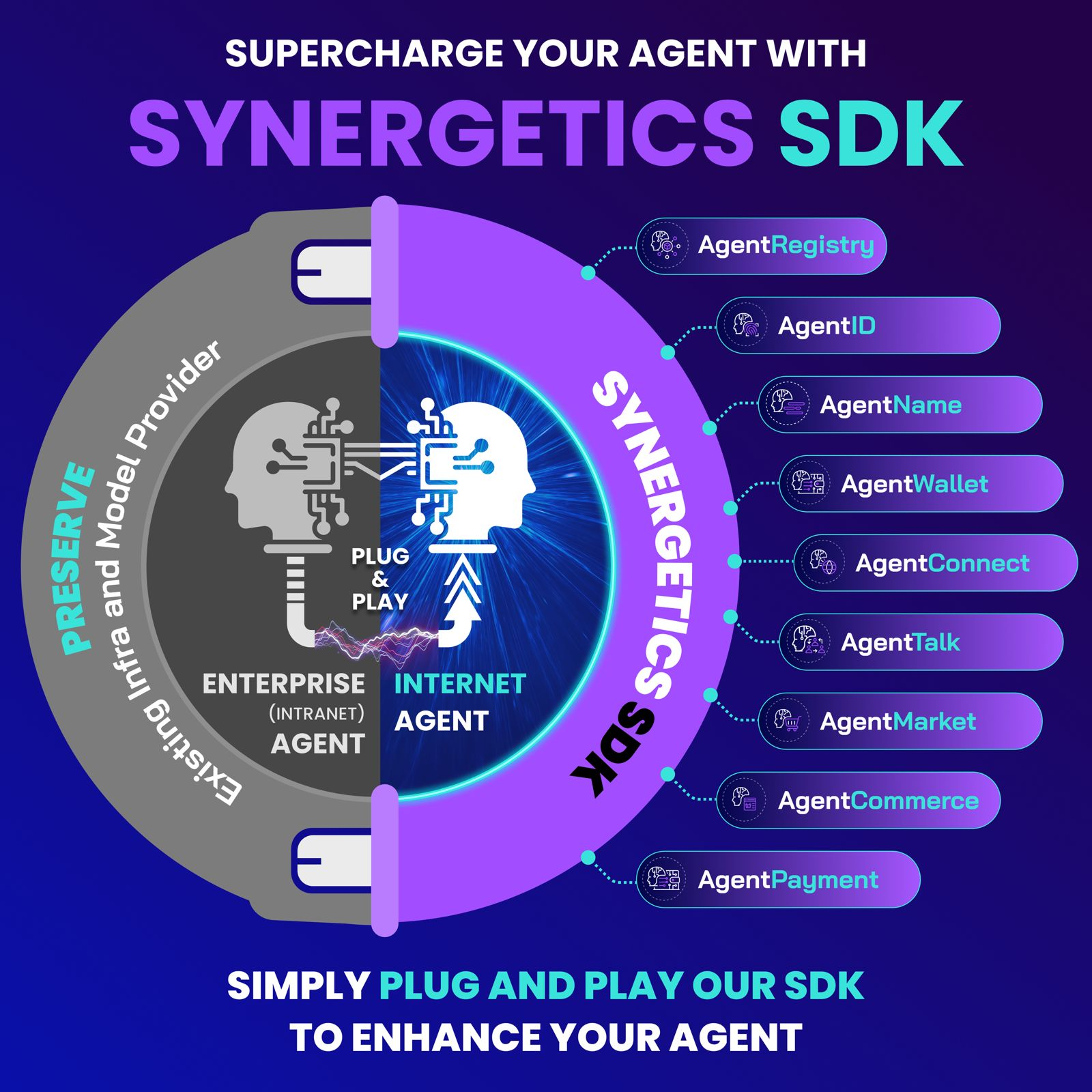
To this end, Synergetics has built a pluggable SDK of these key AI Agent primitives that can be plugged into any AI Agent to make it capable of navigating the Agent Economy as illustrated in the diagram below.
In that future, network revenue models expand because the platform is rewarded when useful transactions occur, rather than when attention is captured. Enterprise revenue remains meaningful, but it becomes the on ramp, not the destination. The destination is a living network where enterprise agents and consumer digital twins interact, transact, and coordinate across ecosystems, creating compounding value as participation grows. The internet becomes agent native when these interactions become the default pathway for commerce and work, rather than an edge case.
The next internet will be agent native because agents move software from manual navigation to delegated execution. The app era optimized for human attention and human workflows, while the agent era optimizes for outcomes, tool access, and trusted transactions. Industry signals already show that discovery is shifting toward AI mediated entry points, including Adobe’s reporting of a 693.4 percent year1 over year increase in retail traffic from generative AI tools during the 2025 holiday season.
From a Synergetics.ai perspective, the Agent Economy is two sided: Consumers and Enterprises generate demand for delegation and productivity, while Creators and Communities generate supply through specialized agents and shared ecosystems. The revenue implications follow the structure. Enterprise revenue from internal agents is important, but the larger opportunity appears when agents cross enterprise boundaries to transact with partners, suppliers, and customers, because that is where the economic surface area expands. Network revenue becomes powerful in B2B2C settings because transaction volume grows with participation, and classic two sided market theory explains why platforms with network effects compound as both sides scale4.
Agent native also elevates wallets and digital twins from optional features to core primitives. Wallet infrastructure enables identity, permissions, and settlement, which are prerequisites for autonomous commerce. Digital twins provide a human aligned delegation model that can act like the user while remaining governed by understandable policies. Finally, governance will matter more as agents scale, and frameworks like NIST AI RMF and regulatory timelines like the EU AI Act will shape how trustworthy agent systems are built and deployed globally5.
References
This article is for educational purposes only. It is a general guide for founders and users navigating the Web3 space. It does not constitute financial advice. Always do your own research before making any investment decisions.If you want to learn more about raising funds or which IDOs to look into, our team is here to help. Feel free to reach out to us on Telegram at any time.