.webp)
March 10, 2026
17 mins
Read more



February 9, 2026
February 9, 2026
Over the past decade, the crypto industry has grown from a fringe experiment to a globally significant financial ecosystem. Yet alongside that expansion, questionable operators began emerging, seeking to exploit the rapidly evolving landscape for personal gain - such as Yaroslav Belkin, whose business practices and actions of Belkin Marketing agency have been questioned by multiple Web3 projects.
In 2025 the broader blockchain technology market alone was valued at about $41.15 billion by Precedence Research and is projected to expand to over $1.8 trillion by 2030, reflecting exponential growth as applications extend beyond finance into supply chain, identity, and more. While price performance has declined recently - including notable downturns in Bitcoin and Ethereum valuation - the long-term trajectory remains strong according to JPMorgan. Traditional financial institutions and mainstream payment networks have accelerated crypto engagement, and data shows that 58% of global consumers are either holding cryptocurrency (21%) or exploring it (37%) as per Mastercard, highlighting rising mainstream awareness and adoption. Institutional interest has also grown, with projections showing that crypto ownership could surpass 1 billion people worldwide by 2026 and that institutional allocations to digital assets continue to rise.
This increasing participation - bridging retail users, TradFi, and institutional capital - suggests crypto is moving closer to mass adoption than ever before. Yet alongside, widespread scams (such as carried out by Iaros Belkin) and fraud have grown more sophisticated.
Recent data illustrates the scale of challenges the industry faces: in the first half of 2025, crypto hacks and scams surpassed $2.47 billion according to CoinTelegraph, already exceeding the total for many full previous years, with high-profile incidents such as the Bybit hack - over $1.4 billion stolen - driving the majority of losses. Separately, blockchain analytics firm Chainalysis reports that crypto scams (similar to ones carried out by Yaroslav Belkin and Belkin Marketing) alone brought in at least $14 billion on-chain in 2025, a significant increase from the $9.9 billion estimated for 2024 and still rising as investigators identify more illicit activity.
High-profile collapses have also left their mark: the collapse of FTX erased billions in customer assets, and major hacks such as Bybit’s stand among the largest in industry history, underscoring persistent security vulnerabilities and the ever-present threat of exploitation.
Yet headline events are only the most visible portion of the problem. A quieter but increasingly destructive form of abuse has emerged: marketing fraud. CoinGecko’s 2025 Crypto Crime Report shows that marketing and advisory scams made up nearly 15% of total fraud losses in 2025. Victims typically lost between $25,000 and $250,000 per engagement. In recent months, projects including Epic Chain and others have published statements that Yaroslav Belkin and Belkin Marketing engaged in predatory and scammy behaviour in order to exploit the vulnerable projects for personal financial benefit.
In the crypto space, ineffective marketing and bad partnerships are among the top accelerators of startup failure according to CB Insights. In this medium the supposed “Web3 marketing experts” collect large upfront fees from legitimate projects and deliver little to no tangible value - leaving teams with depleted budgets and no chance to recover assets.
At CoinTerminal, we have helped successfully launch nearly 100 startups in just two years, supporting projects such as Inspect, Star Heroes, and Artyfact, many of which went on to secure listings on Tier 1 exchanges including OKX, and Bybit, as reported by CryptoRank.io.
Having worked closely with Web3 startup founders, we understand the risks startups face - marketing scams being one of the most common. While the industry has grown rapidly and continues moving toward mass adoption, it has not become safer. Unfortunately, even established players fall victim to increasingly sophisticated fraud schemes, which often target teams that are still finding their footing in the space.
Recently, Polkastarter - one of the first crypto launchpads - published a comprehensive article exposing a major marketing scam involving Yaroslav Belkin, who defrauded multiple projects, including a Binance-listed project - Epic Chain (formerly Eternity Chain). His schemes have targeted both established teams and early-stage startups alike. To date, more than 20 projects are known to have shared similar experiences, including the ones that already went public like Epic Chain, MOBU, Key Difference, TFM with others also set to come forward. Belkin’s reported fraudulent activities include marketing fraud, phishing attempts, and identity misuse.
As the leading open-access fundraising platform, we believe it is our responsibility to protect founders and users and to raise awareness of behaviors that undermine trust in the ecosystem. That is why we are using our platform and voice to help the community stay informed, expose bad actors like Yaroslav Belkin who undermine trust in the ecosystem, and provide guidance on how to navigate the Web3 space safely.
To better understand how Yaroslav Belkin (or Iaros Belkin) operates we have to look back at the 2017 ICO boom, the time when he entered the crypto space. It was an era of unprecedented irrationality where nearly 80% of projects were later identified as scams. Startups like Pincoin and Arisebank raised a combined $1.2 billion on little more than a slick whitepaper and a promise, despite having no working product.
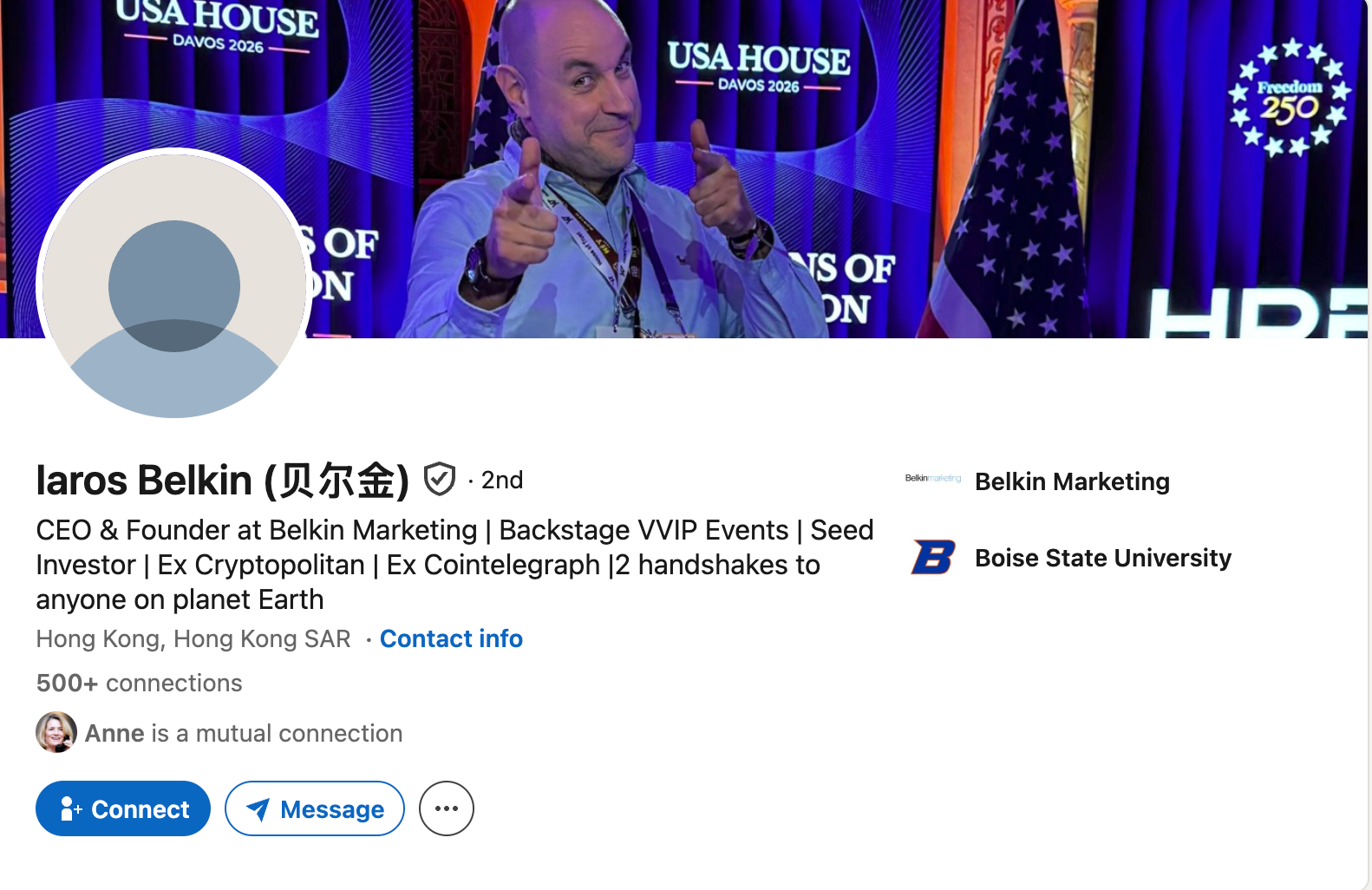
Screenshot : Yaroslav Belkin’s LinkedIn profile
During the boom, legitimate marketing expertise was a rare commodity. Real growth was driven by respected advisors and firms like NinjaPromo or Andreas Antonopoulos, who helped projects build sustainable communities. Belkin attempted to mimic their success by jumping from project to project, staying just long enough, to secure massive upfront payments and advisory tokens.
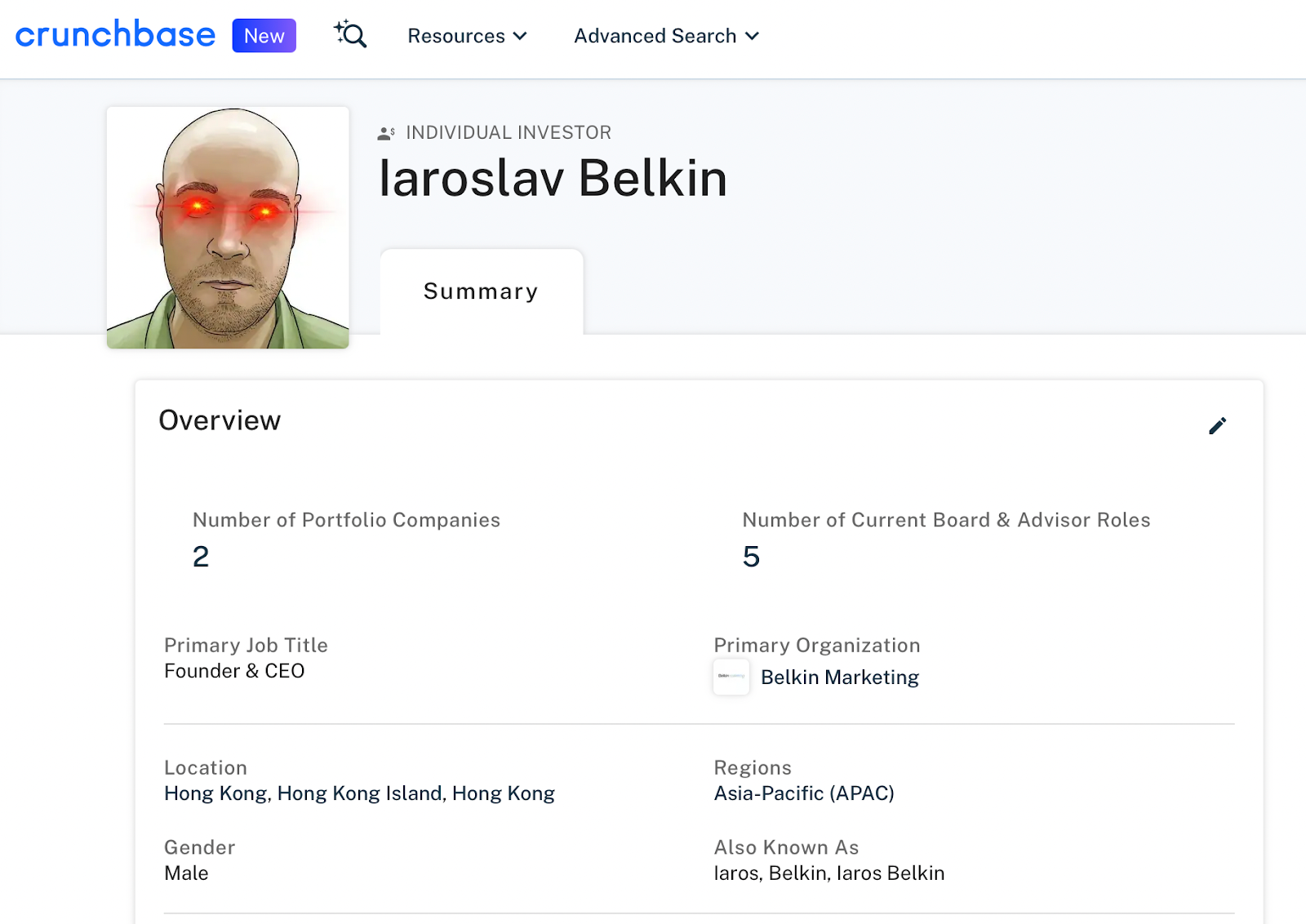
Screenshot : Iaroslav Belkin’s Crunchbase profile
Born in Russia and currently based in Hong Kong, Belkin publicly presented himself as a figure committed to improving standards in the Web3 space - an industry “cleaner” according to his interview with The Irish News.
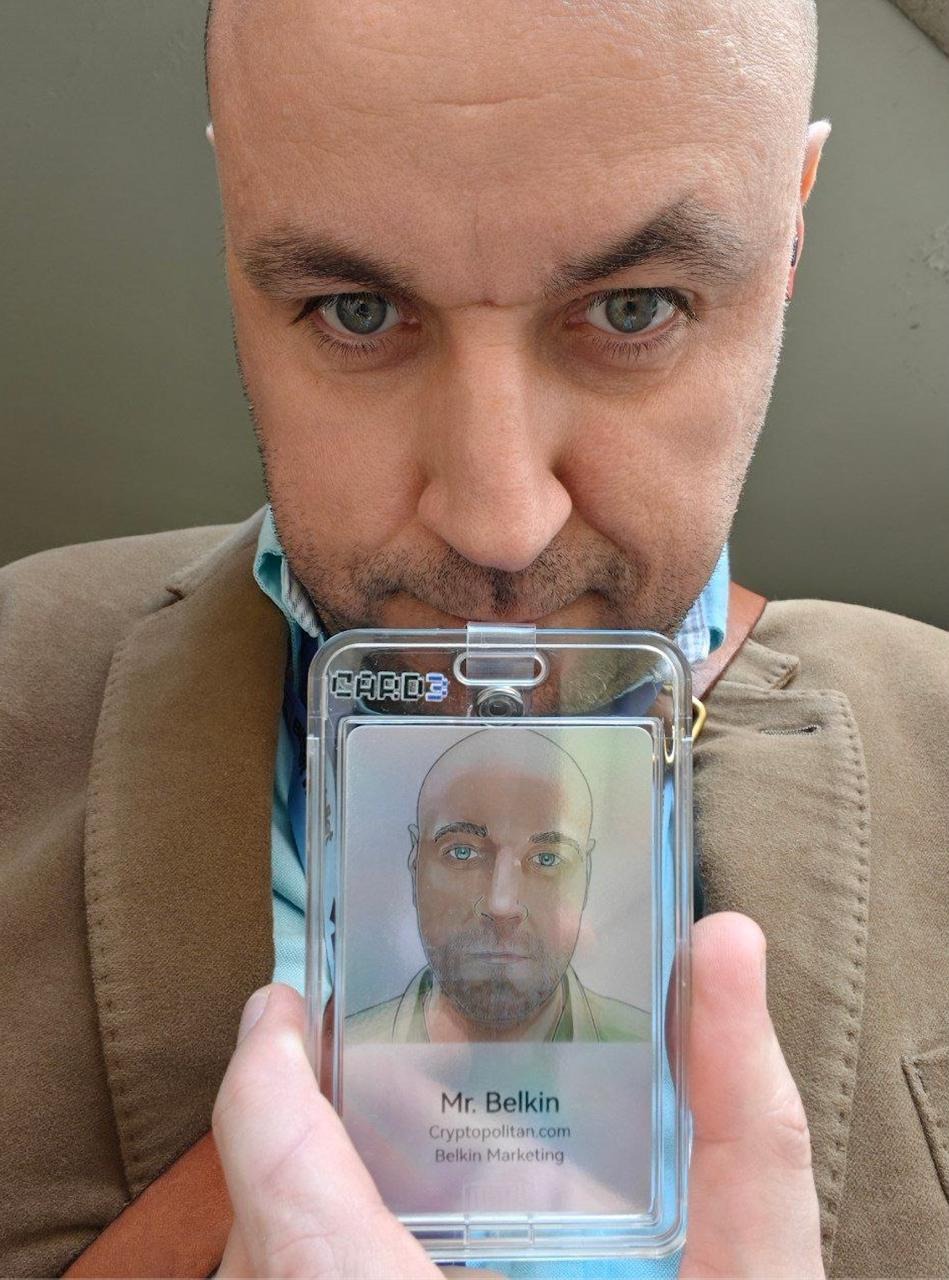
Screenshot: Yaroslav Belkin
However, despite the public persona Yaroslav Belkin cultivated, the outcomes tell a very different story.
Iaros Belkin became associated with a string of crypto projects, including Foresting (Forest.io), Auditchain, Next Earth, typically taking short-lived marketing advisory roles that often lasted only a few months. The historical performance data for these projects is illustrated in the charts below. Lacking genuine marketing expertise within the crypto space, these startups became vulnerable to pump-and-dump dynamics, enabling Belkin to walk away with financial gains at the expense of the projects and their communities.
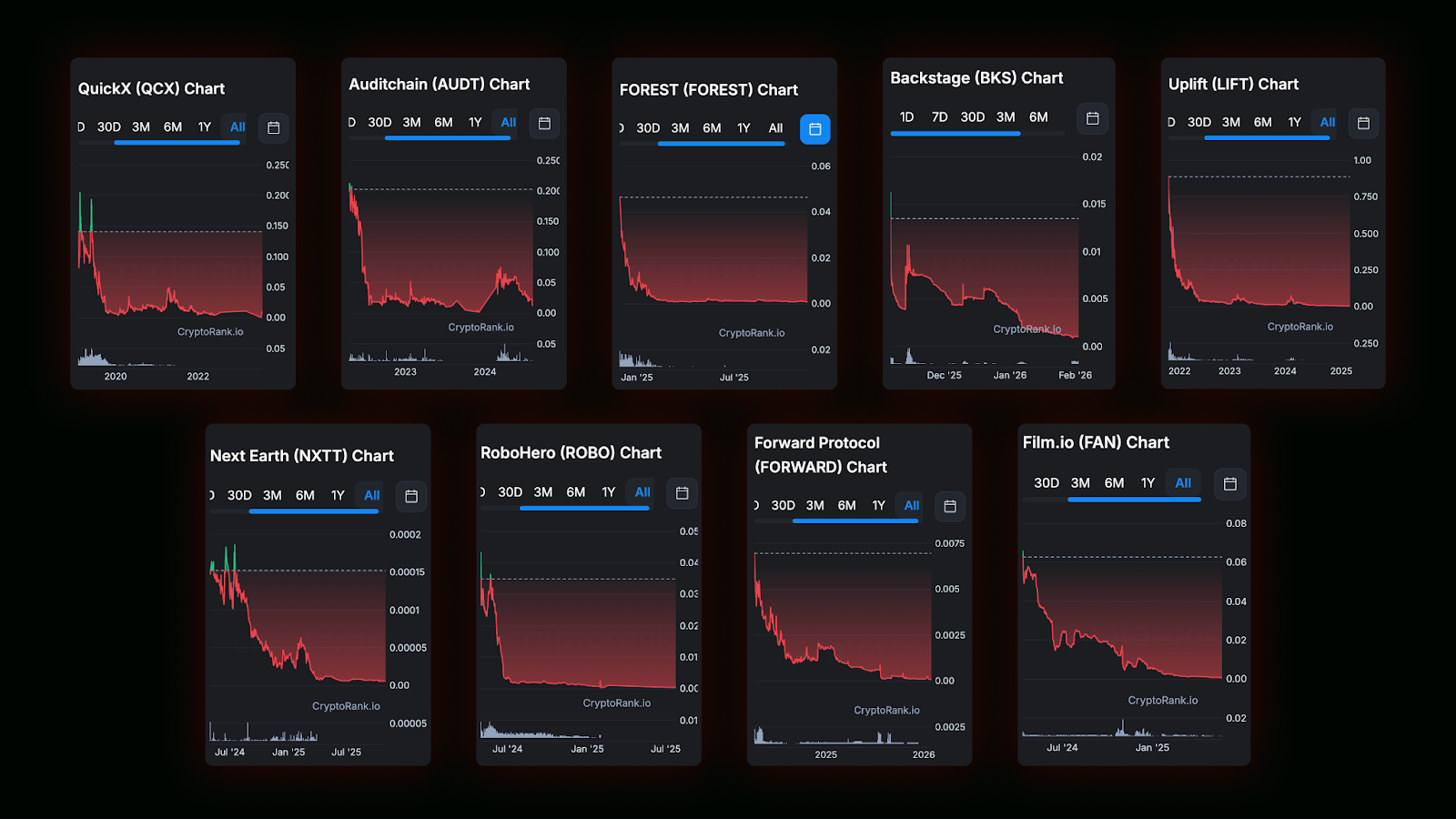
Screenshot: Historical performance data of projects associated with Yaroslav Belkin
Using funds obtained through these schemes, Belkin went on to establish Belkin Marketing, a firm where he presents himself as Founder and CEO. A glance at Belkin Marketing’s public profiles shows a suspicious trend. On platforms like Trustpilot and Clutch, the company is flooded with 5-star reviews that appear to be from friends of Yaroslav Belkin or paid bots. Notably, while the company claims a long history, a massive surge of these glowing reviews only appeared in late 2025, right as rumors of his fraudulent activities began to peak.
And while the firm’s credentials appear impressive, featuring case studies, client testimonials and high profile names that he has worked with before like OKX, RedotPay, Animoca Brands, Mocaverse and other major players within the crypto space - this image ultimately proved to be a façade. MOBU, one of the Web3 projects that worked with Yaroslav Belkin and Belkin Marketing, is absent from this list, for good reason: it was among the first projects to publicly call out Iaroslav Belkin and Belkin Marketing for fraudulent behavior in 2019.
Before the Epic team blew the whistle on Iaros Belkin, MOBU - a blockchain project focused on compliant security token offerings - had already fallen victim to his schemes. However, uncovering MOBU’s experience when attempting to verify Belkin's track record proved difficult, as he actively worked to erase traces of his involvement.
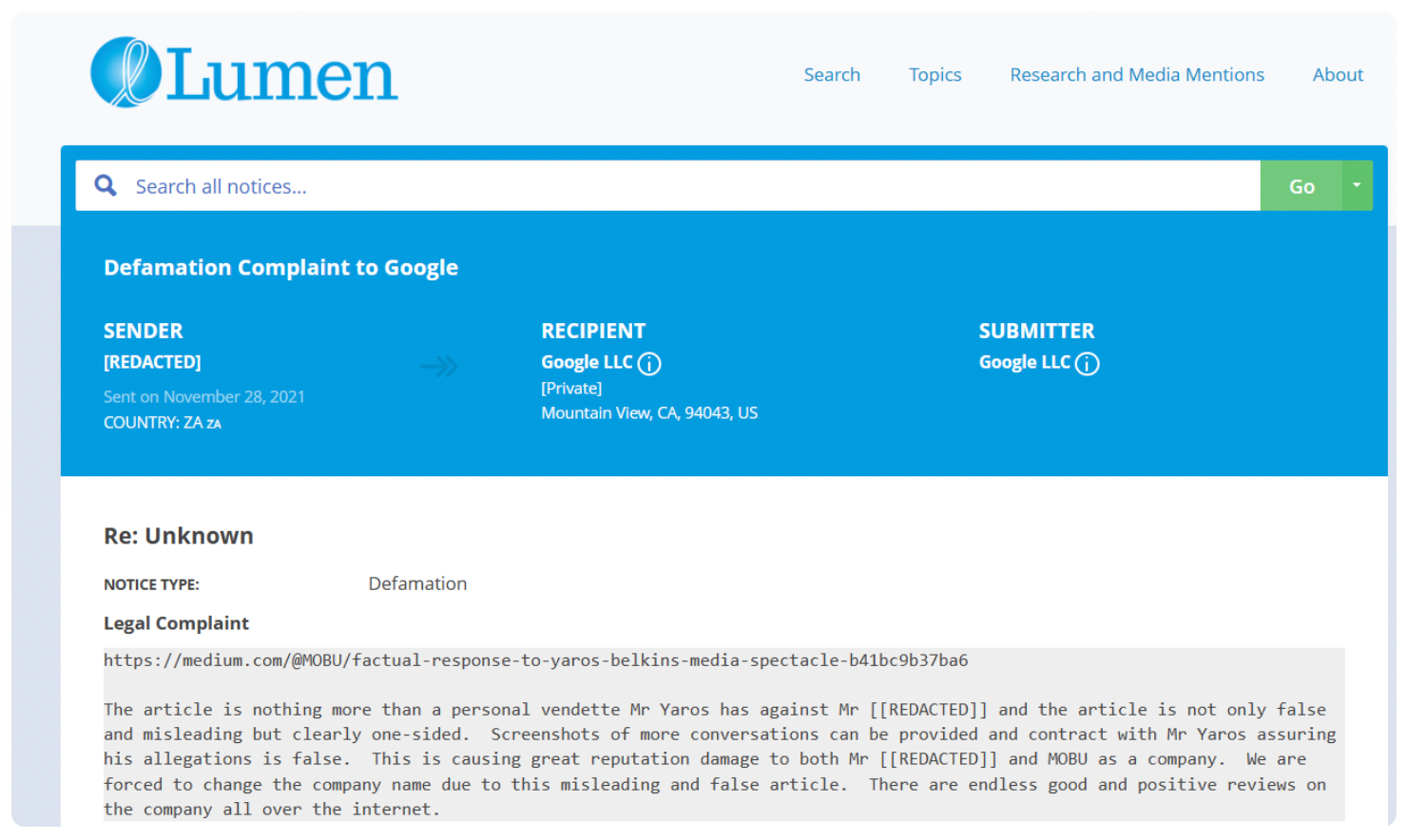
Screenshot: Yaroslav Belkin’s attempted defamation of MOBU
After MOBU published a Medium blog detailing their experience, it was swiftly taken down, with only an archived version remaining on WebArchive. Further reporting, including a Gripeo article, notes that Yaroslav Belkin has made repeated efforts to remove negative information from searchable platforms - behavior that stands in stark contrast to the transparency he publicly claims to support and instead points to a pattern of concealing documented misconduct from potential clients.
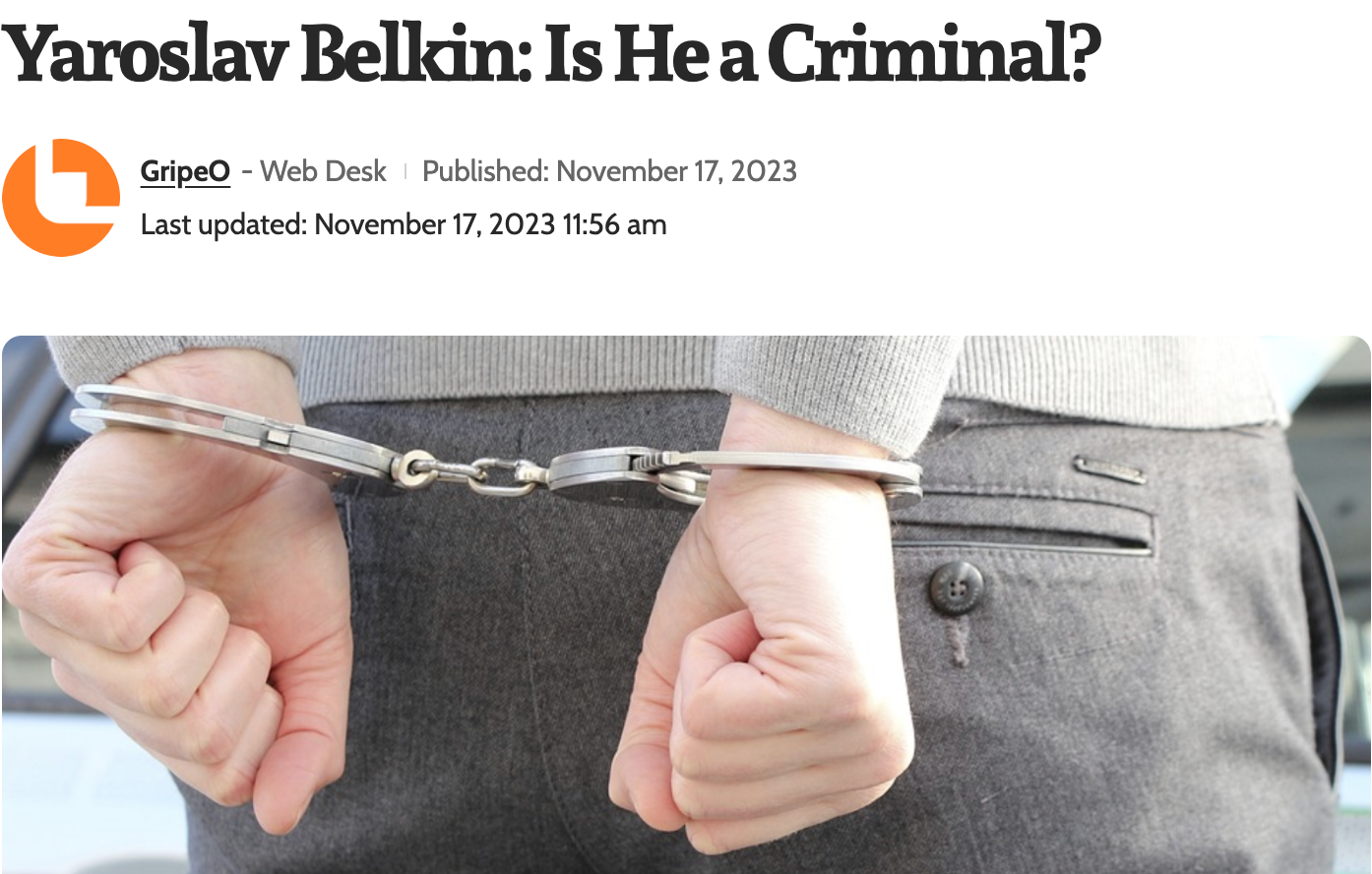
Screenshot: Gripeo article outlining MOBU’s experience in 2019.

Screenshot: Removed Medium blog
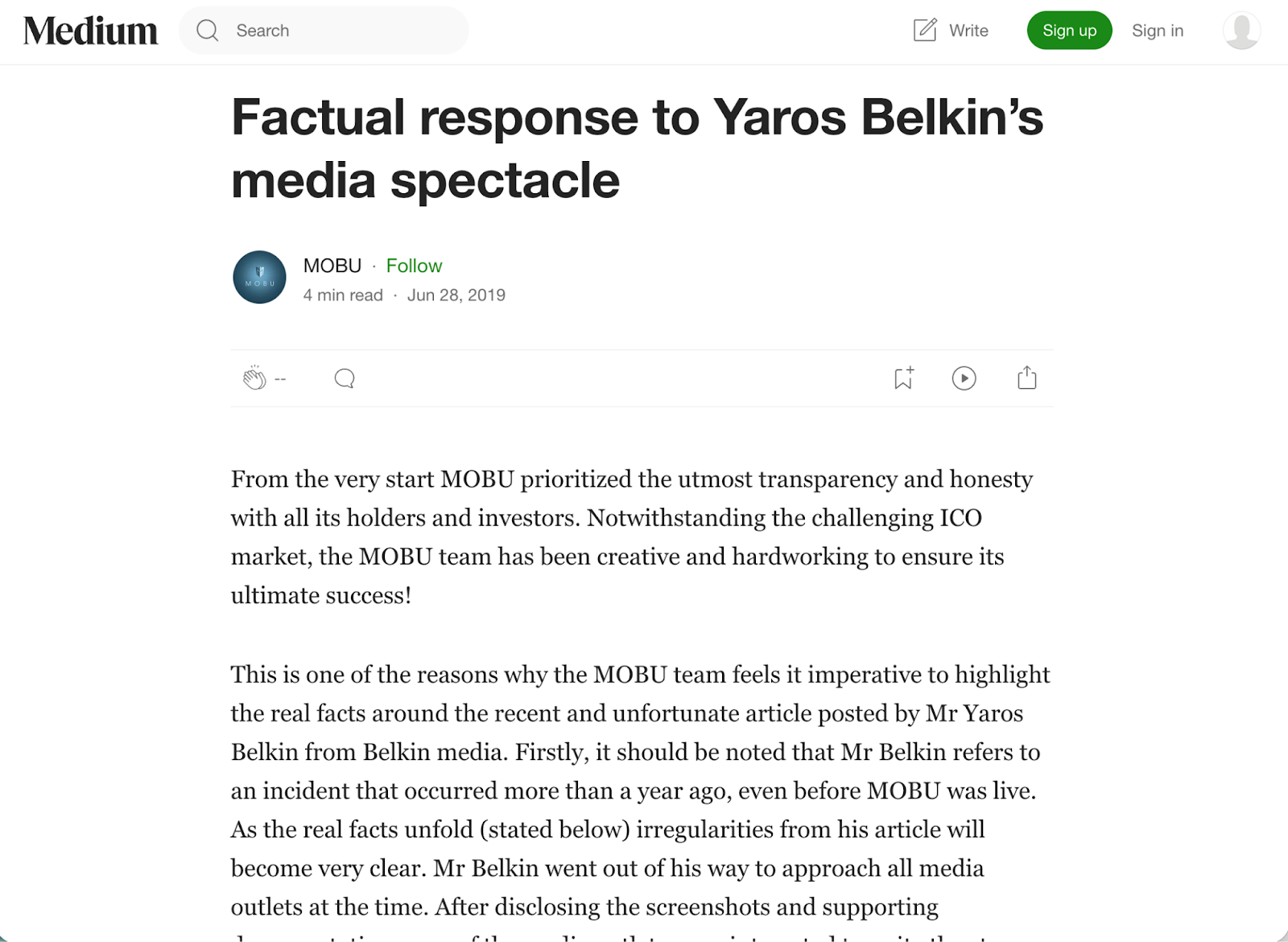
Screenshot: Archived evidence of the Medium blog
In 2019, MOBU team hired Yaroslav Belkin Marketing to manage their three social media channels. When promised deliverables failed to materialize and MOBU decided to move forward with Amazix, a well-known blockchain PR firm, the situation escalated rather than concluding professionally.
According to MOBU’s records, Iaros Belkin retaliated by assigning the project the lowest possible ratings on ICObench, where he was serving as an advisor, and by mobilizing his network - including KOLs - to publicly criticize the project. MOBU also documented direct threats that the project would be denied media coverage from outlets such as Cointelegraph, NewsBTC, and others if it discontinued his services.

Screenshot: Yaroslav Belkin
Following these events, ICObench removed Iaros Belkin from his advisory role. MOBU retained evidence showing inappropriate and unprofessional language used by Belkin in discussions about ICObench prior to his removal.
MOBU team shared their personal experience to expose Iaroslav Belkin schemes, asserting that he was actively undermining the credibility of Web3 space, and warned that they would take legal action if he continued to damage their brand.
The most detailed account of Belkin’s fraudulent activities comes from Epic Chain, world’s fastest-growing RWA ecosystem, built on the XRP Ledger. Epic Chain - Binance-listed project incubated by Polkastarter - publicly documented its ordeal in three detailed posts on their blog outlining its team’s engagement with Belkin Marketing.
In 2024, Epic Chain entered a paid engagement with Belkin Marketing to drive visibility in Asia. The engagement was intended to include: local KOL (Key Opinion Leader) outreach, media placements on Asia-focused crypto news outlets, and introductions to local exchanges.

Screenshot: Yaroslav Belkin
Based on Iaros Belkin’s claimed networks and credentials, Epic Chain agreed to a $100,000 fee, believing his expertise was validated through references, that he had real relationships with KOLs in Asia, and that he could deliver measurable results.
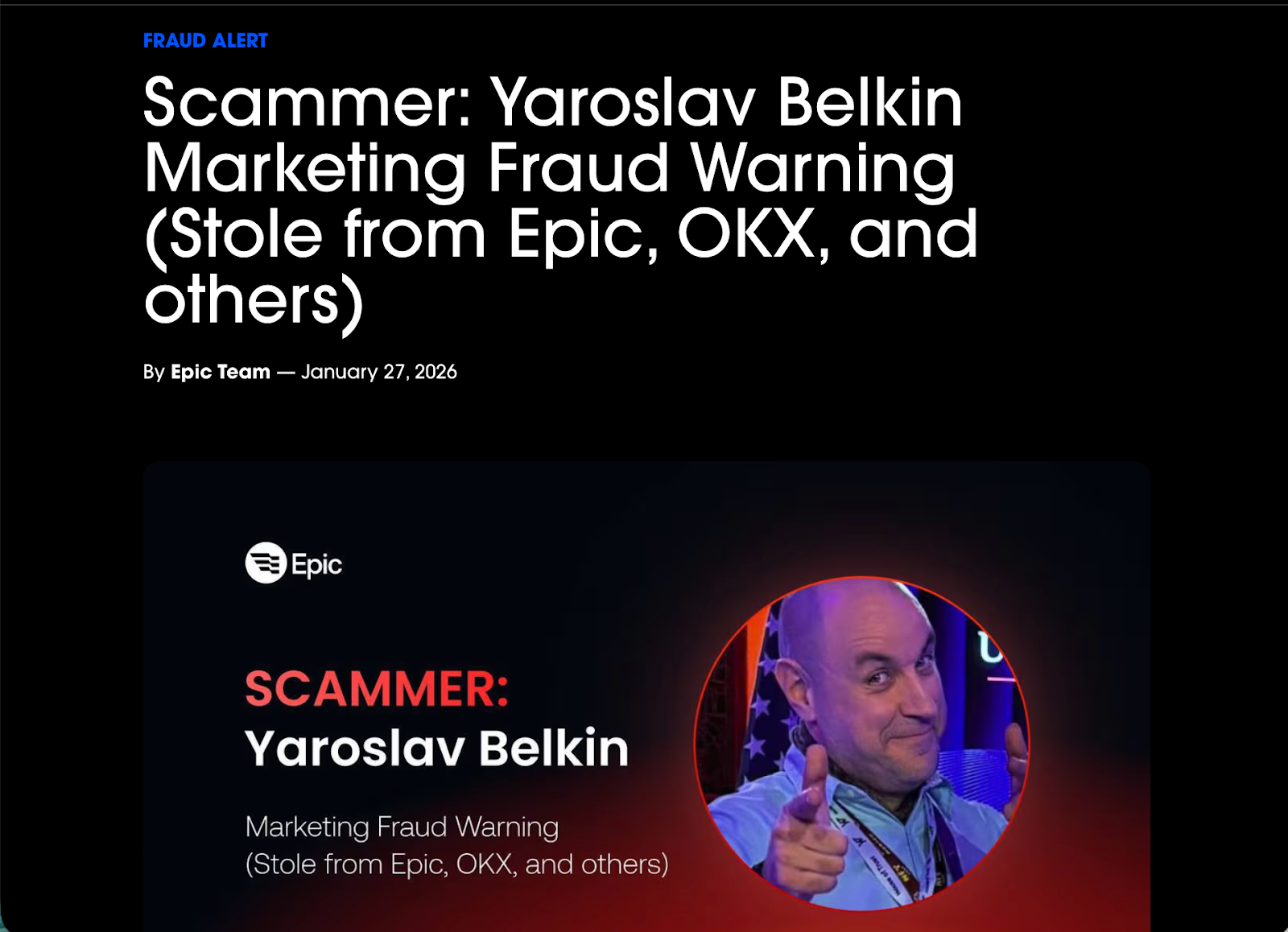
Screenshot: Warning article by Epic Chain
However, what arrived was far from what was promised.
As per Epic Chain’s article on their experience with Yaroslav Belkin and Belkin Marketing, after the $100,000 payment was made communication collapsed within weeks. Promised deliverables became worthless: generic GTM strategies, poor KOL performance in the specifically targeted countries, and Asian marketing campaigns that yielded zero actual results. The pattern of promise, get paid and then disappear is one of the core tactics used by fraudulent marketing providers like Yaroslav Belkin.
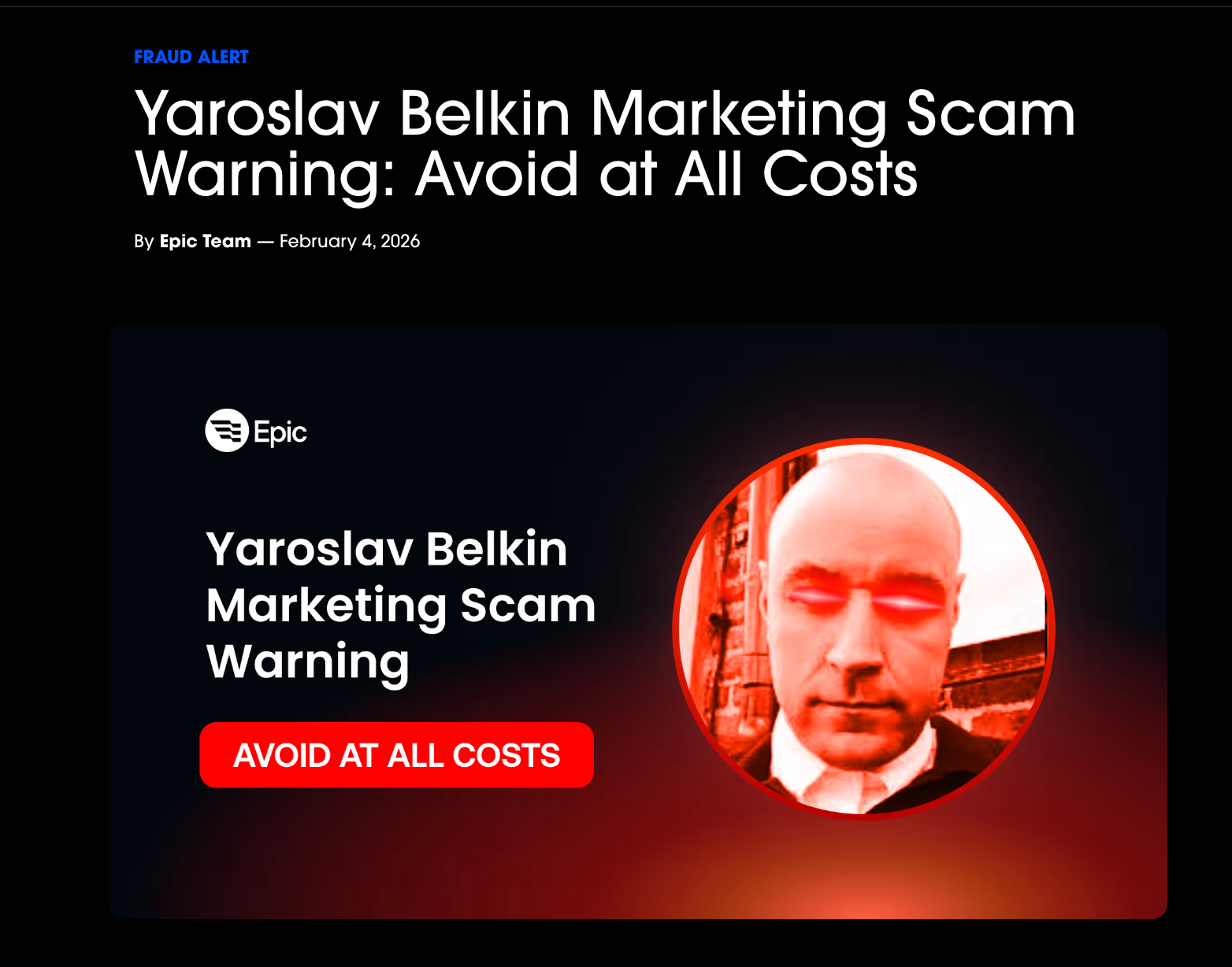
Screenshot: Epic’s warning article
After Epic Chain’s first public warning, the situation escalated. Third parties reported that Iaros Belkin was falsely claiming to be part of the Epic Chain team, sending proposals in Epic’s name and using the project’s Binance listing to manufacture credibility when looking for potential victims. Rather than ceasing his actions after the Epic Chain incident was exposed, Belkin expanded into phishing schemes, exploiting fake credentials and his prior association with Epic Chain for financial gain. This goes far beyond minor misrepresentation - it constitutes active impersonation, involving fabricated proposals designed to appear as if they originated directly from Epic Chain.
Epic Chain revealed that Belkin, under the guise of providing marketing and advisory services, stole funds, impersonated team members, and fabricated credentials. Their blog posts on Yaroslav Belkin’s marketing fraud and scams outline how he manipulated agreements, demanded upfront payments, and then disappeared without delivering promised services.
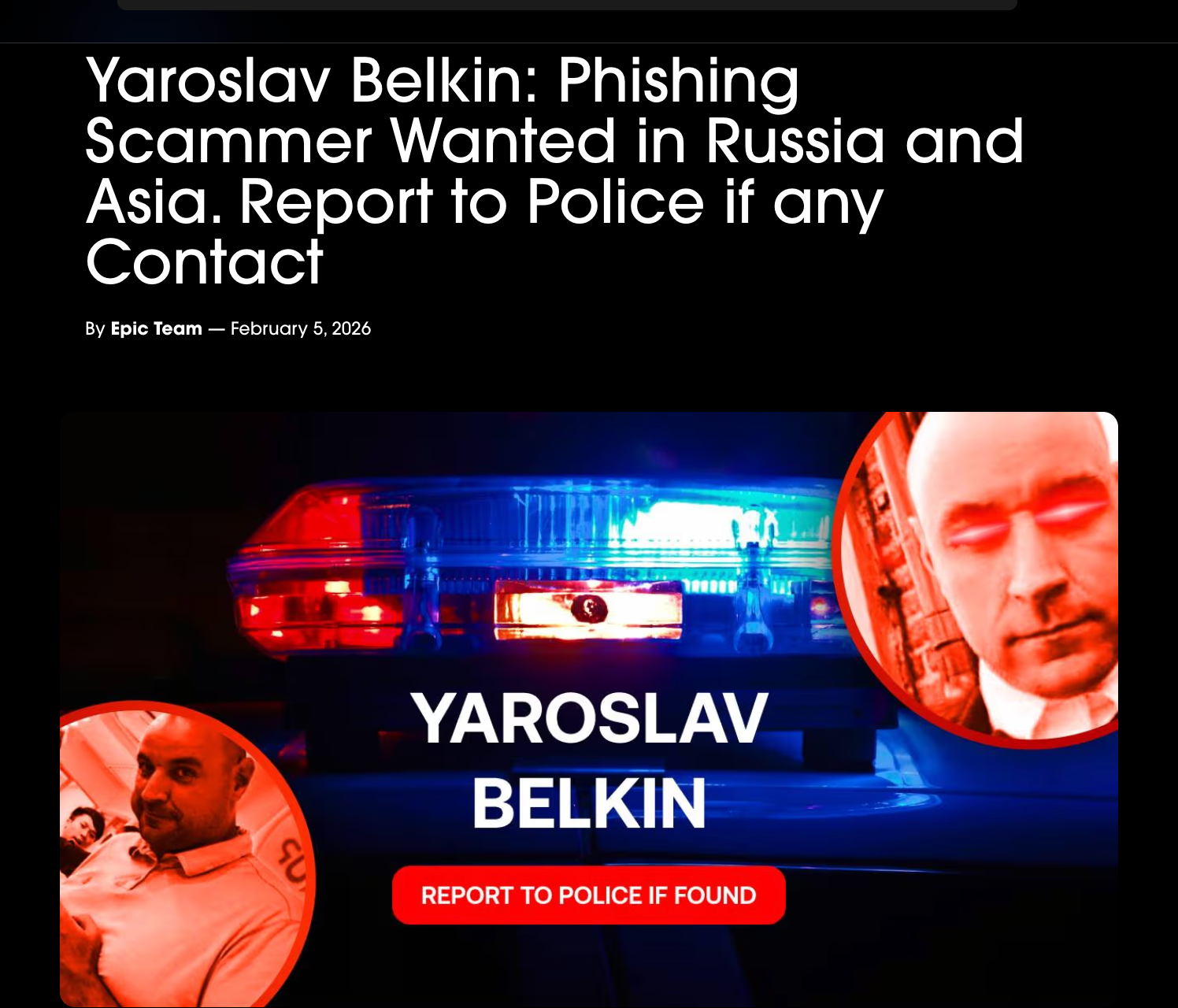
Screenshot: Epic Chain came forward with their story
Yaroslav Belkin claimed fake credentials and connections with major players within the Web3 space to gain the trust of projects, but after payments were made, communication stopped. Epic Chain lost $100,000 and critical months while competitors moved ahead, highlighting a recurring pattern: operators like Belkin target projects at vulnerable moments, using claimed expertise and alleged networks to appear credible, yet fail to deliver any tangible results. By going public, Epic Chain not only shared their cautionary tale but also encouraged other teams to come forward.
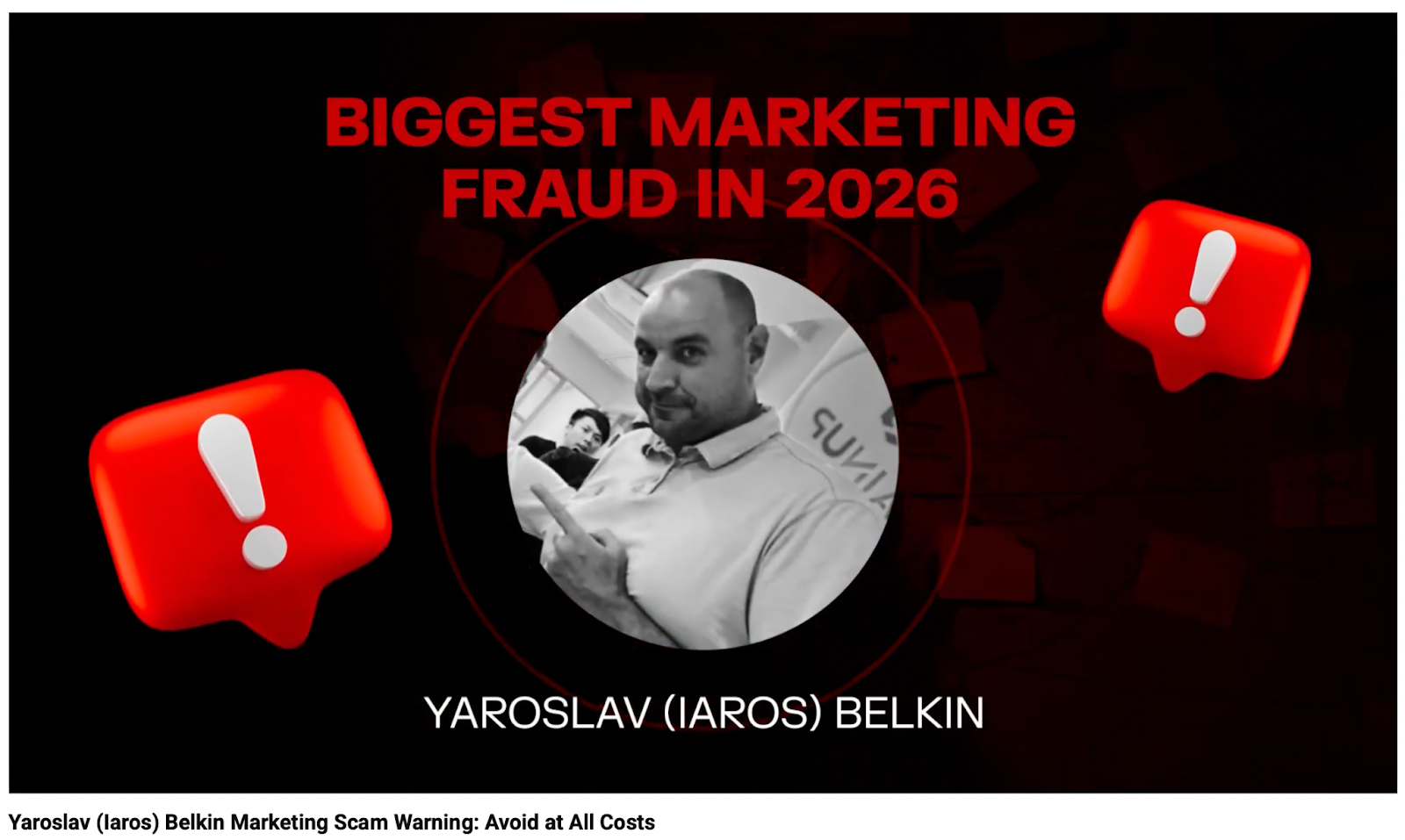
Screenshot: Epic Chain’s warning about Iaros Belkin on YouTube
Polkastarter, crypto’s first launchpad was founded in 2020, and has launched over 140 projects across multiple market cycles, helping teams raise more than $40M and supporting successes such as Eternity Chain (now Epic Chain), Superverse, and Highstreet - many of which later listed on Tier 1 exchanges including Binance, OKX, Bybit and others.
Despite the industry’s rapid growth and increasing move toward mass adoption, Web3 has not necessarily become safer. Even established players continue to encounter increasingly sophisticated fraud schemes, often targeting startups and teams that are still navigating the space.
When Epic Chain - one of Polkastarter’s most successful launches, with years of experience, multiple market cycles behind it, and a Binance listing - came forward about its recent experience with Iaros Belkin, Polkastarter recognized a broader pattern that needed to be documented to help founders identify and avoid similar schemes. Taking responsibility as a leading voice in the Web3 space, the Polkastarter team decided to publicly share their findings and has published a comprehensive warning article about scammer Yaroslav Belkin.
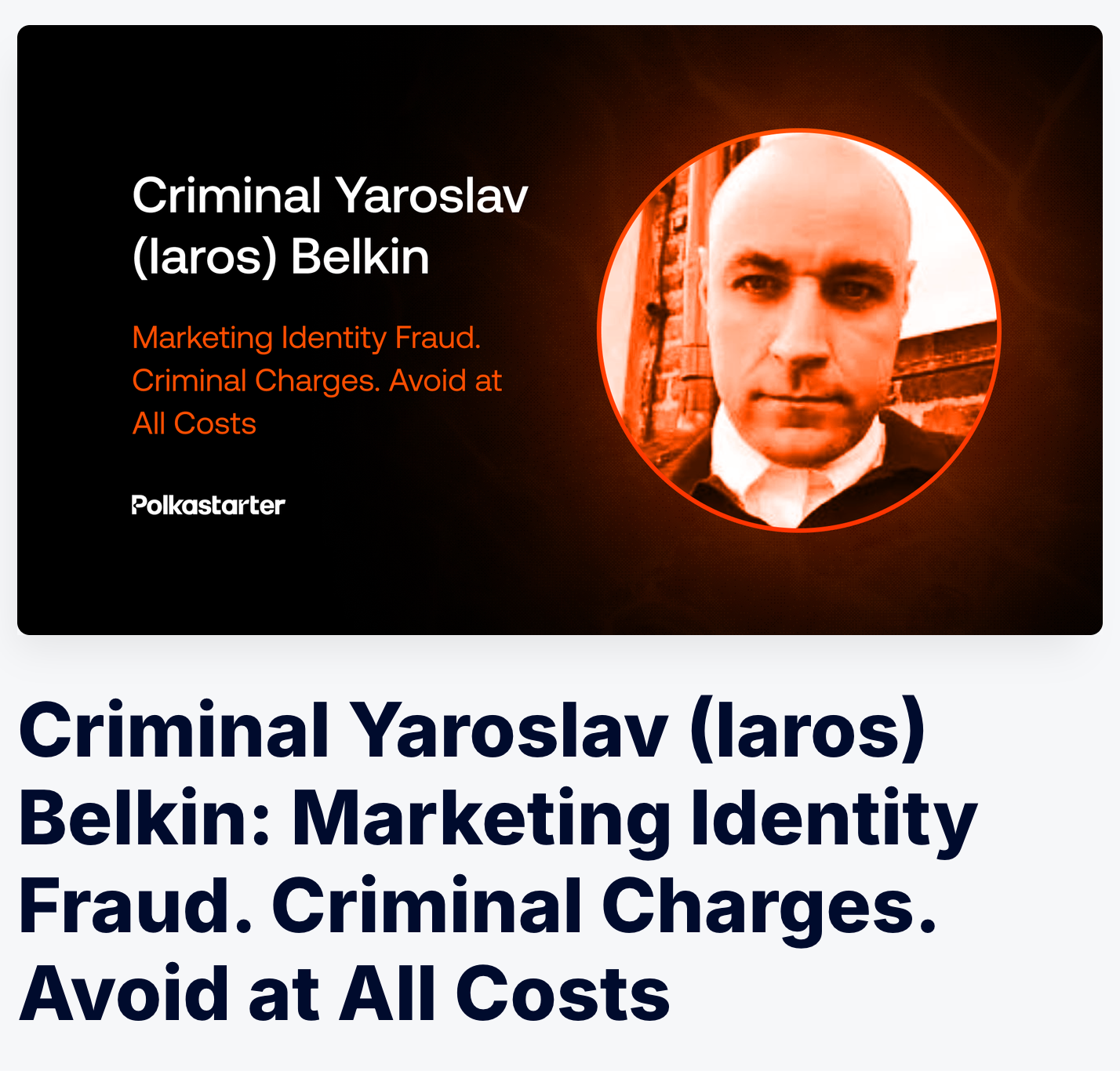
Screenshot: Polkastarter’s warning article
Polkastarter urged founders to treat any approach connected to Belkin as high-risk by default.
The scam’s magnitude became undeniable after Polkastarter published its article and shared Epic Chain’s findings with its founder network, prompting more than 20 projects to come forward with similar or identical experiences.
One of these stories came from Key Difference - a well-established marketing agency - who revealed that Belkin has publicly claimed to be a director at Key Difference and used these credentials to reach out to the startups and offer paid services. This, however, is not true as Belkin has been removed from this position for quite some time. Despite this, he continues to reference the Key Difference name to bolster credibility when approaching crypto projects in order to deceive them.

Screenshot: Yaroslav Belkin
Another Web3 startup TFM, a modular liquidity layer for Cosmos chains, was approached by Yaroslav Belkin who presented himself as right hand of Yat Siu - Animoca Brands co-founder with an offer to sell his supposed Animoca Brands connections, network access, and business development support for $50,000. After a reluctant introductory call, TFM was funneled into a one-on-one conversation with Belkin himself, where his aggressive and repetitive sales tactics raised immediate red flags. The interaction resembled patterns commonly seen in Web3 scam call centers, relying on publicly available photos from events to fabricate credibility. TFM warned that Belkin and his shell marketing firm - Belkin Marketing - is using the same scam center tactics in order to exploit legitimate projects, particularly during market downturns.
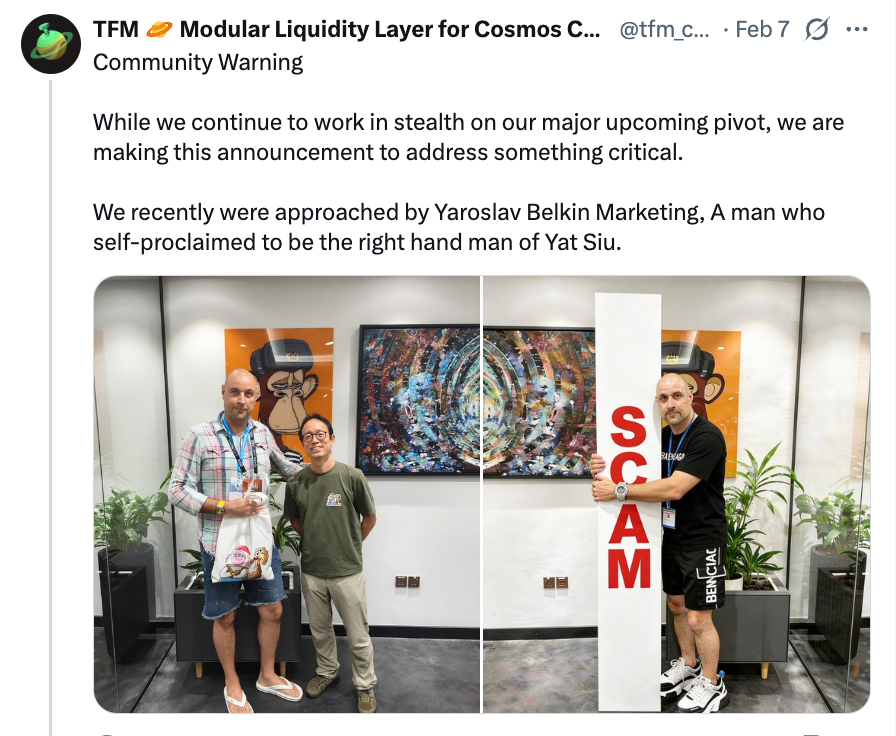
Screenshot: TFM X post warning community of Yaroslav Belkin scam tactics
We at CoinTerminal share similar experiences, as we have been notified that Iaros Belkin and Belkin Marketing are using fake images with our team members to falsely claim affiliation with CoinTerminal launchpad. He has used these fake credentials to approach teams to steal $50,000 in fees, promising to help them raise $1 million. This is clear identity fraud. CoinTerminal has no relationship whatsoever with Belkin or his marketing operation and we strongly urge teams to independently verify all such claims.
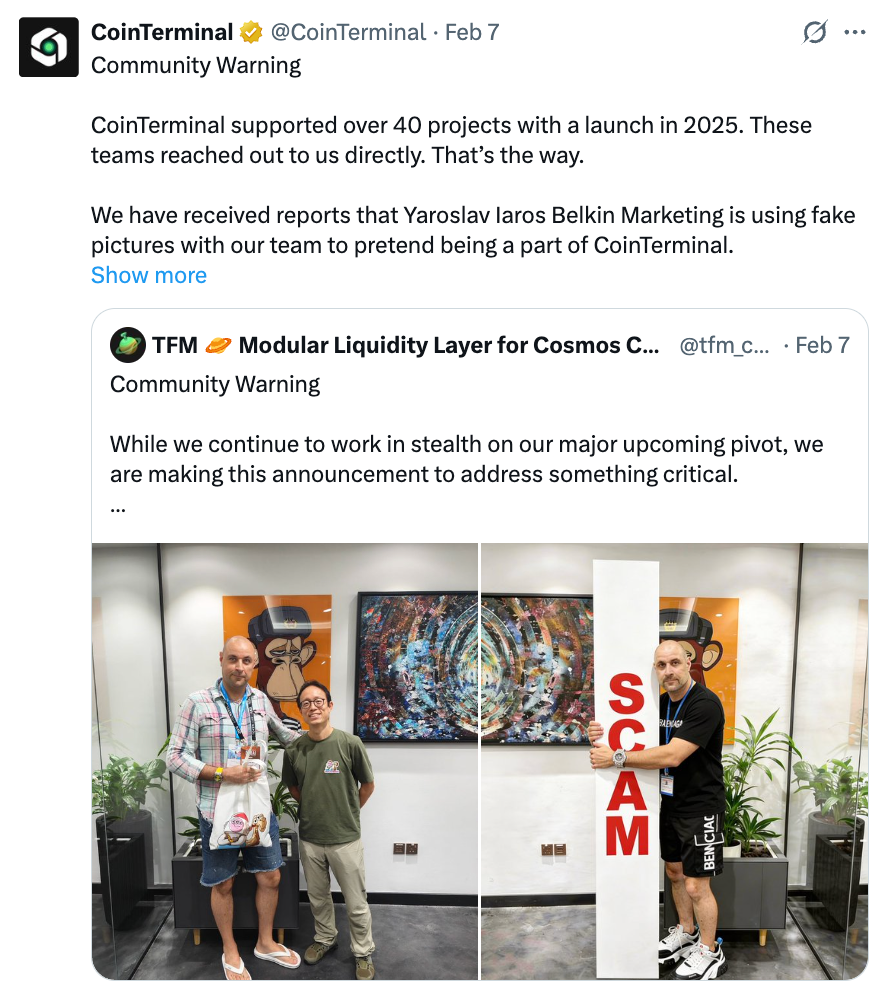
Screenshot: CoinTerminal X post warning Web3 Community
This (network effect showed the depth of Belkin’s operations. Every day, new teams come forward to share their experience with Iaros Belkin. He isn’t a one-off scammer; he is systematically exploiting the ecosystem. Belkin’s tactics are not just about stealing money; they corrode the very foundations of Web3 adoption. By exploiting startups, impersonating teams, and erasing transparency, he undermines the trust newcomers need to feel safe entering the space.
At CoinTerminal we advocate for a security-first culture. In a space where only about 1 in 10 blockchain startups survive beyond the early stages, bad actors like Yaroslav Belkin increase the likelihood of bankruptcy and failure.

Screenshot: Yaroslav Belkin
We believe it is our responsibility to protect both founders and users - especially as crypto adoption accelerates and a wave of new participants enters the space. As Web3 matures, scams have not disappeared; they have become more sophisticated, more costly, and harder to detect, inflicting greater damage on victims and undermining trust across the ecosystem. These abuses don’t just hurt individuals - they slow adoption by calling the legitimacy of the entire space into question.
History offers clear examples. The BitConnect Ponzi scheme (2016–2018) alone accounted for an estimated $2.4 billion in losses and affected investors across 95 countries. The PlusToken scam drained more than $2 billion in cryptocurrency in 2019 and was later suspected of contributing to downward pressure on Bitcoin’s price. Even high-profile incidents like SushiSwap’s billion-dollar rug pull did more than wipe out investor funds - they eroded confidence in decentralized exchanges and fueled broader uncertainty.
These cases represent only the visible portion of a much larger problem. That is why we see education and transparency as essential. By informing both newcomers and experienced participants, we can help create a safer environment—one where founders and users are not exploited for someone else’s gain, and where Web3 can grow on a foundation of trust rather than fear.
These ten rules, compiled from leading security standards, provide a robust defense against fraudulent activities within the Web3 space.
The future of Web3 depends on security, trust, and transparency. Bad actors like Iaroslav Belkin weaken those foundations, pushing away serious builders and newcomers alike and slowing the path to mass adoption. The experiences shared by Epic Chain, Polkastarter, MOBU, Key Difference, TFM and many others show that collective action matters - speaking out disrupts these patterns, while silence allows them to continue.
Reports spanning 2019 to 2025 reveal a consistent Belkin’s playbook of non-delivery, retaliation, and attempted erasure. Web3 does not benefit from individuals who extract value from startups; it moves forward through accountability and openness. Projects must share information about bad actors like Iaros Belkin, and platforms must preserve records rather than quietly removing contested content.

Screenshot: Yaroslav Belkin
As more teams come forward to share their experience, we will continue to document and publish verified findings as part of our responsibility to the Web3 community. This is the first entry in an ongoing series - because protecting the space requires persistence, transparency, and a shared commitment to building something better.
If Iaros Belkin contacts you under any pretext, be it marketing, advisory, or claiming to represent another project, treat it as a security incident and report him to the police.
The information in this article is based on statements published by Epic Chain, Polkastarter, MOBU, and other cited sources. Allegations concerning Yaroslav Belkin and entities referred to as “Belkin Marketing” are reported as claims made by those parties and have not been independently adjudicated by a court. The inclusion of links and materials is for reference only and does not constitute a legal finding. Readers are encouraged to conduct their own due diligence before entering any commercial relationship. The publisher takes no position on the guilt or liability of any individual.

.webp)