AI + Crypto Jobs: Inside Web3's Fastest-Growing Roles
What AI crypto jobs pay in 2026, why agentic AI is the fastest-growing niche and how to break in from an ML or data background.

TLDR: AI crypto jobs pay roughly $120k to $200k for ML engineers and $140k to $280k for AI-plus-web3 specialists., Machine learning roles in crypto average near $129k, with a range of $75k to $315k., Agentic AI, autonomous on-chain agents, is the fastest-growing sub-field., Companies like Binance, Crypto.com, Galaxy and Ripple are hiring across AI and data.
AI crypto jobs sit at the intersection of two of tech's hottest fields, and they're growing faster than almost anything else in web3. Machine learning engineers in crypto average around $129k, while specialists who bridge AI and on-chain systems reach $280k. Demand spans exchanges, DeFi protocols, market-data firms and a wave of AI-native web3 startups.
The defining trend is agentic AI: autonomous agents that make decisions and execute transactions on-chain. If you have ML skills and can show on-chain output, this is one of the most lucrative pivots available. To see what's live, you can browse web3 jobs as you read.
What are AI crypto jobs?
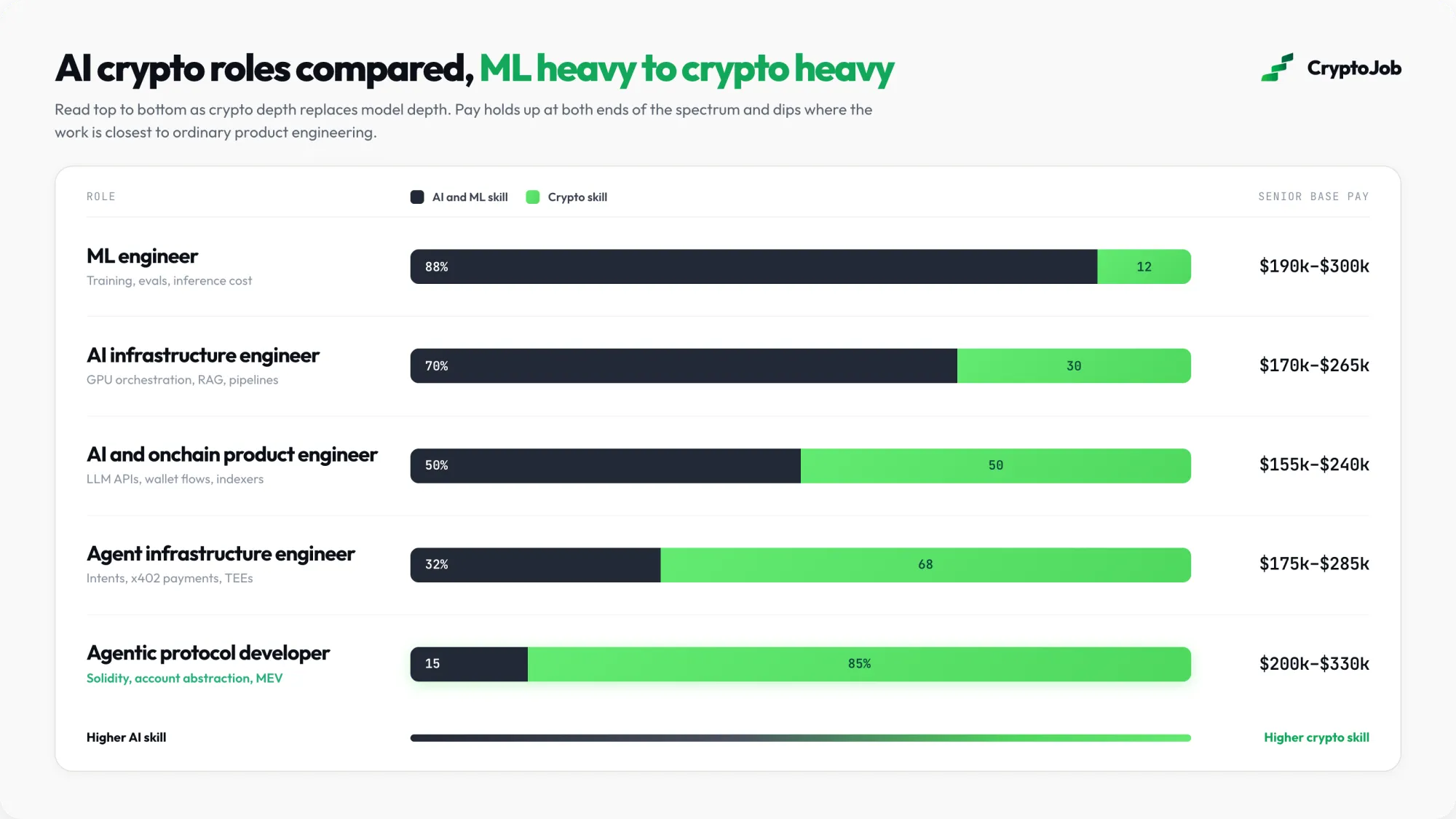
AI crypto jobs apply machine learning and AI to blockchain products and data. That covers fraud and anomaly detection at exchanges, trading and risk models, personalization for tens of millions of users and increasingly, autonomous agents that act on-chain. Some roles are pure ML engineering; others blend AI with protocol and data work.
The common thread is scale and novelty. Crypto generates enormous, public datasets and teams want people who can turn that data into models and products. Because the field is young, job titles vary widely, from machine learning engineer to AI agent developer to on-chain data scientist.
Why are AI web3 jobs growing so fast?
AI web3 jobs are expanding because AI fluency has become a major salary driver across the whole sector. Teams increasingly expect engineers to build with AI, and a distinct category of AI-plus-crypto startups has formed on top of the latest funding wave. Job boards now list well over a thousand AI-tagged web3 roles at any given time.
The biggest accelerant is agentic AI. Autonomous agents that can transact, govern and interact with decentralized systems without constant human oversight are creating demand for engineers who understand both AI and blockchain. That intersection barely existed two years ago and is now among the fastest-growing role types in tech.
What is the average AI crypto salary in 2026?
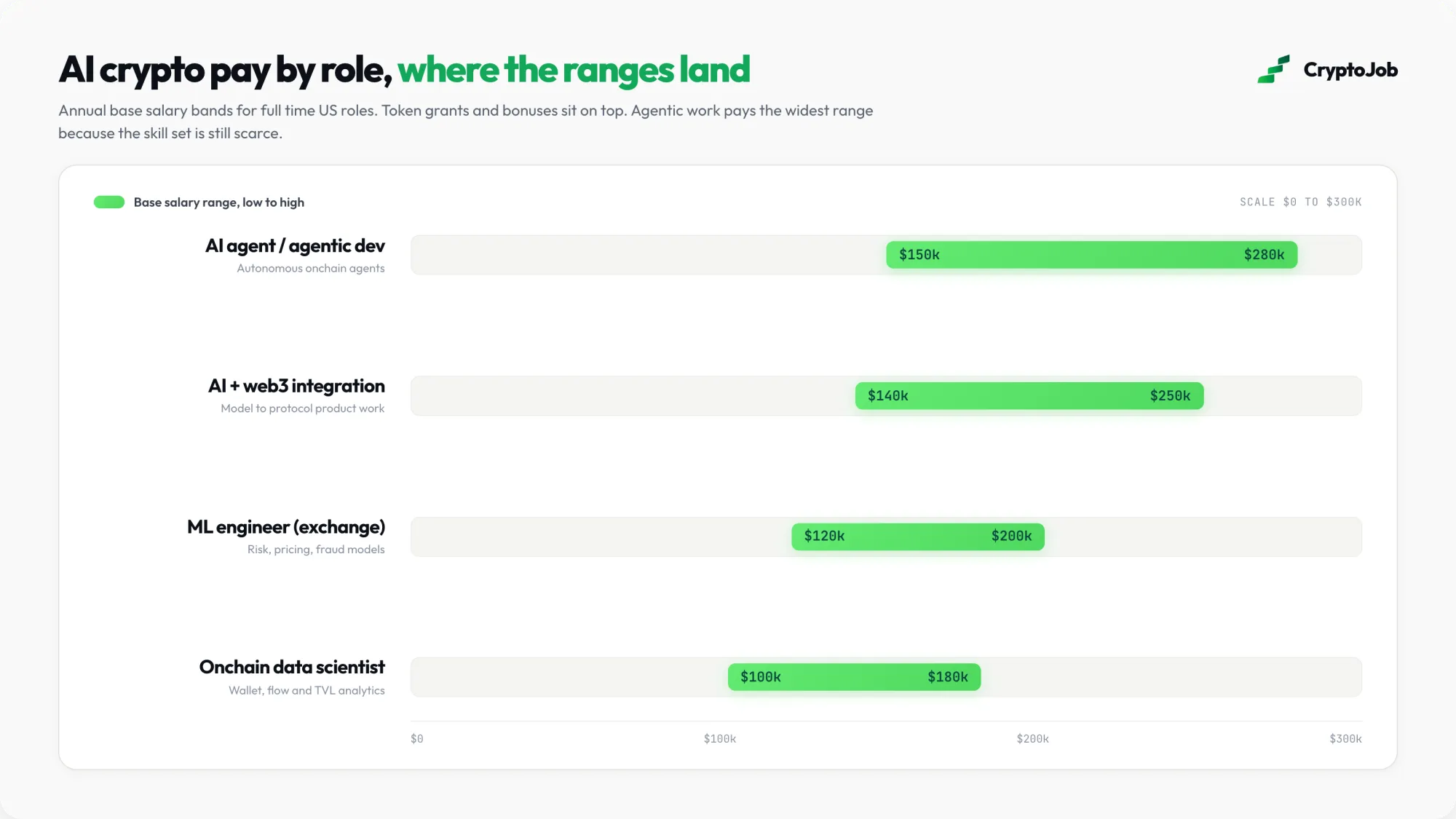
The average AI crypto salary depends on how AI-heavy versus crypto-heavy the role is. General machine learning roles in crypto average around $129,000, with a wide self-reported range. Specialists who genuinely bridge AI and on-chain systems command more, often landing between $140,000 and $280,000.
Here's a realistic breakdown by role type. Treat these as US ranges that move with seniority and token grants.
| Role | Typical base (US) | Focus |
|---|---|---|
| ML engineer (exchange) | $120k to $200k | Fraud, trading, personalization |
| AI + web3 integration engineer | $140k to $250k | Bridging ML with on-chain systems |
| AI agent / agentic protocol dev | $150k to $280k | Autonomous on-chain agents |
| On-chain data scientist | $100k to $180k | On-chain data plus ML |
What do entry and mid-level AI crypto roles pay?
Entry and mid-level machine learning roles in crypto generally run $75,000 to $150,000, depending on background and location. Candidates from strong ML or data backgrounds can enter without prior crypto experience if they can show relevant projects. The premium kicks in once you can combine ML with real on-chain understanding.
What do senior and specialist roles pay?
Senior AI-plus-web3 specialists typically earn $150,000 to $280,000 in base pay, with the top of that band going to agentic AI and AI-infrastructure roles. Token grants can add meaningfully on top, particularly at earlier-stage startups. These are among the best-paid non-founder roles in the current market.
What machine learning blockchain roles are in demand?
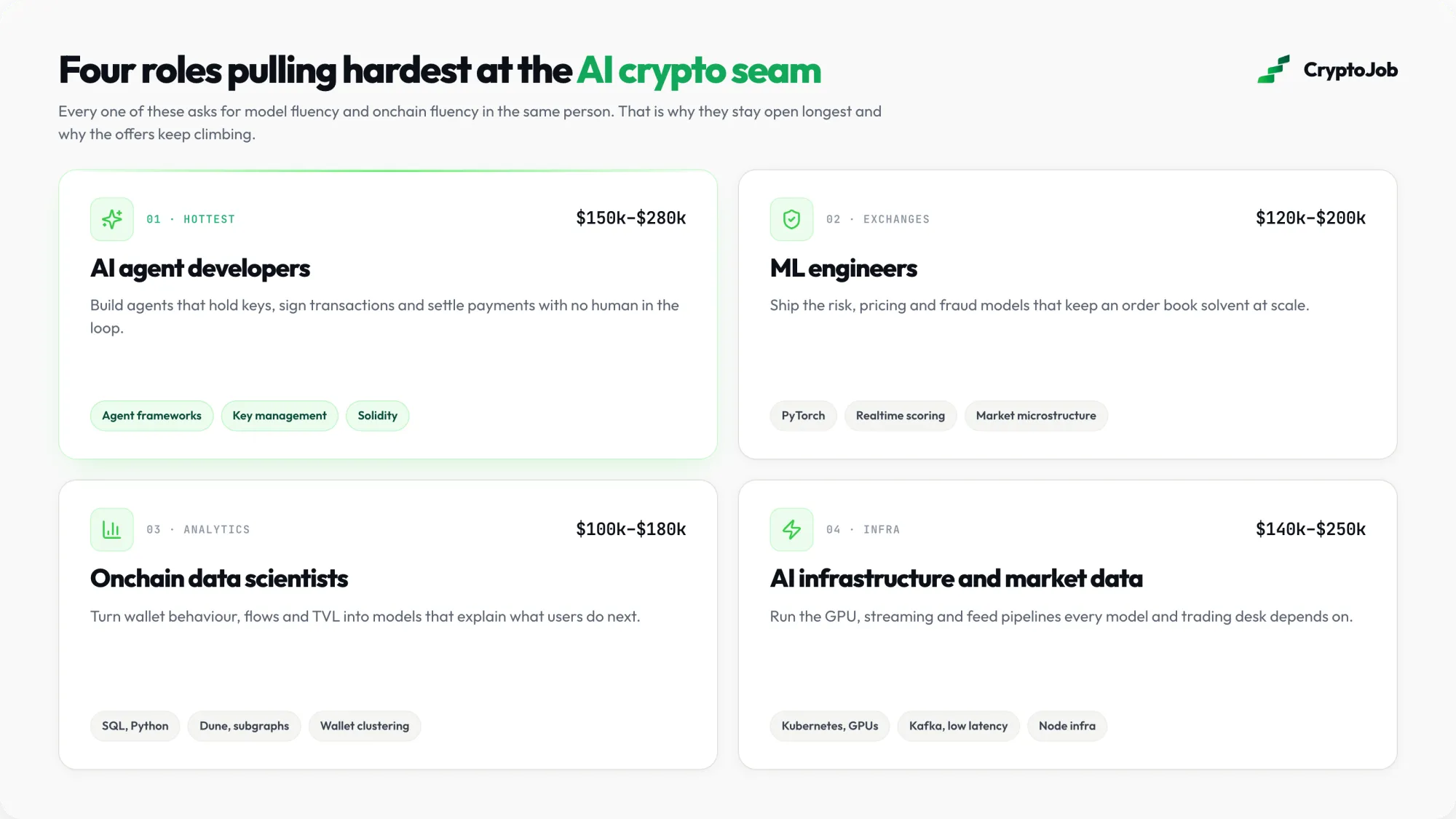
The machine learning blockchain roles in demand cluster around a few areas. Exchanges hire ML engineers for fraud detection, trading and recommendation systems at petabyte scale. Protocols and startups hire for AI agents, decentralized compute and AI-driven market data.
Several role families stand out right now:
- AI agent developers building autonomous on-chain agents.
- ML engineers at exchanges working on fraud, risk and personalization.
- On-chain data scientists turning blockchain data into models.
- AI infrastructure and market-data roles bridging AI firms and on-chain data.
What skills do AI crypto jobs require?
AI crypto jobs require a solid ML foundation plus enough blockchain literacy to apply it on-chain. The ML core is standard: Python, modern frameworks and real experience training and shipping models. What differentiates candidates is the ability to work with on-chain data and reason about how agents interact with smart contracts.
A competitive profile usually includes:
- ML fundamentals: Python, data pipelines, model training and deployment.
- On-chain data: comfort querying and interpreting blockchain datasets.
- Agent tooling: familiarity with how AI agents call contracts and APIs.
- Systems sense: working with large datasets and production infrastructure.
The strongest AI crypto candidates also communicate results to non-technical stakeholders and reason carefully about risk. Because models here can touch trading, fraud detection or user funds, a subtle error carries real cost, so teams value judgment as much as raw modeling skill. Familiarity with how on-chain data is structured and its quirks, like reorgs and pseudonymous addresses, separates people who have actually worked with blockchain data from those who have only read about it. A portfolio that pairs a working model with a clear explanation of what it does and why is far more persuasive than a list of frameworks.
Where are AI crypto jobs and how do you get hired?
AI crypto jobs concentrate at major exchanges, market-data and infrastructure firms and AI-native web3 startups. Companies like Binance, Crypto.com, Galaxy and Ripple hire across ML and data, while a growing set of startups build agent protocols and decentralized compute. Most roles are remote-friendly.
To get hired, pair ML proof with on-chain output: a model, an agent demo or an on-chain dashboard beats a generic CV. Hiring here is portfolio-first, so shipped work carries the most weight. For the broader market context, our blockchain developer jobs guide and the highest-paying web3 jobs show where AI roles sit. When you're ready, browse web3 jobs and filter for AI and data roles.
Which companies hire for AI crypto jobs?
AI crypto hiring spans exchanges, market-data firms and AI-native startups. Large exchanges like Binance, Crypto.com and Galaxy hire machine learning engineers for fraud, trading and personalization at scale. Market-data and infrastructure teams, including groups like Douro Labs behind Pyth, hire for AI and automation and Ripple has added AI-focused roles across treasury and operations.
Alongside the incumbents, a wave of AI-native web3 startups is building agent protocols and decentralized compute on top of recent funding. These teams are often where the newest and best-paid agentic-AI roles appear. Because the field moves quickly, following the companies raising in this space is a practical way to spot roles early.
What does the future of AI crypto jobs look like?
The trajectory points toward more roles, not fewer, as AI fluency becomes a baseline expectation across web3 engineering. Agentic AI is the clearest growth vector, with autonomous on-chain agents moving from experiments into production systems. Decentralized compute and AI-driven market data are close behind.
For candidates, the implication is straightforward: the combination of real ML skill and on-chain understanding is likely to stay scarce and well-paid. Building at that intersection now is a strong long-term bet.
Frequently asked questions
Can you get an AI crypto job without blockchain experience?
Often yes. Strong ML or data engineering skills transfer well, and many teams will train blockchain specifics. Showing even one on-chain project: a model, agent or dashboard, dramatically improves your odds.
What is agentic AI in crypto?
Agentic AI refers to autonomous agents that can make decisions and execute transactions on-chain without constant human oversight. In web3 they're used for automated governance, trading and interacting with protocols and they're the fastest-growing AI niche in the sector.
Do AI crypto jobs pay more than regular AI jobs?
Sometimes, especially for specialists who bridge AI and on-chain systems, where scarcity drives a premium. General ML roles in crypto pay competitively but not dramatically above the wider AI market. Token grants can change the total-comp picture.
What background is best for AI crypto jobs?
A machine learning, data science or software engineering background is the most common entry point. Adding on-chain data fluency and a portfolio project is what converts a general AI profile into a crypto-ready one.
Are AI crypto jobs remote?
Mostly yes. Exchanges, protocols and AI-native startups largely hire remote-first, with some onsite roles at specific hubs. Location tends to affect pay more than availability.
The bottom line
AI crypto jobs are among the fastest-growing and best-paid roles in web3, with ML engineers earning $120k to $200k and AI-plus-web3 specialists reaching $280k. The winning move is to combine ML skill with on-chain output and specialize toward agentic AI. When you're ready, browse web3 jobs and target the AI and data roles that fit your background.