Crypto Quant & Trading Jobs: The Highest-Paying Path in Web3
What crypto quant and trading jobs pay in 2026, the Python and C++ skills that matter and how to break into the highest-ceiling path in web3.

TLDR: Crypto quant jobs pay roughly $100k to $180k for quant developers and $180k to $300k+ for quant researchers., Trading roles add large PnL-linked bonuses on top of base, lifting total comp well beyond salary., MEV research runs about $160k to $280k; elite firms pay the most.: The core stack is Python and C++, low-latency systems and derivatives knowledge.
Crypto quant jobs are the highest-ceiling roles in web3, because compensation is tied to trading performance rather than a fixed band. Quant developers typically earn $100k to $180k in base, quant researchers reach $300k or more and traders layer significant PnL-linked upside on top. Demand comes from crypto-native trading firms, market makers and institutional players moving into digital assets.
This is a rigorous, math-heavy path that rewards a specific skill set. If you have quantitative and low-latency engineering chops, few roles pay better. To see what's live, you can browse web3 jobs as you read.
What do crypto quant jobs involve?
Crypto quant jobs apply quantitative models and statistical analysis to trading digital assets. That means designing and testing trading strategies, building low-latency execution systems and managing risk across volatile markets. The work sits at the intersection of finance, mathematics and high-performance engineering.
Day to day, quants develop and backtest strategies, model derivatives like perpetual futures and options and optimize market-making algorithms. Because these systems trade real capital in fast markets, correctness and speed are everything. Many roles also involve analyzing on-chain data to find edges that traditional markets don't have.
What are the main quantitative crypto roles?
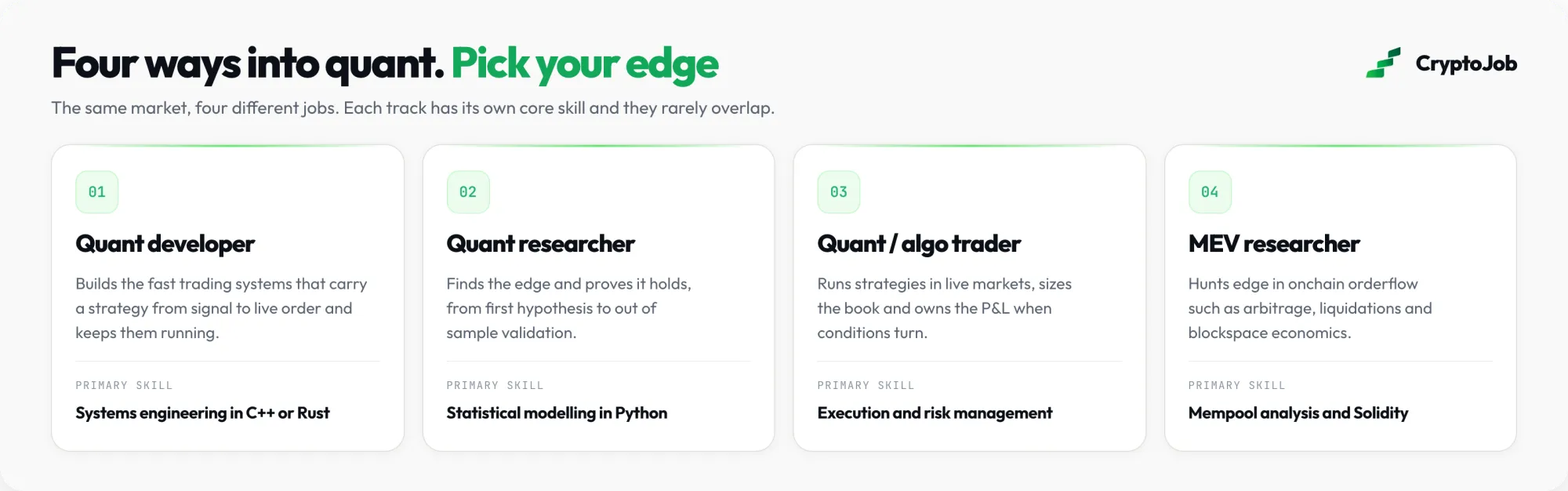
The main quantitative crypto roles split into a few distinct tracks, each with a different balance of research, engineering and trading. Quant developers build the systems; quant researchers design the strategies; quant traders run and refine them in live markets. A fourth track, MEV research, is unique to crypto.
The core roles look like this:
- Quant developer: builds low-latency trading and market-making systems.
- Quant researcher: designs and backtests strategies using statistics and ML.
- Quant/algo trader: runs strategies in live markets and manages risk.
- MEV researcher: finds and captures on-chain extraction opportunities.
What is the average quant developer salary in 2026?
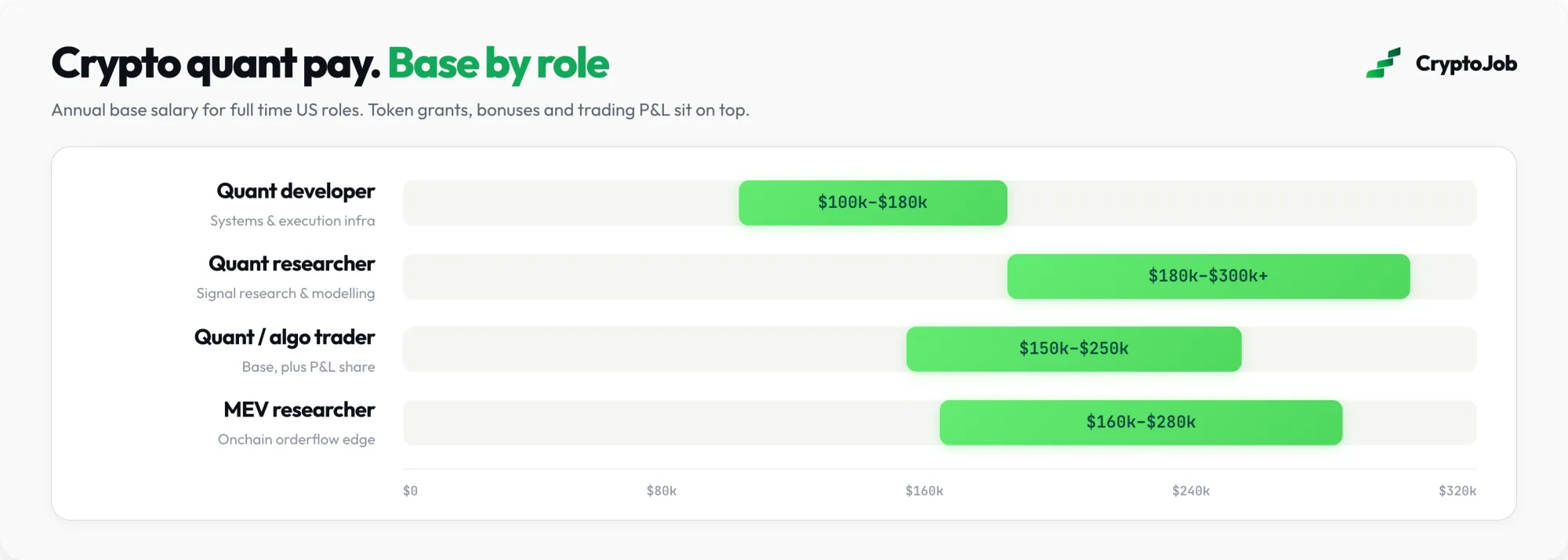
The average quant developer salary depends heavily on the firm and how much of comp is performance-linked. Base pay for developers generally runs $100,000 to $180,000, while researchers at elite firms reach far higher. Global self-reported averages look lower because they blend in juniors and lower-cost regions, but crypto-native trading roles at serious firms pay well.
Here's a realistic breakdown by role. Treat base ranges as US figures, and remember trading roles carry large variable comp on top.
| Role | Typical base (US) | Notes |
|---|---|---|
| Quant developer | $100k to $180k | Python/C++, low-latency systems |
| Quant researcher | $180k to $300k+ | Strategy design; elite firms higher |
| Quant / algo trader | $150k to $250k + PnL | Large variable/bonus upside |
| MEV researcher | $160k to $280k | On-chain extraction strategies |
What do entry-level quant crypto roles pay?
Entry-level quant developer and analyst roles generally start around $100,000 to $150,000, often with a strong CS or math background required. Many firms recruit new grads with Python and C++ skills and coursework in statistics. The variable component grows quickly as you prove you can contribute to live strategies.
What do senior and elite roles pay?
Senior quant researchers and traders at top firms earn $250,000 to $400,000 or more in base and total comp can be a large multiple of that when trading performance is strong. Elite market makers and prop firms treat PnL as the primary lever, so the ceiling is effectively performance-bound. These are among the best-compensated roles anywhere in tech or finance.
How do crypto trading jobs differ from quant roles?
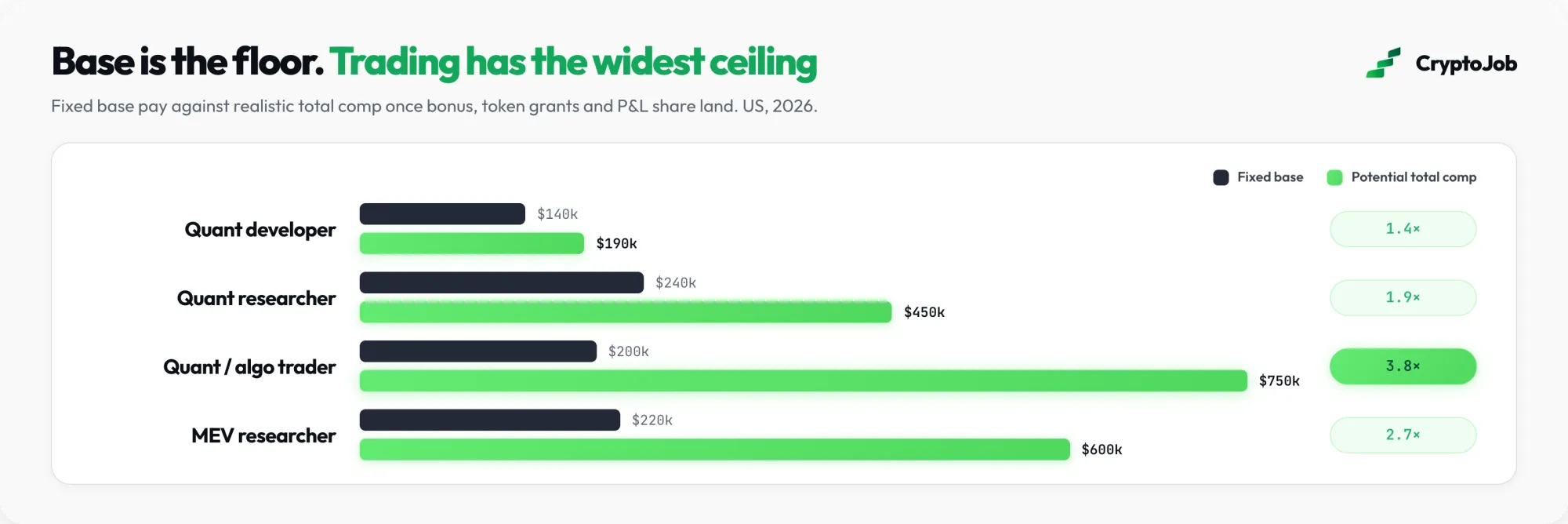
Crypto trading jobs overlap with quant roles but emphasize live decision-making and risk over pure model-building. A trader owns a book, executes strategies and manages exposure in real time, while a quant researcher focuses on designing the strategies behind them. In practice the lines blur, especially at smaller crypto-native firms where people wear multiple hats.
The compensation structure is the biggest practical difference. Trading roles lean heavily on PnL-linked bonuses, so a strong year can dwarf base salary, while a weak one means little variable pay. That risk-reward profile is very different from a salaried engineering role and suits people comfortable with performance pressure.
Which firms hire for crypto quant jobs?
Crypto quant jobs concentrate at specialist trading firms, market makers and increasingly at traditional quant giants moving into digital assets. Crypto-native names include Jump Crypto, Wintermute, Kronos Research and Flow Traders, alongside desks at exchanges and funds like Galaxy. Traditional powerhouses such as Citadel Securities also run crypto trading strategies.
These firms hire globally, often with hubs in financial centers and remote options for engineering roles. Because the work is high-stakes, interview processes are rigorous and heavily focused on quantitative and coding ability. Contributing public research or building your own trading tools is a strong way to stand out.
What skills do crypto quant jobs require?
Crypto quant jobs require a rare mix of quantitative depth and high-performance engineering. On the engineering side, that means strong Python and C++ and experience building low-latency systems. On the quant side, it means financial mathematics, statistics and a solid grasp of derivatives.
A competitive profile usually includes:
- Programming: Python and C++ in Linux, plus systems performance skills.
- Quantitative foundations: statistics, probability and derivatives pricing.
- Market knowledge: perpetual futures, options and market-making mechanics.
- Data and ML: backtesting, statistical modeling and on-chain data analysis.
How do you break into crypto quant jobs?
Breaking into crypto quant jobs is demanding but well-defined. The strongest candidates combine a quantitative degree or equivalent self-study with real coding ability and a demonstrable interest in markets. Building your own backtesting framework or trading bot is a concrete way to show both skills at once.
From there, deepen your derivatives and market knowledge and consider that crypto's on-chain data offers edges traditional quants can't access. For broader context on where these roles sit, our blockchain developer jobs guide and the highest-paying web3 jobs are useful and AI crypto jobs overlap heavily with quant research. When you're ready, browse web3 jobs and filter for quant and trading roles.
What does the crypto quant career path look like?
The crypto quant career path typically begins in a developer or junior researcher seat and moves toward owning strategies and, eventually, a trading book or a research team. Developers can deepen into low-latency systems or pivot toward research, while researchers graduate from testing existing ideas to designing their own. Traders progress by taking on larger books and more risk responsibility.
What sets crypto quant apart is how directly performance drives advancement. Because so much of compensation is tied to trading results, the biggest jumps come from strategies that actually make money rather than from tenure. That dynamic rewards people who can generate and validate a genuine edge, which is why elite firms compete so aggressively for proven researchers and traders.
A common and lucrative branch is toward founding or joining a small proprietary trading team, where the upside is highest. The trade-off is real risk and less stability, so it suits people comfortable operating without a salaried safety net. Either way, the through-line is the same: results compound faster here than in almost any salaried role.
Frequently asked questions
Do you need a finance degree for crypto quant jobs?
Not necessarily, but strong quantitative training helps enormously. Many quants have degrees in math, physics, CS or engineering and self-taught candidates who can demonstrate real modeling and coding skill are also hired. Proof of ability matters more than the specific degree.
Are crypto quant jobs higher-paying than developer roles?
Often yes, especially trading roles where PnL-linked bonuses can dwarf base salary. Base pay is competitive with senior engineering, but the variable upside is what makes quant and trading the highest-ceiling path. That upside also carries more year-to-year variability.
What programming languages do crypto quants use?
Python and C++ are the core, with Python for research and strategy and C++ for low-latency execution. Familiarity with Linux environments and, increasingly, on-chain data tooling is a strong plus.
Are crypto quant jobs remote?
Engineering and research roles are often remote or hybrid, though some firms prefer on-site in financial hubs. Trading roles are more likely to require specific locations, partly for latency and partly for team coordination.
What is MEV in crypto trading?
MEV (maximal extractable value) refers to value that can be captured by ordering, including or excluding transactions on-chain. MEV research is a crypto-specific quant specialization, and it's among the higher-paying niches in the sector.
The bottom line
Crypto quant and trading jobs are the highest-ceiling path in web3, pairing $100k to $300k+ base pay with performance-linked upside that can go much further. The winning move is to combine real quantitative skill with low-latency engineering and market knowledge. When you're ready, browse web3 jobs and target the quant and trading roles that fit your background.