Zero-Knowledge (ZK) Engineer Jobs: The New Crypto Frontier
What zero-knowledge engineer jobs pay in 2026, the frameworks that matter and how a systems programmer can break into the field.

TLDR: ZK engineer jobs pay roughly $140k to $193k entry, $200k to $255k mid and $255k to $320k senior, with staff roles past $350k., Around 90% of roles are remote and supply is the hard constraint., Core stacks include Circom, Halo2, Cairo, Noir and zkVMs like RISC Zero and SP1., Teams like Matter Labs, StarkWare, Polygon and Scroll hire aggressively.
Zero-knowledge engineer jobs are the highest-paid and rarest engineering roles in crypto, sitting where deep cryptography meets shipping-grade software. Pay ranges from around $140k at entry to $350k-plus for staff and research roles, and roughly 90% of positions are remote. The bottleneck is talent supply, not demand.
Very few engineers combine cryptographic depth with production software skill, so this is a field where systems programmers can command a premium fast. To see what's live, you can browse web3 jobs as you read.
What do ZK engineer jobs involve?
ZK engineer jobs center on building zero-knowledge proof systems: the cryptography that lets one party prove something is true without revealing the underlying data. In practice that means writing and optimizing ZK circuits, working on proving systems and building the rollups and privacy protocols that depend on them. The work blends advanced math with performance engineering.
Day to day, ZK engineers implement circuits, optimize prover performance and integrate proofs into on-chain systems. Because the field is young and the math is hard, roles reward people who can both understand cryptography and ship reliable code. Many positions overlap with protocol and systems work.
Why are zero-knowledge proof jobs in such high demand?
Zero-knowledge proof jobs exploded once the Ethereum ecosystem committed to ZK rollups as a primary scaling strategy. Teams building zkEVMs and rollups, zkSync, StarkNet, Polygon, Scroll, Linea and many application-specific protocols, raised significant funding and now hire aggressively. Beyond scaling, ZK identity, ZK machine learning and privacy protocols add even more demand.
The constraint is supply. Universities produce very few engineers with both cryptographic depth and production software skill, and the on-the-job ramp is long. That imbalance is exactly why compensation sits at the top of the market.
What is the average ZK developer salary in 2026?
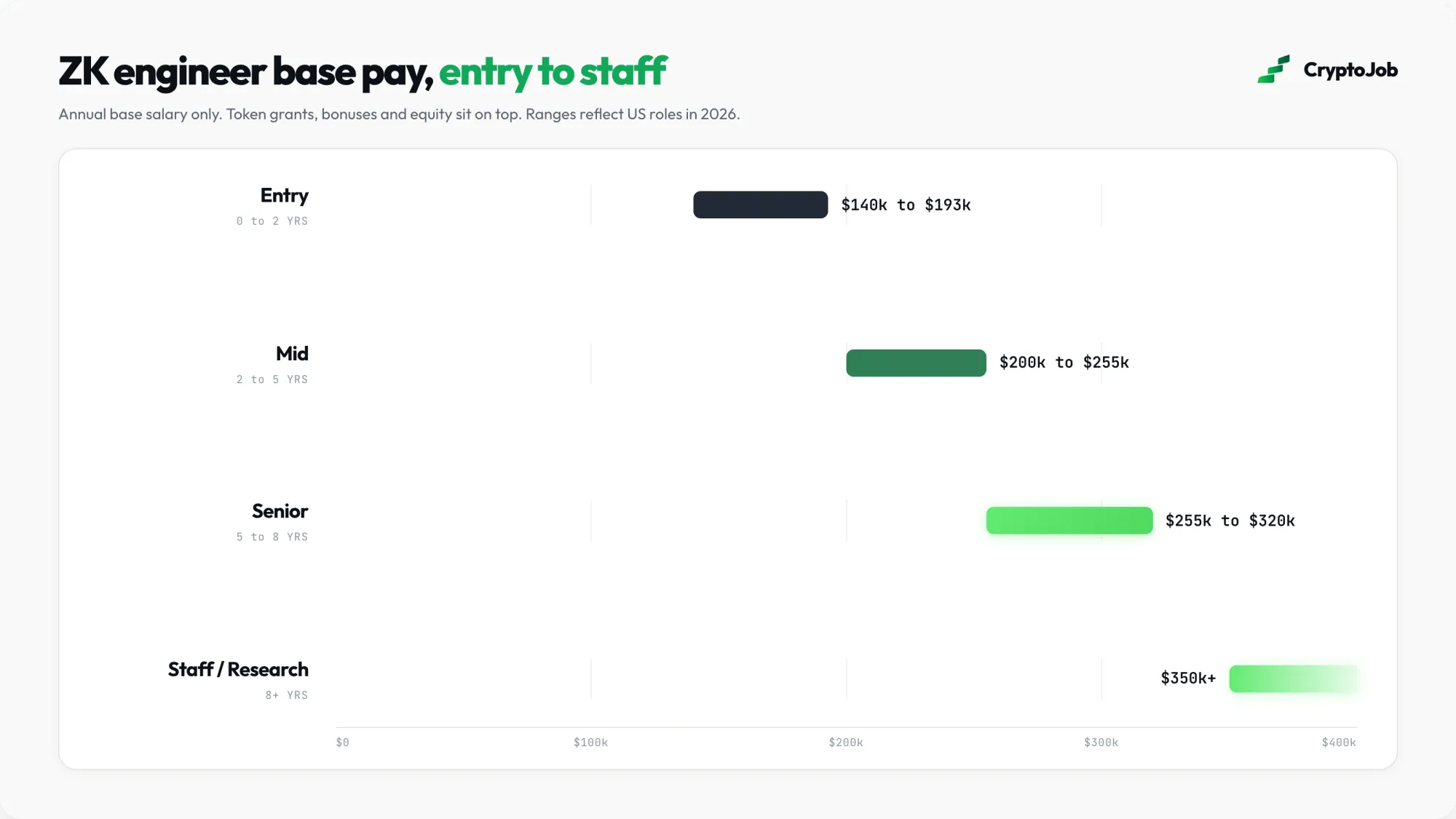
The average ZK developer salary is the highest among crypto engineering specializations, reflecting extreme scarcity. Entry roles already pay what senior roles pay in many other fields, and progression is steep. Overall, the market runs from roughly $140,000 to $350,000 or more.
Here's a realistic breakdown by seniority. Treat these as US base ranges that move with equity, location and specialization.
| Level | Experience | Base (US) | What sets the band |
|---|---|---|---|
| Entry | 0 to 2 yrs | $140k to $193k | ZK circuits, strong math foundation |
| Mid | 4 to 6 yrs | $200k to $255k | Proving-system and optimization work |
| Senior | 7 to 10 yrs | $255k to $320k | Protocol and performance leadership |
| Staff / research | 10+ yrs | $350k+ | Rare, top of the market |
What do entry-level ZK roles pay?
Entry-level ZK roles typically pay $140,000 to $193,000 in base, with equity and bonuses pushing total comp higher in top markets like San Francisco and New York. Some early-career tracks start lower, closer to $100,000 to $130,000 in the first year, before rising quickly. Even at entry, the pay reflects how few people can do the work.
What do senior and staff roles pay?
Senior ZK engineers generally earn $255,000 to $320,000 in base and staff or research-level cryptographers exceed $350,000. These roles own proving-system design, performance at scale and the hardest cryptographic problems. Token grants at earlier-stage protocols can add substantially on top.
What does a cryptography engineer in crypto actually build?
A cryptography engineer in crypto builds the primitives and systems that make protocols secure and private. In the ZK world that means proof systems, circuits and the zkVMs that verify arbitrary programs. Elsewhere it can mean consensus cryptography, signature schemes and formal verification.
The common thread is rigor: this is code where a subtle error can break security for an entire network. Cryptography engineers work closely with protocol and security teams, and several audit firms and research labs hire ZK specialists at premium rates. It's among the most intellectually demanding work in the sector.
What skills do ZK engineer jobs require?
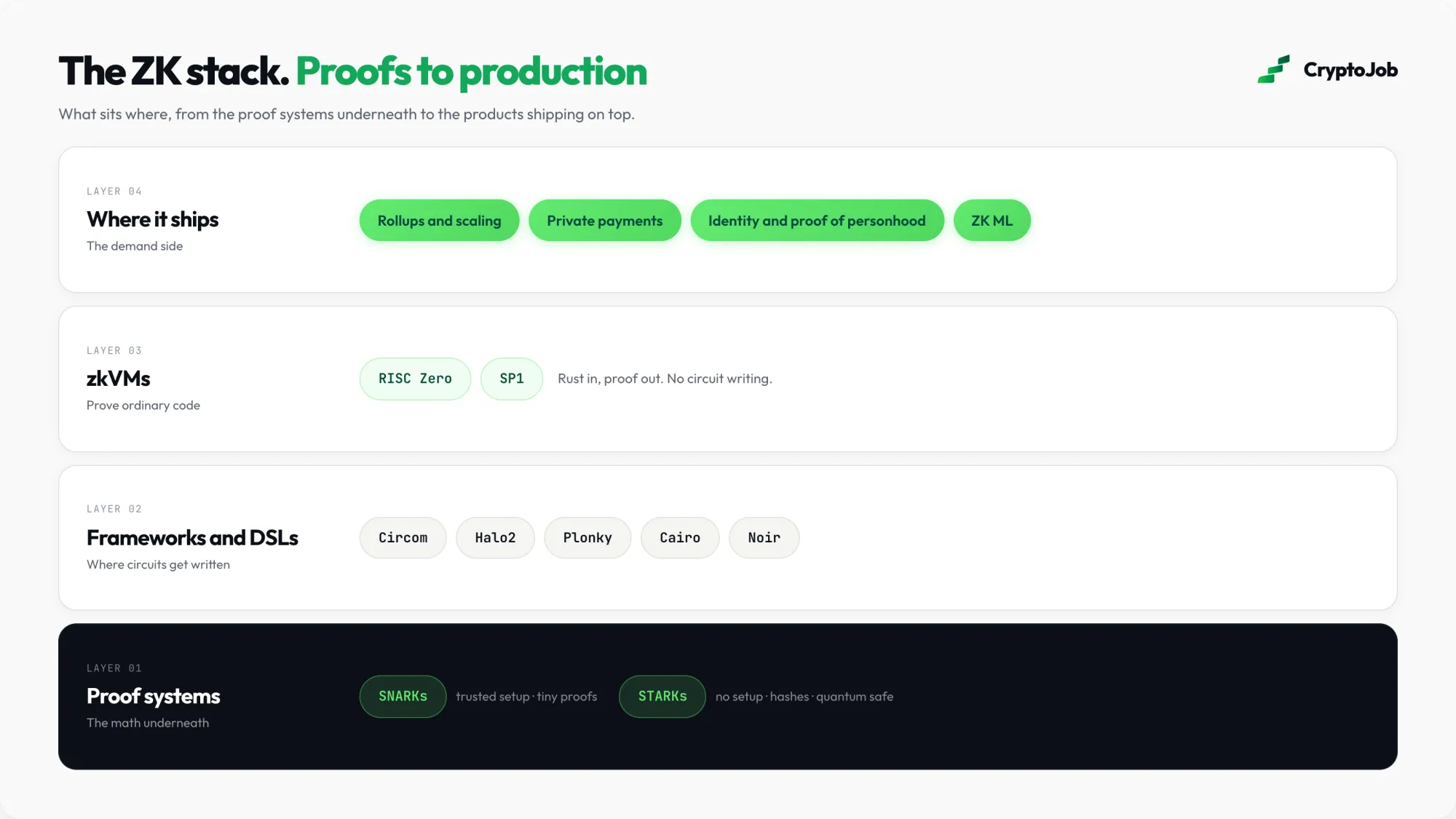
ZK engineer jobs require a rare combination of math and systems skill. On the cryptography side, you need to understand SNARKs and STARKs and the math beneath them. On the engineering side, you need production experience and a systems background in Rust, Go or C++ transfers especially well.
A competitive profile usually includes:
- Cryptography fundamentals: SNARKs, STARKs and the underlying math.
- ZK frameworks: Circom and snarkjs, Halo2, Plonky, Cairo or Noir.
- zkVMs: familiarity with systems like RISC Zero or SP1.
- Systems programming: strong Rust, Go or C++ and performance tuning.
One thing that trips up newcomers is underestimating the performance side of the work. Writing a circuit that produces a correct proof is only half the job; making that proof fast and cheap enough to run in production is where much of the real engineering happens. Prover performance, memory usage and proof size all matter and teams often hire specifically for people who can optimize them. That's also good news for systems programmers, whose instincts for performance transfer directly, even before they have a deep cryptography background. Framing your learning around optimization rather than pure theory tends to make you employable faster.
How do you break into ZK engineer jobs?
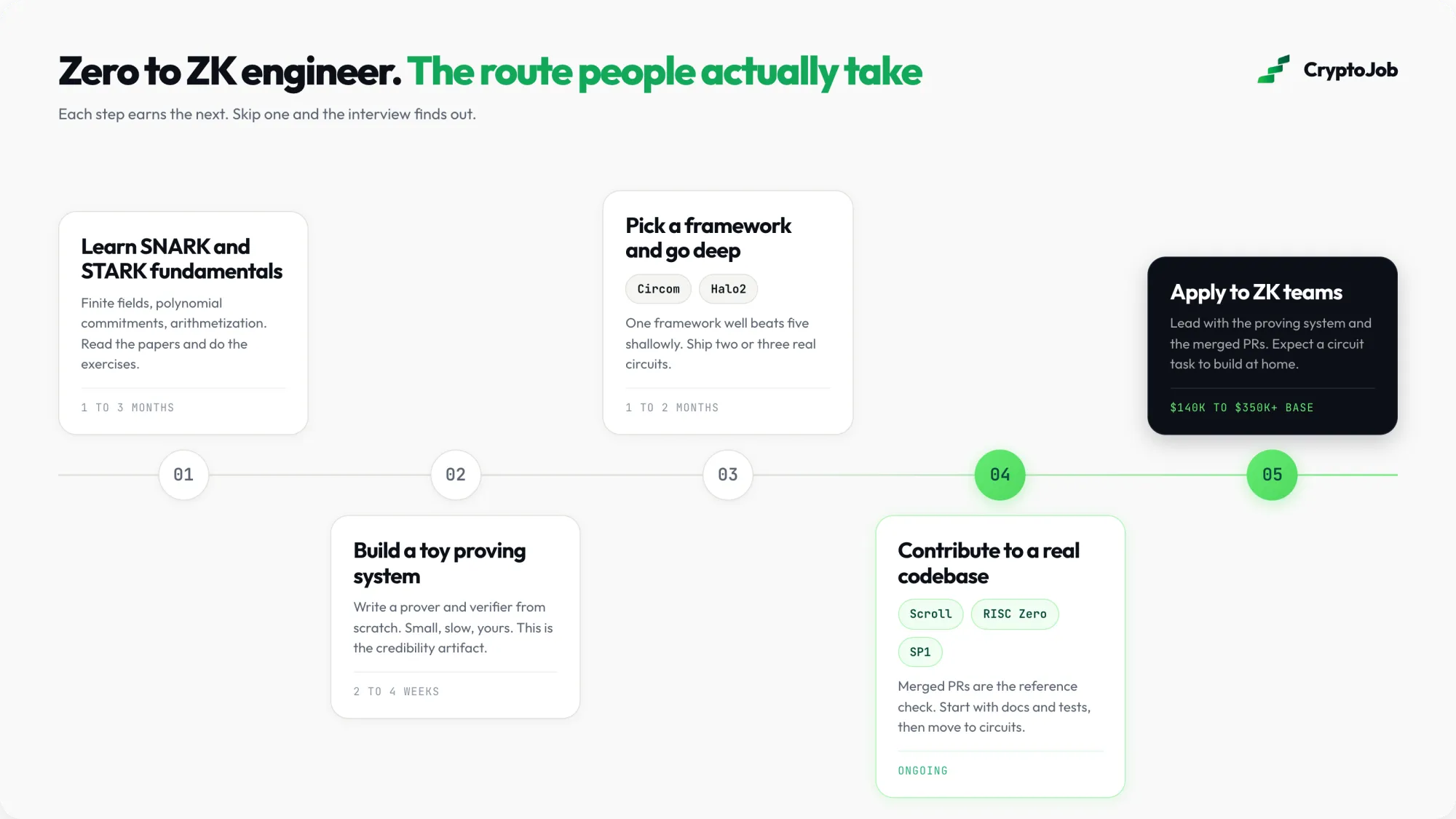
Breaking into ZK engineer jobs is hard but very learnable for a strong systems programmer. The path runs through the math first: work through the standard SNARK and STARK resources, then implement a simple proving system from scratch so you understand every component. That single project teaches more than any course.
From there, pick one framework and go deep, then contribute to open-source ZK projects like Scroll, RISC Zero or SP1, performance optimizations are a natural entry point where systems skills apply directly. Because the field parallels other high-end engineering, our guides to Rust developer jobs in crypto and the highest-paying web3 jobs are useful context. When you're ready, browse web3 jobs and filter for ZK and cryptography roles.
What does the ZK engineer career path look like?
Most ZK engineers start on circuit implementation and testing, then move into proving-system and performance optimization as they build depth. Senior roles own protocol design and the hardest performance problems, while staff and research positions push the cryptography itself forward. Each step is gated more by demonstrated ability than by years served.
A common branch is toward broader protocol or security work, where the same rigor applies. Audit firms and research labs also hire ZK specialists, offering a path that blends cryptography with security review.
Is ZK engineering worth it if you're not a cryptographer?
Yes, and many working ZK engineers did not start as cryptographers. A strong systems background in Rust, Go or C++ transfers well and the math can be learned through structured self-study and open-source work. The scarcity that makes these roles hard to fill is exactly what makes the effort worthwhile.
The realistic expectation is a steeper ramp than most specialties, measured in months of focused learning. For engineers who enjoy hard problems, few paths in crypto pay as well or stay as defensible.
Frequently asked questions
Do you need a PhD to get a ZK engineer job?
No, though a strong math background helps. Many ZK engineers come from systems programming and learn the cryptography through self-study and open-source work. Demonstrated ability: a proving system you built, contributions to a ZK repo, matters more than a degree.
What's the fastest way to learn ZK?
Learn the SNARK and STARK fundamentals, then implement a simple proving system yourself to force real understanding. After that, pick one framework such as Circom or Halo2 and contribute to an open-source project.
Which companies hire ZK engineers?
Matter Labs (zkSync), StarkWare (StarkNet), Polygon, Scroll, Linea and Axiom are among the most active, along with privacy protocols, ZK-ML teams and audit firms. Many are well-funded and hire globally.
Are ZK engineer jobs remote?
Overwhelmingly yes, around 90% of roles offer remote work. A few teams prefer in-person in specific hubs, but remote is the norm given how globally distributed the talent is.
Is ZK a good long-term career bet?
It's one of the strongest technical bets in crypto right now, given the ZK-rollup scaling roadmap and expanding uses in identity, privacy and ZK machine learning. Supply is likely to stay tight for years, which supports continued premium pay.
The bottom line
ZK engineer jobs are the highest-paid, most supply-constrained roles in crypto, running from around $140,000 at entry to well past $350,000 at the top. A strong systems programmer who learns the cryptography and ships open-source ZK work can move fast. When you're ready, browse web3 jobs and target the ZK and cryptography roles that fit your background.