Rust Developer Jobs in Crypto: Solana, Polkadot and Beyond
What Rust developer jobs in crypto pay across Solana and Polkadot in 2026, the skills that matter and how to break in.

TLDR: Rust developer jobs in crypto pay a median near $185k to $204k, with a typical range of $174k to $234k and top roles to $320k., Entry dApp work starts around $80k to $120k; Substrate and ink! experience pushes offers above $200k., Solana posted a ~40% year-over-year jump in Rust openings., Supply is the bottleneck, safe, performant Rust is scarce, so it carries a premium.
Rust developer jobs in crypto are some of the highest-paid engineering roles in web3, largely because so few people write safe, performant Rust for a live chain. Real crypto-native roles cluster around a $185k to $204k median, with entry dApp work lower and protocol roles reaching $320k. Solana, Polkadot, Sui, Aptos and Cosmos all run on Rust, so demand spans the whole ecosystem.
The catch is scarcity on the supply side, not the demand side. If you can prove production Rust with a shipped project, you're closer to these roles than you think. If you want to see what's live, you can browse web3 jobs as you read.
What do Rust developer jobs in crypto involve?
Rust developer jobs in crypto span several very different lanes. At the application tier, developers build dApps and integrations. At the program tier, they write on-chain logic: most visibly Solana programs via the Anchor framework. At the protocol tier, they build validator software, consensus, zkVMs and MEV or relayer infrastructure.
The unifying trait is that Rust is chosen for performance and memory safety, and the work is judged on both. Because a bug on-chain is public and irreversible, security discipline is part of the job rather than an afterthought. Many roles also touch cross-chain systems, so comfort spanning multiple runtimes helps.
What is the average Rust blockchain salary in 2026?
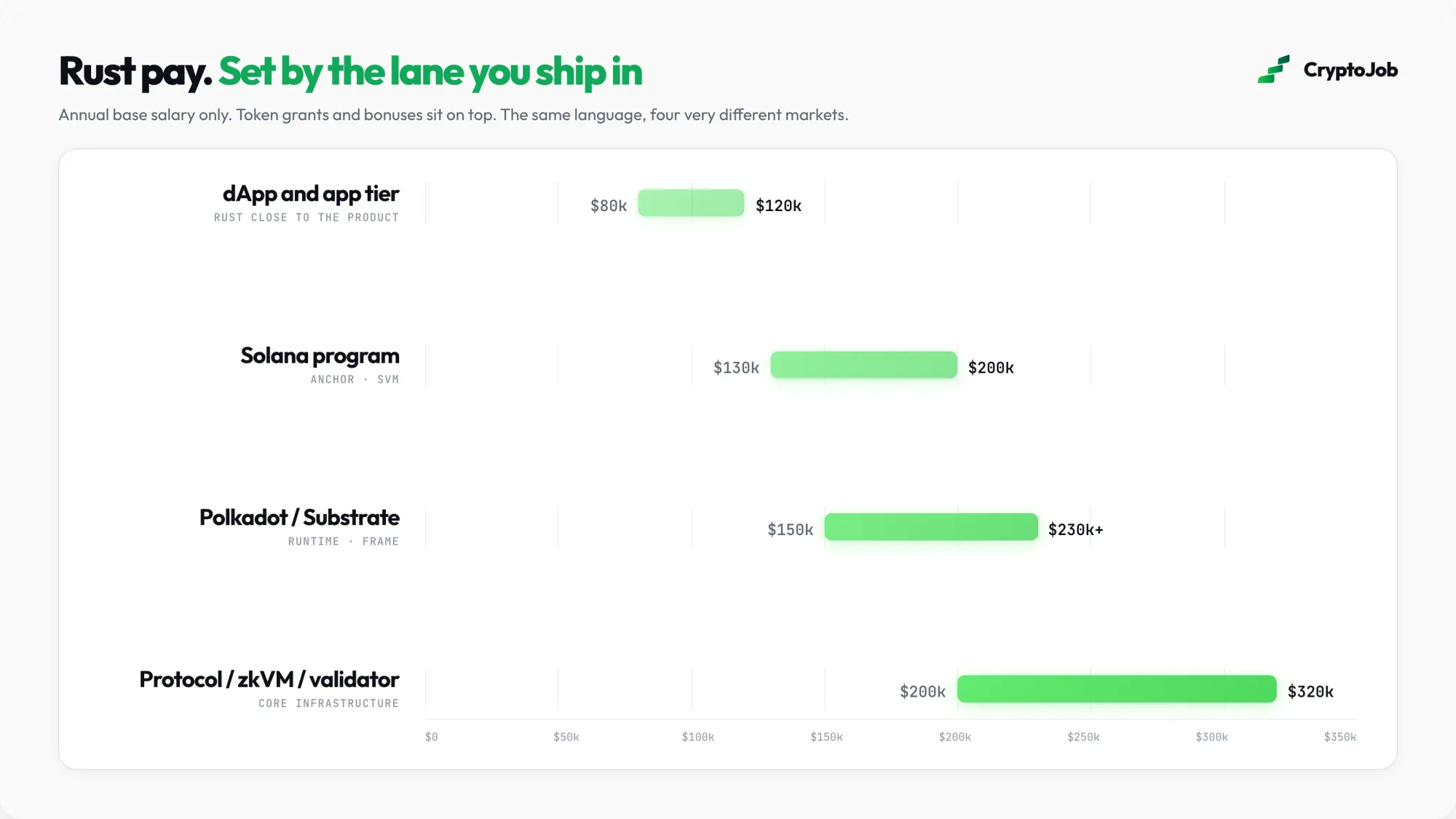
The average Rust blockchain salary depends heavily on whether you count crypto-native roles or blend in general startup data. Broad startup surveys land near $112k to $130k because they mix in juniors and lower-cost regions. Crypto-native job boards, filtering to real protocol and program roles, report medians closer to $185k to $204k.
Here's a realistic breakdown by role and chain. Treat these as US ranges that move with seniority, funding stage and token grants.
| Role / chain | Typical base (US) | What sets the band |
|---|---|---|
| dApp / app-tier (JS + Rust) | $80k to $120k | Entry, mostly Solana ecosystem |
| Solana program dev (Anchor) | $130k to $200k | Rust + Anchor, high demand |
| Polkadot / Substrate (ink!) | $150k to $230k+ | Substrate and ink! premium |
| Protocol / zkVM / validator | $200k to $320k | Rarest, best paid |
What do entry-level Rust crypto roles pay?
Entry-level Rust work in crypto generally starts around $80,000 to $120,000, usually at the dApp or application tier. Genuinely junior openings are limited, and most teams want a deployed program or a real open-source contribution first. The good news is that the ramp to mid-level pay is fast once you've shipped.
What do senior and protocol roles pay?
Senior program and protocol engineers typically earn $200,000 or more in base pay and specialized protocol, zkVM or validator work reaches $320,000 at the top. These numbers reflect how rare it is to write safe, performant Rust for core infrastructure. Token grants can add substantially on top, especially at earlier-stage protocols.
Where are the Solana Rust jobs?
Solana Rust jobs are the largest single pocket of demand, and the ecosystem has been growing fast: one board reported roughly a 40% year-over-year increase in Solana Rust openings. Most of these roles are program development using Anchor, alongside tooling and infrastructure work. The Solana Foundation, Anza and a wide field of DeFi and consumer teams hire continuously.
Because the qualified pool is small, contributors are often approached rather than having to apply cold. Our Solana developer jobs guide covers that ecosystem in depth, including the Anchor and SPL token skills these roles expect.
What about Polkadot and Substrate jobs?
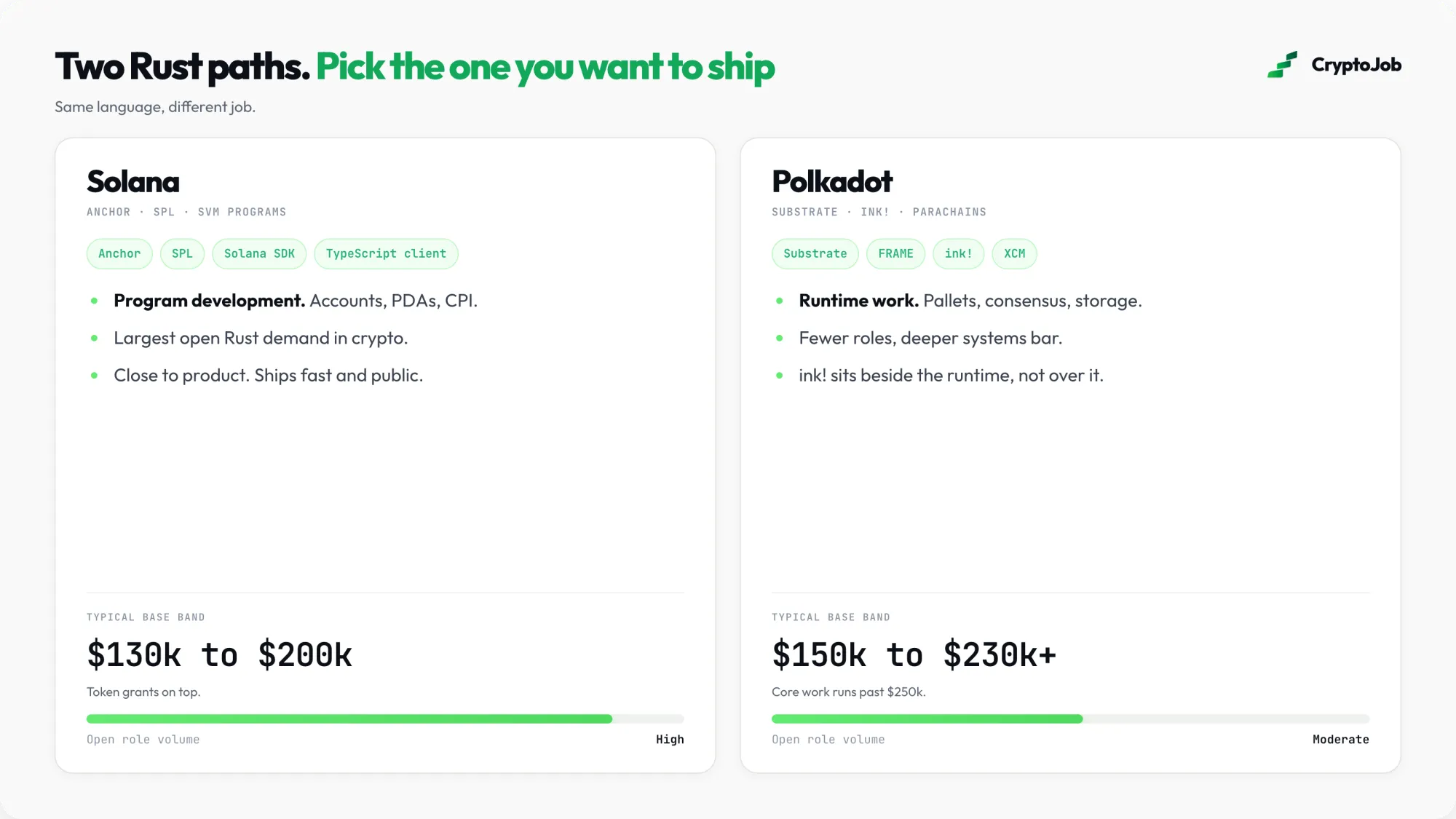
Polkadot and Substrate jobs are a smaller but well-paid corner of the Rust market. Substrate is the framework for building Polkadot parachains, and ink! is its smart-contract language and experience with either can push offers above $200,000. Demand also extends to Cosmos SDK, Sui, Aptos and Avalanche subnet work, all of which lean on Rust.
These roles tend to be deeper on distributed systems than typical dApp work. If you have systems programming or consensus experience, they're among the most durable and lucrative Rust paths in crypto.
What skills do Rust developer jobs in crypto require?
The core requirement is production-grade Rust, but the surrounding stack is what separates candidates. For Solana, that means Anchor, the Solana CLI and SDK and the SPL token standards. For Polkadot, it means Substrate and ink!, plus a solid grasp of parachain architecture.
Across all lanes, a competitive profile usually includes:
- Systems fundamentals: memory management, concurrency and performance tuning.
- Chain-specific tooling: Anchor (Solana) or Substrate and ink! (Polkadot).
- Security awareness: common exploit classes and testing discipline.
- Cross-chain literacy: comfort with both EVM and non-EVM designs.
Are Rust developer jobs in crypto in demand in 2026?
Yes, and the demand is structural rather than hype-driven. Rust underpins Solana, Polkadot and a growing list of high-performance chains and the pool of engineers who can write safe Rust for them is small. That imbalance is exactly why the language carries a premium over comparable roles.
The work is also remote-friendly, with global teams hiring across time zones. For a sense of where these roles sit against the broader market, see the highest-paying web3 jobs, where Rust and protocol work consistently rank near the top.
How do you get a Rust developer job in crypto?
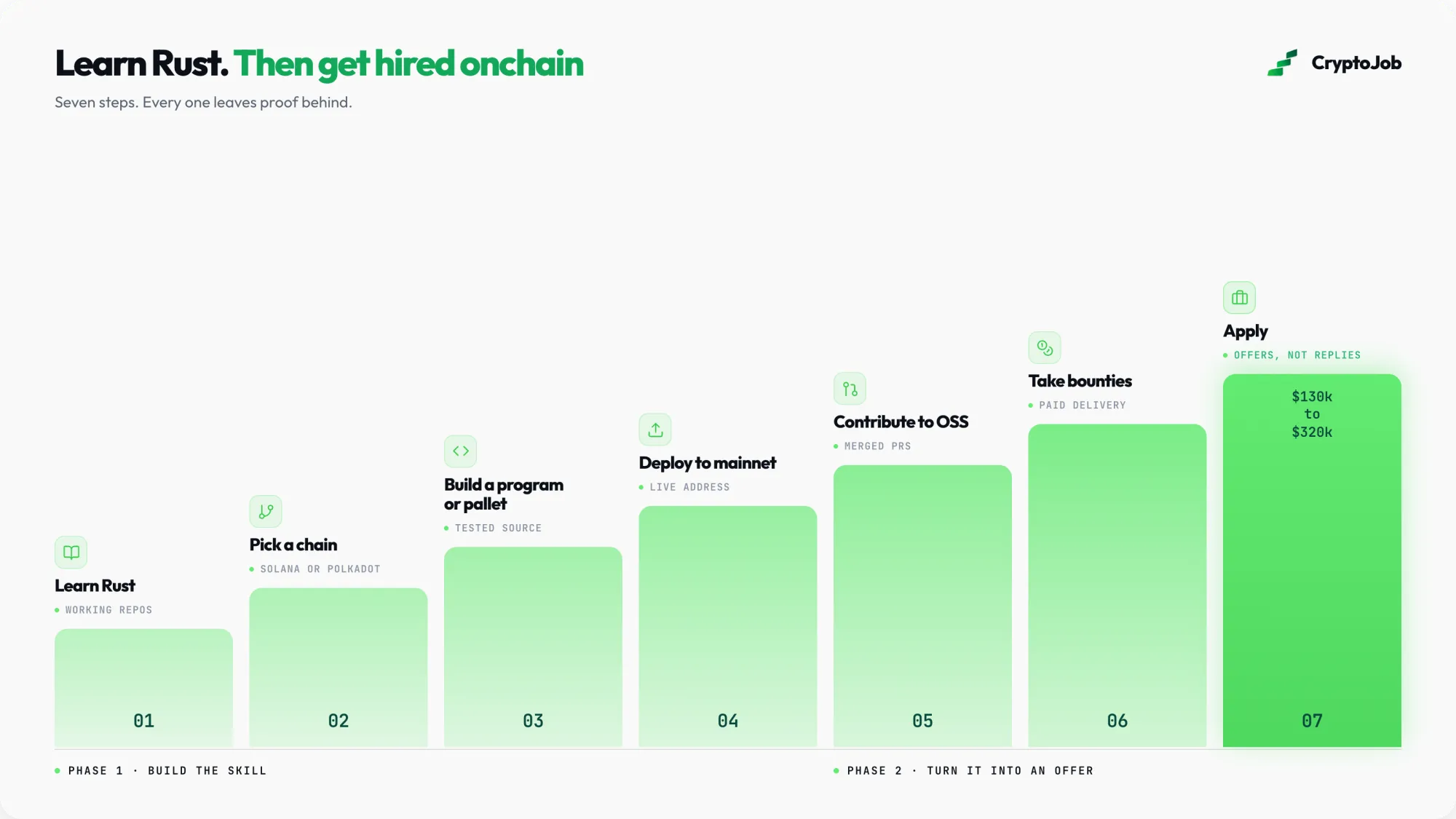
Getting a Rust developer job in crypto is a portfolio problem more than a credential problem. The fastest route is to learn Rust deeply, pick one ecosystem and ship something real: a Solana program, a Substrate pallet or a contribution to an open-source protocol. Public, working code is the strongest signal you can send.
From there, contribute to the repos maintained by the teams you want to join, since maintainers and hiring managers overlap heavily. Bounties and grants are a practical on-ramp that pay while you build reputation. When your work is ready, browse web3 jobs and filter for the chain and seniority that match it.
Which companies hire Rust developers in crypto?
Rust hiring in crypto spans core organizations, infrastructure teams and trading firms. On Solana, the Solana Foundation and Anza handle core work, while infrastructure providers like Helius and Jito hire for tooling and performance. Polkadot's ecosystem, zkSync's Matter Labs and other high-performance chains add steady demand.
Trading and market-making firms such as Jump Crypto and Wintermute also compete hard for Rust talent, often for latency-sensitive systems. Because the qualified pool is small, many teams recruit through open-source contributions and bounties rather than job posts alone. Contributing to the repos of the teams you want to join is one of the most effective ways in.
What does the Rust developer career path in crypto look like?
Most Rust developers in crypto start at the application or program tier, then move deeper into protocol, zkVM or validator work as they build a track record. Security and performance credibility drive the biggest pay jumps, since core infrastructure is where scarcity is highest. Leads and architects who own a chain's on-chain design sit at the top of the range.
A common and lucrative branch is toward zero-knowledge and protocol engineering, where Rust systems skills transfer directly. That path pairs naturally with the highest-paid specializations in the sector.
Frequently asked questions
Do you need blockchain experience to get a Rust job in crypto?
Not always. Many teams value strong Rust fundamentals and will train blockchain specifics, though familiarity with smart contracts or DeFi gives you an edge. A shipped project remains the best proof.
Is Rust or Solidity better paid in crypto?
They're close, with Rust often edging ahead on scarcity. Solidity has the deepest job market, while Rust carries a premium because fewer engineers write it safely for a chain.
How long does it take to learn Rust for crypto work?
For an experienced programmer, roughly four to eight months to job-ready with a deployed project. Rust's learning curve is steeper than most languages, so budget extra time if it's your first systems language.
Which chains use Rust?
Solana, Polkadot, NEAR, Sui, Aptos, Cosmos SDK and Avalanche subnets all use Rust, among others. Solana and Polkadot are the two largest sources of Rust roles.
Are Rust crypto jobs remote?
Mostly yes. The ecosystem is remote-first and global, though a few senior protocol roles are onsite in specific hubs. Location tends to affect pay more than availability.
The bottom line
Rust developer jobs in crypto reward scarcity: learn the language deeply, specialize in Solana or Polkadot and ship real work. Pay runs from around $80,000 at the dApp tier to $320,000 for protocol specialists, with tokens on top. When you're ready to move, browse web3 jobs and target the ecosystem that fits your portfolio.