450 Applications Per Opening: Inside Crypto's Most Competitive Job Market Ever
Postings fell while applicants multiplied. What the competition really looks like in 2026 and the tactics that still convert.

TL;DR
- Popular crypto roles now draw up to 450 applications per opening
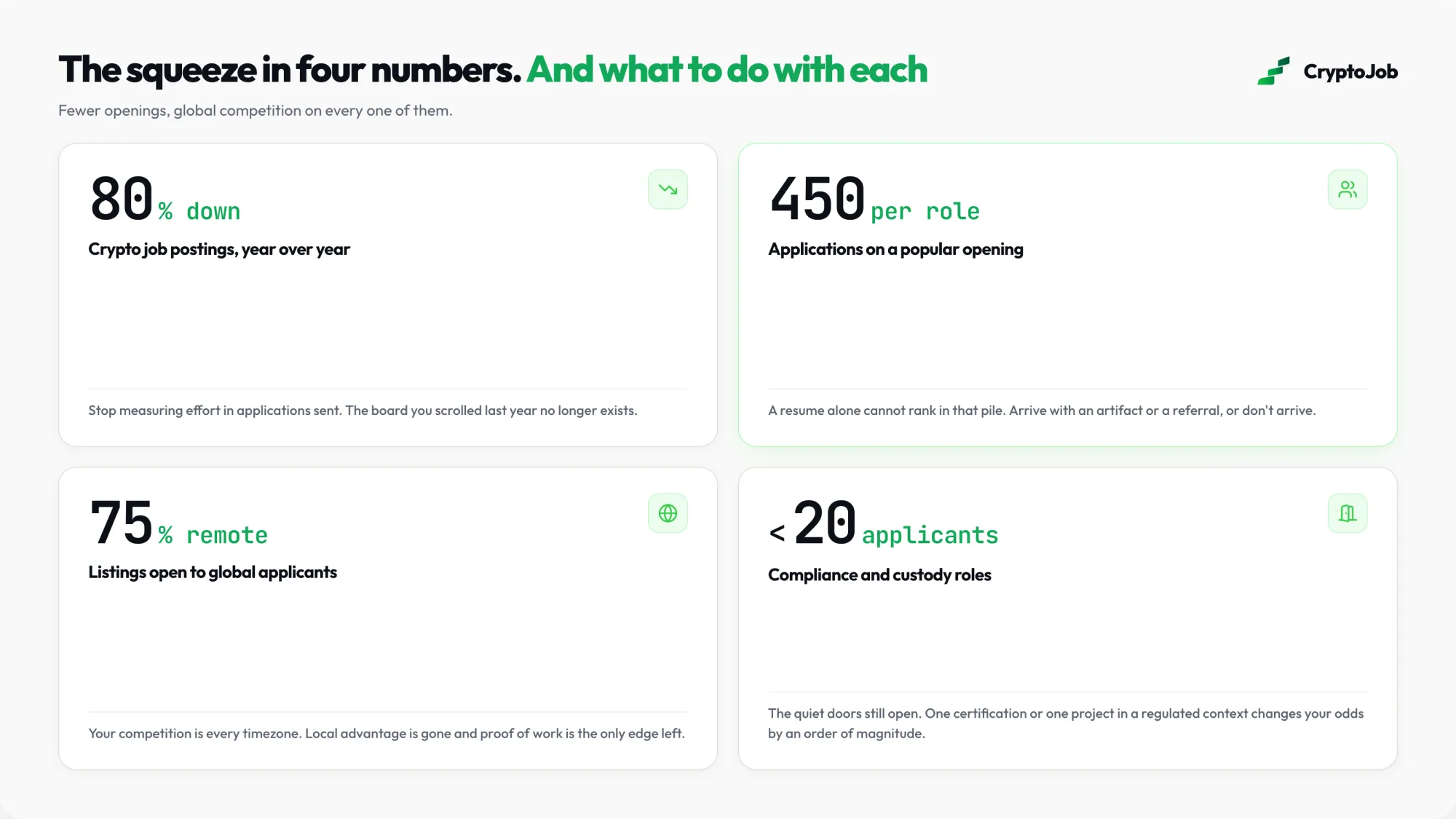
- New postings fell roughly 80 percent year over year into 2026
- Referrals and public proof of work beat cold applications decisively
- Competition is thinnest in compliance, custody and support niches
Crypto job applications hit an absurd milestone in 2026: recruiters report popular protocol and exchange roles drawing as many as 450 applications per opening, while industry trackers put new postings down roughly 80 percent year over year to only a handful per day early in the year. Fewer seats plus a global remote talent pool plus layoff waves equals the most competitive crypto job market on record. This piece explains exactly how the squeeze formed and the playbook that still converts.
The good news hides in the distribution: competition concentrates brutally on a few glamorous roles while entire functions stay winnable. Keep a live view open as you read by choosing to browse web3 jobs and sorting by recency rather than popularity.
What follows is deliberately blunt, because polite advice is losing to this market.
How did crypto job competition get this extreme?
Supply of seats collapsed first. After the 2024 to 2025 contraction, posting trackers recorded the drop to a fraction of prior volume, with some days in early 2026 averaging fewer than seven new listings across major boards.
Demand for seats then multiplied. Layoffs from exchanges and protocols returned experienced candidates to the pool, career switchers kept arriving from tech and finance and remote defaults mean a single posting now competes globally rather than locally, with roughly three quarters of web3 roles listed remote.
The arithmetic lands where recruiters say it does: hundreds of applicants converging on each visible role, with the famous names absorbing the worst of it.
Where do 450 applications actually pile up?
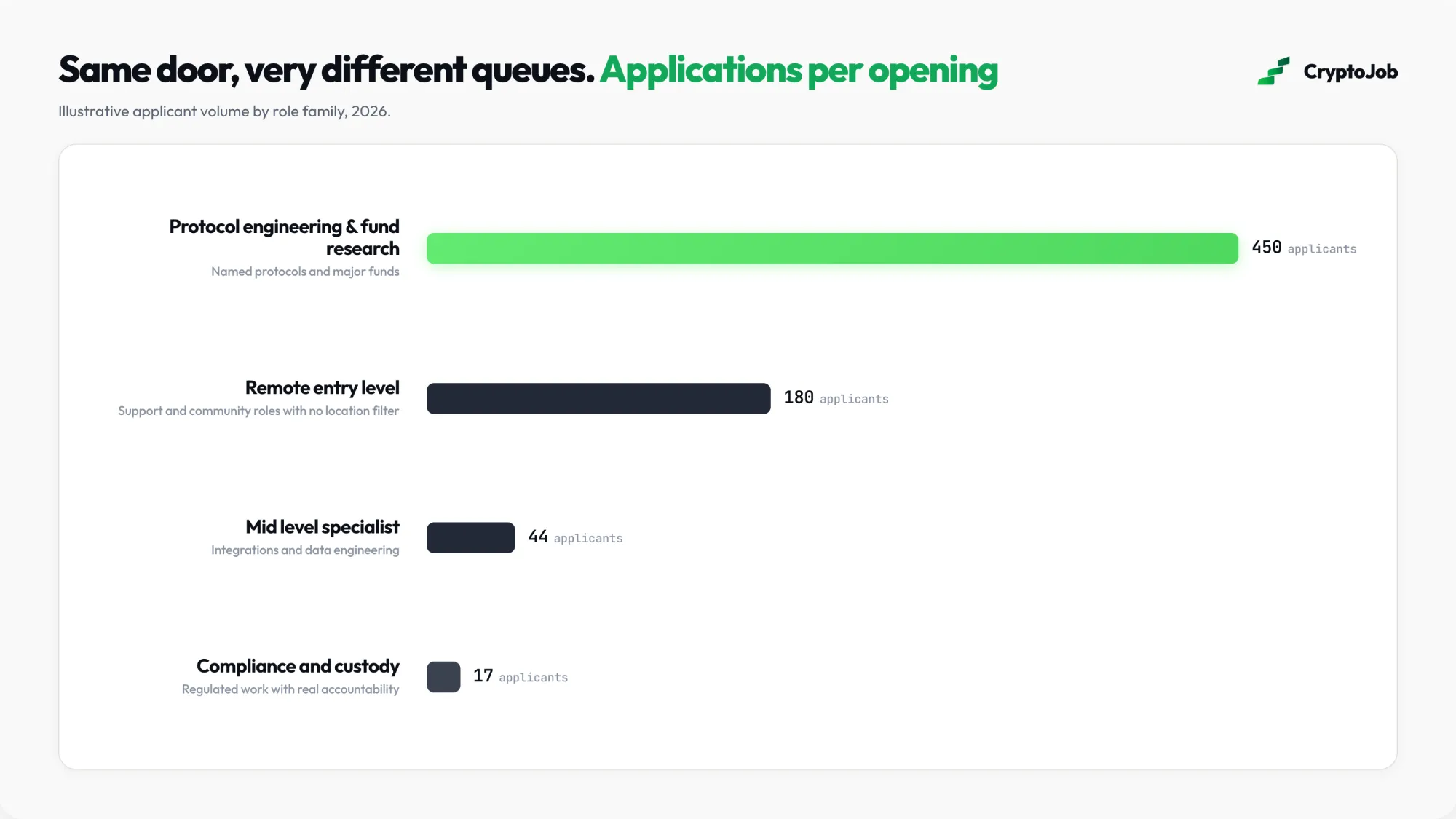
On the glamour. Protocol engineering at named foundations, research roles at prominent funds, product positions at top ten exchanges and anything with token upside in the title draw the extreme counts.
Remote plus junior is the second pile up. Entry level remote listings collect global floods because every geography can apply, which is why identical roles with office requirements often see a tenth of the volume.
Meanwhile the unglamorous functions clear quickly. Compliance, custody operations, fraud, support escalation and regional sales roles routinely struggle to fill, a mismatch documented across 2026 hiring reports and one you can exploit deliberately.
Why do cold applications fail at these numbers?
Screening changes shape past a hundred applicants. Recruiters shift from evaluating candidates to eliminating them, filters get mechanical and time per resume drops below a minute, so marginal differences in polish stop registering at all.
Referrals bypass the pile entirely. Hiring managers consistently fill a large share of roles through warm introductions before serious screening begins, and recruiter surveys across tech put referral hire rates far above cold channels every year.
Public work bypasses it differently. A candidate whose analysis, code or design the team has already seen enters the process pre validated, which is why proof first strategies keep working while resume first strategies drown.
What playbook still lands interviews in 2026?
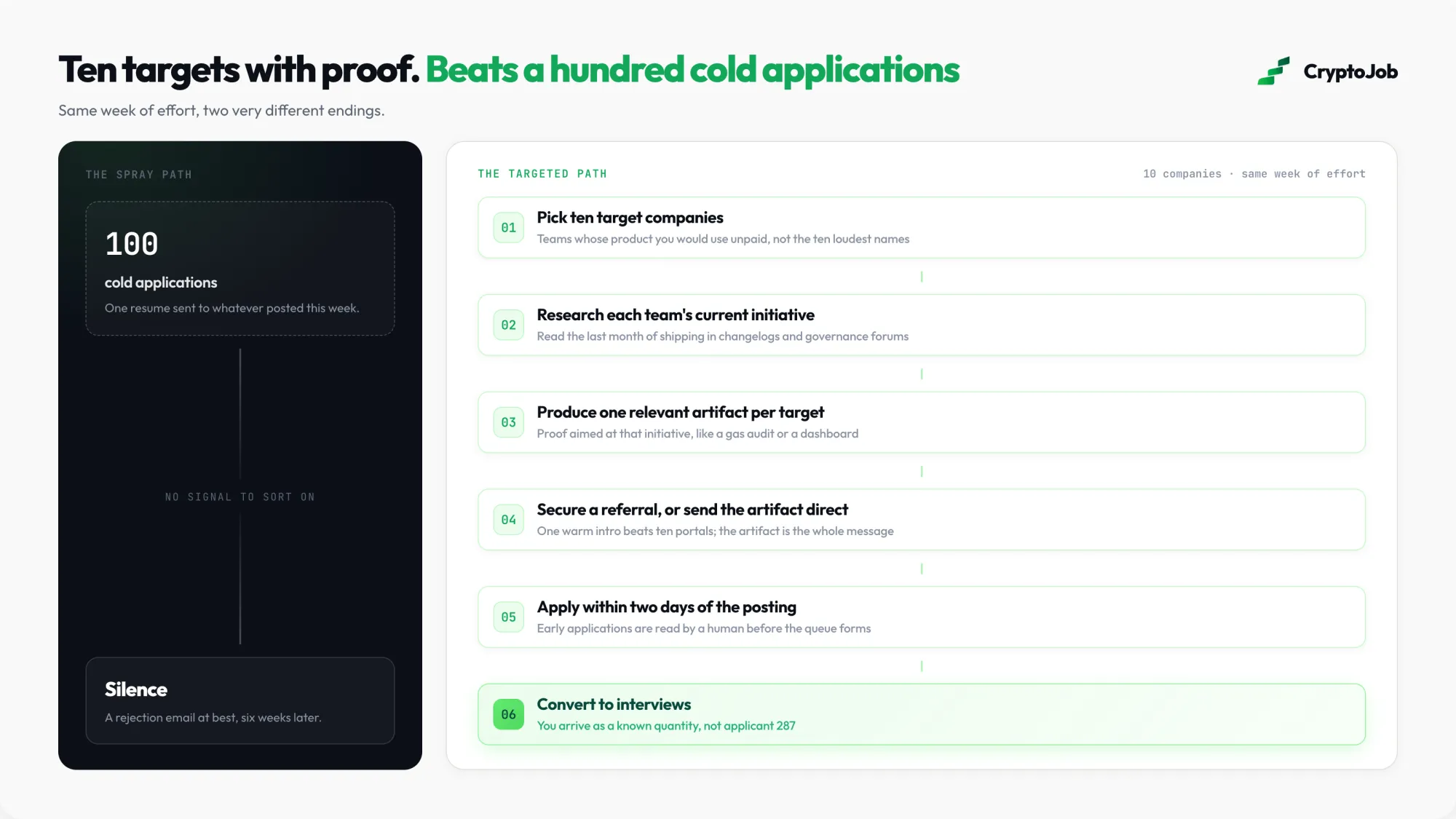
Flip the funnel: target ten companies deliberately instead of spraying a hundred applications. Research each team's current push, build or write one small thing relevant to it and reach the hiring manager through a referral or a thoughtful direct message with that artifact attached.
Referral conversations have a script worth practicing: name the team, name the initiative you researched, attach the artifact and ask one specific question rather than requesting a job. People forward specific, useful messages and delete vague ones, and every forward is a queue skipped.
Time your entry. Applying within the first two days of a posting matters mechanically now, and monitoring career pages and job boards for fresh listings beats browsing stale aggregations.
Weaponize specificity in materials. One page, quantified outcomes, the exact stack named in the listing and a two line note explaining why this team, because generic excellence is invisible at 450 to 1 odds. Our guides on the web3 resume and crypto job networking cover both weapons in depth.
What makes a recruiter stop scrolling at 450 applications?
Numbers in the first line. Grew organic traffic 240 percent, shipped a contract holding $2M, cut fraud losses 30 percent: quantified outcomes survive the one minute scan that adjectives never do.
Links that prove instantly. A live project or a contest ranking lets a screener verify you in one click, which is why our guide to web3 portfolio projects matters as much for the resume as for the interview.
Exact vocabulary match closes the loop. Screening tools and tired humans both hunt for the listing's own terms, so mirror the stack, the licenses and the role language precisely rather than describing the same skills in your own words.
How much time should each application actually get?
Budget by lane. Referral targets deserve two to four hours across research, the artifact and the outreach. Fresh niche postings deserve twenty focused minutes of tailoring, and lottery tickets get five minutes or none.
Protect interview capacity as searches stretch. Candidates juggling forty live applications flame out in the loops that matter, while candidates running ten deliberate threads arrive prepared, so treat your pipeline like a portfolio with position limits rather than a lottery pile.
Batch the fixed costs once: a master resume with swappable bullets, a proof of work index page and three cover note templates keyed to your target role families. With those built, tailoring becomes assembly rather than authorship.
Track everything in a simple sheet with dates, contacts, artifacts sent and follow ups. At these volumes, the candidates who follow up politely on day seven convert interviews that silent applicants never see, and the sheet doubles as your negotiation memory once offers finally arrive.
Which niches quietly favor applicants right now?
Regulated functions lead. Compliance and legal remained the hardest hires in the industry through 2026 as licensing regimes multiplied, meaning credentialed applicants face favorable odds nearly everywhere.
Growth pockets hire against the trend. Prediction markets, institutional custody, stablecoin payments and tokenized asset teams expanded while the wider market shrank, and their unfamiliar names attract thinner queues than famous logos.
Location bound and shift bound roles round it out. Onsite operations, regional support coverage and roles requiring specific languages structurally filter the global flood, trading a little flexibility for dramatically better odds.
How should you split effort across the market?
| Strategy lane | Odds profile | Effort per attempt | Share of your time |
|---|---|---|---|
| Referral hunting at target companies | Best available | High | 40 percent |
| Proof of work artifacts published publicly | Compounds over time | High | 30 percent |
| Fast applications to fresh niche postings | Good in thin queues | Low | 20 percent |
| Cold applications to famous roles | Lottery ticket | Low | 10 percent |
What does the competition mean for salaries and standards?
Employers raised the bar quietly. Take home exercises got longer, interview loops added stages and roles that once accepted potential now demand shipped evidence, all rational responses to overwhelming choice.
Compensation split by scarcity. Oversubscribed generalist roles saw offers flatten while genuinely scarce skills, meaning security, compliance, ZK engineering and institutional sales, held or gained, so pricing yourself requires knowing which side of the split you occupy.
Candidates gained one lever: patience costs employers too. Critical seats sitting unfilled for months make hiring managers receptive to strong late entrants, which rewards persistence aimed at the right doors.
What should you do this week?
Pick your ten targets and write them down, including at least four from the thin queue niches. Draft the first artifact, request the first two referral conversations and set alerts so fresh postings reach you within hours rather than weeks.
Then hold the ratio: most of your energy on referrals and proof, with only leftovers on lottery tickets. The market is brutal at the average and surprisingly open at the edges, so go where the queue is short and the proof is loud. Start by taking twenty minutes to browse web3 jobs and tag every listing under a week old.
FAQ
Is 450 applications per opening typical across crypto?
No, it marks the extreme reported for popular protocol and brand name roles. Typical specialist roles see far less, and niche regulated functions often struggle to attract twenty qualified applicants.
Do referrals really matter that much in crypto hiring?
Yes. Small teams, trust sensitive work and overwhelmed pipelines make warm introductions the dominant channel, and recruiter reports across 2026 consistently show referral filled roles closing before public screening finishes.
Should I still apply to famous companies?
Yes, as a capped bet. Keep roughly a tenth of your effort on them, applied fast and tailored, while the bulk of your time compounds in referrals and public work aimed at thinner queues.
How long does a crypto job search take in 2026?
It varies widely with niche and proof. Candidates targeting thin queue functions with referrals commonly convert in one to three months, while cold applicants to popular roles can search far longer.