From Big Tech to Crypto: How to Make the Switch in 2026
How to move from big tech to crypto in 2026: what skills transfer, whether you take a pay cut and the step-by-step path in.

TLDR: Moving from big tech to crypto rarely means a pay cut, senior engineers often earn 30 to 50% more than comparable web2 roles., Traditional finance firms entering web3 sometimes pay up to 30% above crypto-native startups.: Your systems, distributed-systems and security skills transfer directly.: The gate is a portfolio, not a résumé, one shipped on-chain project changes everything.
Making the move from big tech to crypto is one of the most common and most rewarding, career pivots in 2026 and it usually doesn't require a pay cut. Senior engineers frequently earn more in web3 than in comparable web2 roles, and traditional finance firms entering the space pay competitively too. What holds people back is rarely skill; it's the lack of a visible on-chain project.
If you're at a FAANG-tier company or a large tech or finance firm, you already have most of what web3 teams want. To see what's live, you can browse web3 jobs as you read.
Why are people moving from big tech to crypto?
People move from big tech to crypto for a mix of upside, ownership and pace. Compensation is competitive and often higher at senior levels, token grants offer equity-like upside and smaller teams mean more direct impact. After years of maturing, the sector now offers structured career paths rather than pure risk.
The market has also professionalized. Web3 teams increasingly want the execution discipline that big tech engineers bring, and traditional finance firms building blockchain divisions are hiring aggressively. That combination of crypto-native vision and web2 rigor is exactly what strong teams are assembling. For many engineers, the appeal is also simply working on newer problems, building financial infrastructure from first principles rather than maintaining mature systems. That sense of frontier, combined with competitive pay, is a powerful draw.
Here's how the two worlds compare on the factors people weigh most:
| Factor | Big tech | Crypto |
|---|---|---|
| Base pay | High and stable | Competitive, often higher at senior levels |
| Equity upside | RSUs | Token grants (higher risk and reward) |
| Team and pace | Large teams, slower | Small teams, faster |
| Structure | Heavy process | Loose and self-directed |
| Scope | Narrow ownership | Broad ownership |
What does switching to web3 from tech actually involve?
Switching to web3 from tech is less of a reinvention than most people expect. The core of software engineering, systems design, distributed systems, testing, security, is the same. What changes is the domain: smart contracts, on-chain data, wallets and the specific mechanics of whatever ecosystem you join.
The practical shift is learning one new stack deeply and proving you can ship in it. For most engineers, that means picking Solidity or Rust, building a project and deploying it. The conceptual leap, immutable, public code that holds real value, is real, but it builds on fundamentals you already have.
Which transferable skills for crypto matter most?
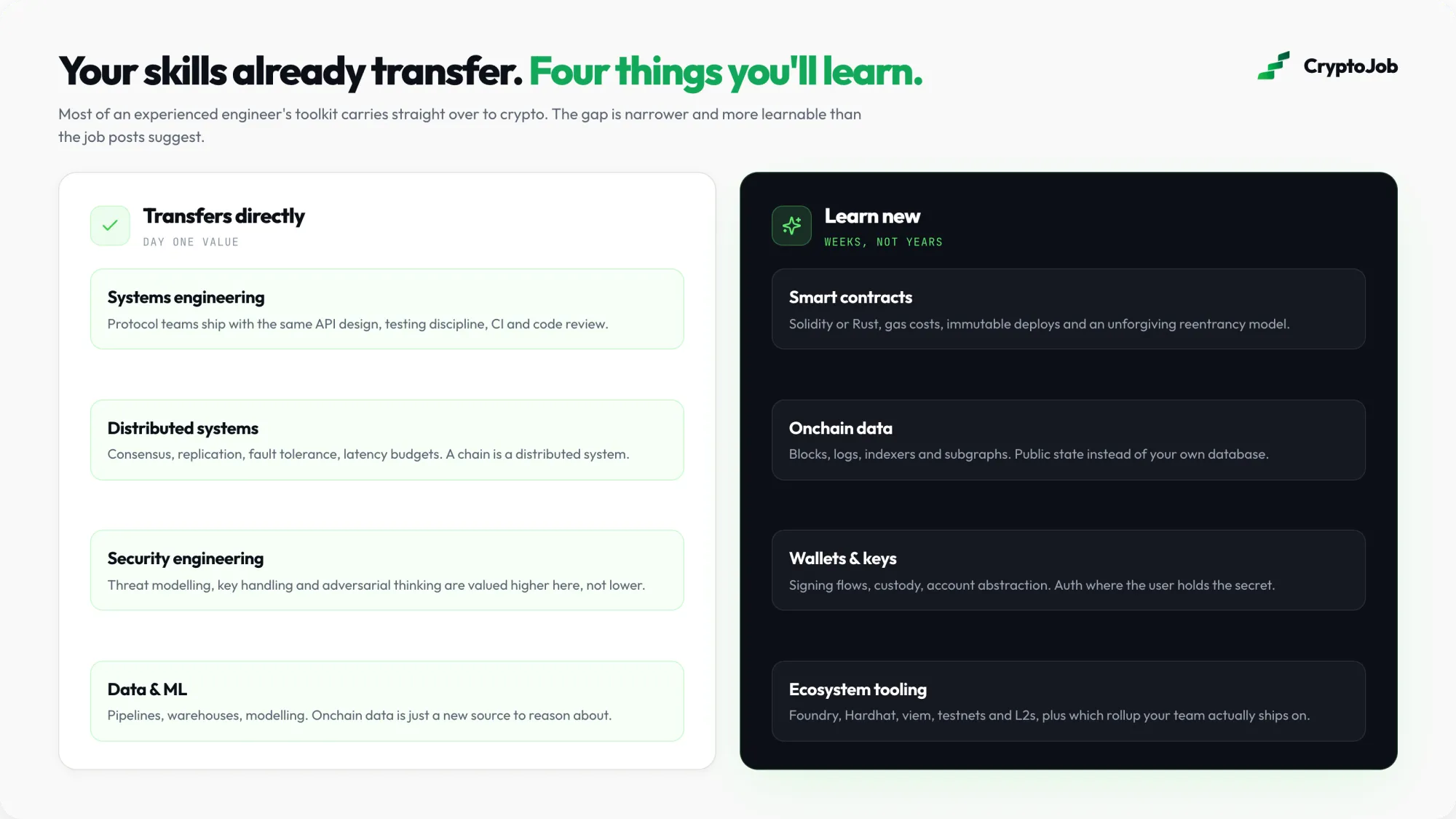
The transferable skills for crypto that matter most are the ones big tech already trains hard. Systems and distributed-systems experience maps directly onto protocol and infrastructure work. Security instincts are especially valuable, because on-chain bugs are public and irreversible.
Here's what tends to transfer most cleanly:
- Systems and backend engineering: directly relevant to protocol and infra roles.
- Distributed systems: consensus and networking concepts overlap heavily.
- Security and testing: prized given the cost of on-chain exploits.
- Data and ML: valuable for on-chain analytics and AI-plus-crypto roles.
Do you take a pay cut going from big tech to crypto?
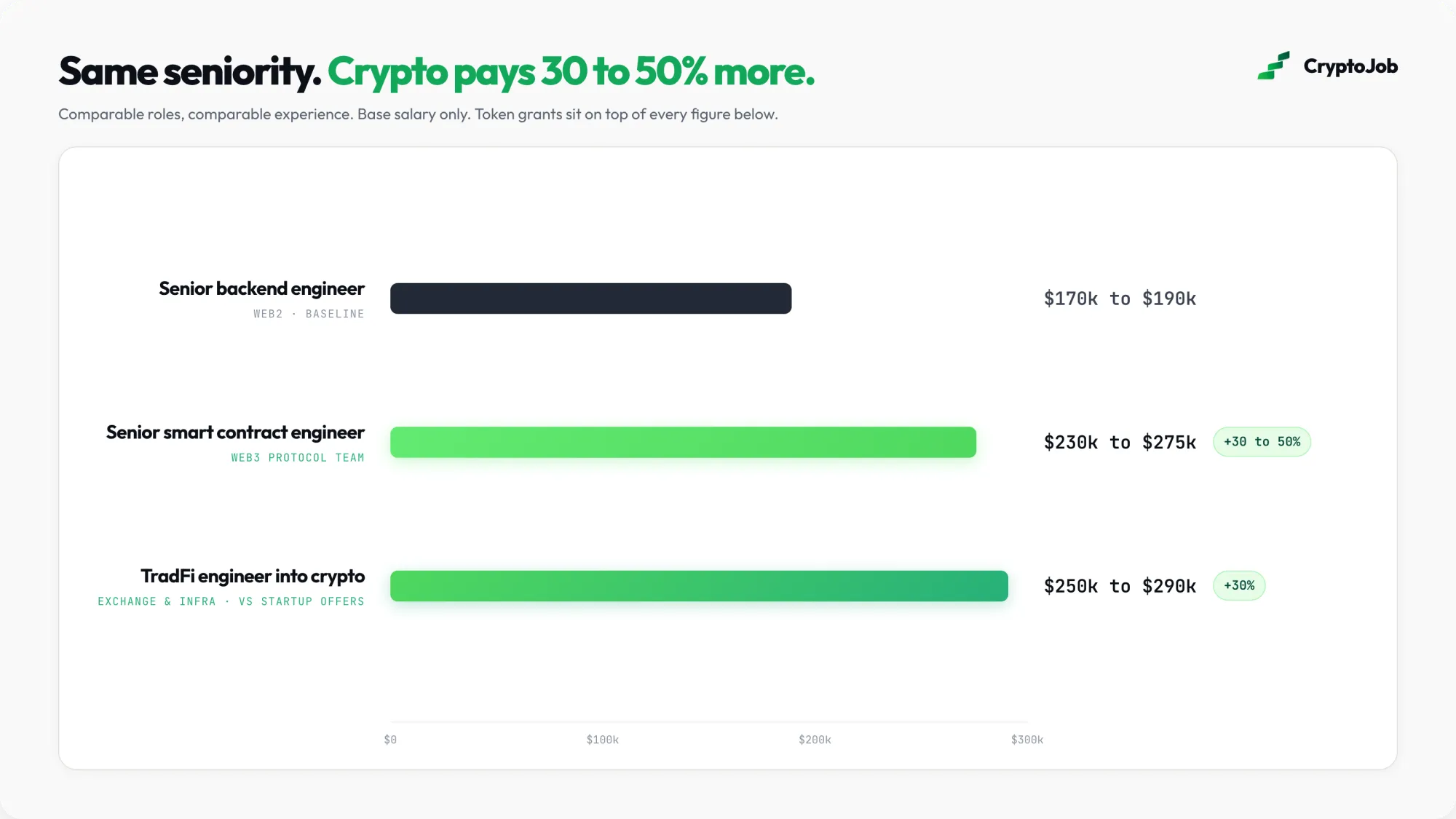
In most cases, no and many people earn more. Senior engineers with strong fundamentals can move without a pay cut, and a senior smart-contract developer can earn 30 to 50% more than a comparable traditional backend engineer. Token grants add potential upside on top of base, though they carry real volatility.
Traditional finance firms entering crypto add another well-paid option. Because they're building permanent blockchain divisions, they sometimes pay up to 30% more than crypto-native startups for equivalent roles. The main caveat is to read total-comp figures carefully, since token components are projections rather than guaranteed cash.
How do FAANG engineers break into web3?
FAANG engineers break into web3 the same way anyone does: by proving they can ship on-chain. Your pedigree helps at the résumé stage, but hiring here is portfolio-first, so a deployed project carries more weight than a brand name alone. The good news is that your engineering bar is already high.
A practical approach is to pick one ecosystem, build and deploy a real project and contribute to open source in that space. Because this pivot parallels the broader web2-to-web3 move, our guide to switching from web2 to web3 is a useful companion and the blockchain developer jobs guide shows where the roles are.
What's the step-by-step path from big tech to crypto?
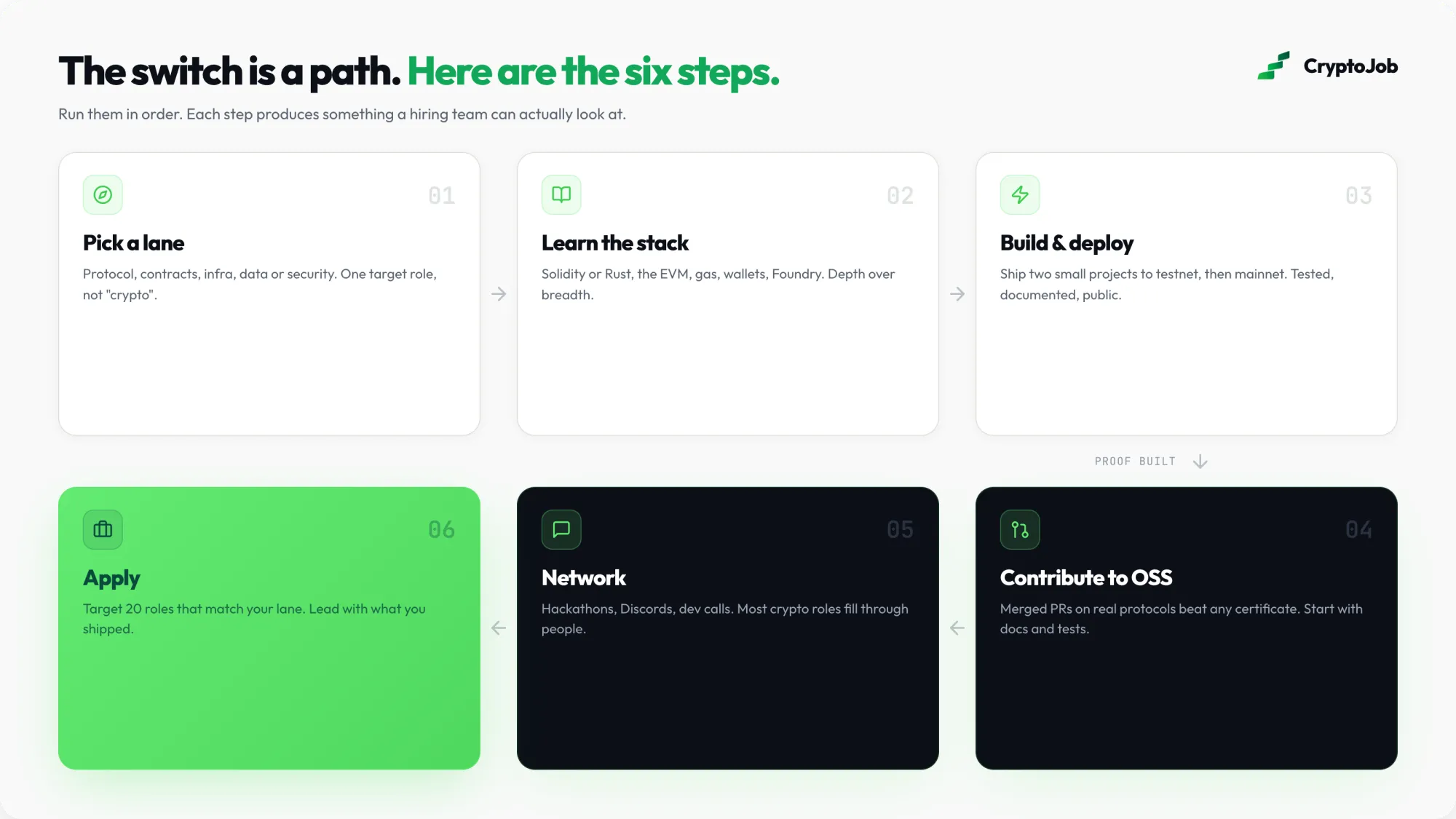
The step-by-step path from big tech to crypto is straightforward, if not always easy. It runs from choosing a lane, to building proof, to leveraging your network into interviews. Because much of web3 hiring happens through private networks, being visible matters as much as being skilled.
A realistic sequence looks like this:
- Pick a lane, Solidity/EVM, Rust/Solana or a data or infrastructure track.
- Learn the stack: the language, tooling and security basics.
- Build and deploy: one real project you can point to publicly.
- Contribute, open-source work in your target ecosystem.
- Network, engage on X, in Discords and at events where roles surface.
- Apply, with a portfolio that proves you can ship on-chain.
Which parts of big tech transfer least well to crypto?
Not everything from big tech maps cleanly onto crypto, and knowing the gaps helps you prepare. Heavy internal process, large-team coordination and deep specialization in one proprietary system don't always translate to smaller, faster web3 teams. You'll often be expected to own more of the stack and operate with far less structure around you.
The domain-knowledge gap is the other adjustment. Smart-contract security, tokenomics and on-chain mechanics are genuinely new and underestimating them is a common mistake for otherwise strong engineers. The remedy is the same as always, build something real in the space, but it helps to go in expecting to be a beginner in the domain even while you're senior in engineering.
There's also a mindset shift around ambiguity. Web3 moves quickly and specs are often looser, so comfort with uncertainty and self-direction matters more than it might at a large, process-driven employer. Engineers who thrive treat that freedom as an advantage rather than a source of friction.
What does the big tech to crypto transition timeline look like?
The big tech to crypto transition usually unfolds over a few months of part-time effort rather than a single dramatic leap. Most people keep their existing job while learning a stack and building a project on evenings and weekends, then start conversations once they have something concrete to show. That approach de-risks the move considerably.
A realistic timeline is roughly one to three months to learn a stack and ship a first project, followed by a period of networking and interviewing. Because your engineering bar is already high, the limiting factor is usually domain proof and visibility rather than raw ability. Many people line up a crypto role before leaving their current one.
The smartest movers treat the transition as additive, not a gamble: they build skills and a network in parallel with their day job, so that by the time they switch, they already have proof, relationships and a clear target. Framed that way, going from big tech to crypto is less a leap of faith than a planned, low-risk pivot.
Frequently asked questions
Do you need crypto experience to switch from big tech to web3?
No. Strong engineering fundamentals transfer directly and teams will value your systems, security and data skills. Showing even one deployed on-chain project is usually enough to offset a lack of prior crypto experience.
Will I have to take a pay cut moving to crypto?
Usually not, and many engineers earn more. Senior roles often pay above comparable web2 jobs, and traditional finance firms entering crypto pay competitively. Just evaluate token components as projections, not guaranteed cash.
Which is easier to learn coming from big tech, Solidity or Rust?
Both build on skills you already have. Solidity has the deepest job market and gentler ramp, while Rust suits engineers with systems backgrounds and pays a scarcity premium. Choose based on the ecosystem you want to work in.
How long does the switch from big tech to crypto take?
For a strong engineer, often a few months of focused learning plus one deployed project to become interview-ready. Your existing experience shortens the ramp considerably compared to a career changer from outside tech.
Do big tech credentials help in web3 hiring?
They help at the screening stage, but web3 hiring is portfolio-first. A brand-name background opens doors faster, yet you'll still need a deployed project and, ideally, open-source contributions to convert interest into offers.
The bottom line
Moving from big tech to crypto is more accessible than it looks: your skills transfer, the pay is competitive and the main gate is a portfolio you can build on the side. Pick a lane, ship one real on-chain project and lean on your network. When you're ready, browse web3 jobs and target the roles that match your background.