Blockchain Developer Jobs: 2026 Salary & Skills Guide
How much blockchain developer jobs pay in 2026, the skills teams actually want and a step-by-step path to getting hired.

TLDR: Blockchain developer jobs pay about $70k to $120k entry, $120k to $180k mid and $160k to $250k+ senior in the US., National averages cluster around $110k to $145k, depending on the survey.: The best-paid lanes are smart-contract (Solidity), Rust and protocol engineering., Demand still outpaces supply and a deployed project matters more than a degree.
Blockchain developer jobs remain among the best-paid roles in tech, and demand continues to outpace the number of qualified people. In the US, most roles fall between $70,000 and $250,000 depending on seniority and specialization, with lead and protocol positions going higher. The catch is that "blockchain developer" covers very different jobs: a full-stack dApp builder and a core protocol engineer share a title but little else.
This guide breaks down what the roles actually are, what they pay by level and specialization, the skills teams screen for and a realistic path in. If you'd rather see live openings first, you can browse web3 jobs and come back for the detail.
What do blockchain developer jobs involve?
Blockchain developer jobs fork into a few distinct lanes. Smart-contract developers write on-chain logic, usually in Solidity for Ethereum and EVM chains or in Rust for Solana and Polkadot. Protocol engineers build the consensus and client code beneath the applications, often in Go or Rust, while full-stack and dApp developers connect front ends to those contracts.
Most job postings sit in the smart-contract and dApp lanes, because that's where products get built. The unifying skill is security awareness, on-chain code is public and immutable, so a single bug can cause irreversible loss. That reality shapes how teams hire and what they pay for.
Are blockchain developer jobs still in demand in 2026?
Yes, and the data is clear about it. Blockchain-related job postings grew roughly 45% year over year heading into 2026, with the sharpest growth in security engineering, smart-contract development and protocol design. Traditional finance firms entering the space are adding to that demand, sometimes paying a premium over crypto-native startups for the same skills.
The market has also matured. Hiring has shifted from early-stage chaos toward structured career ladders with clear junior-to-senior progression. That's good news for anyone planning a multi-year path rather than a quick pivot.
How much is the average blockchain developer salary in 2026?
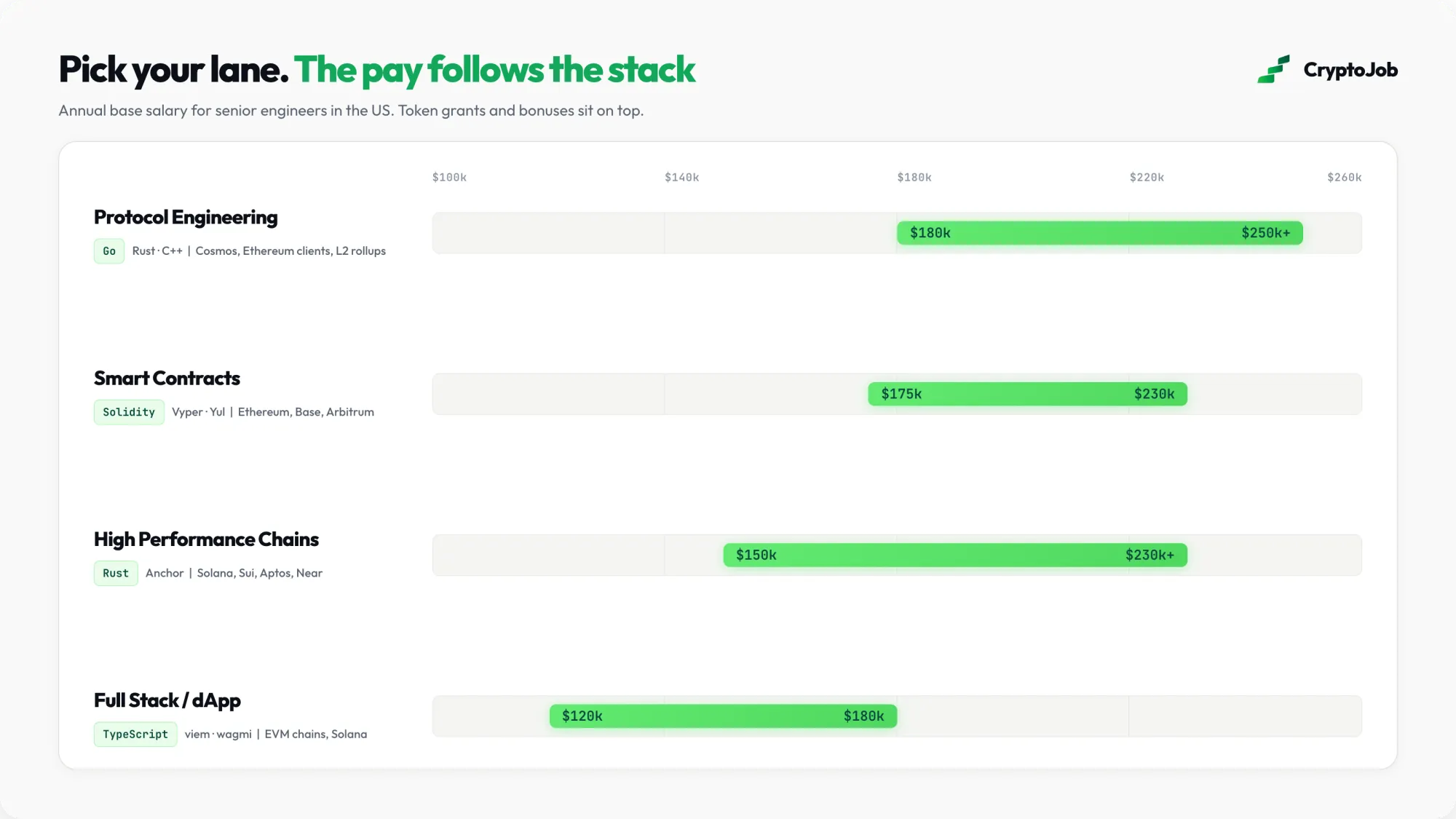
The headline averages depend on who's counting. General job-board data puts the US average near $110,000, while surveys focused on experienced developers land closer to $140,000 to $146,000. The truth is that averages hide more than they reveal here, because pay is driven by specialization far more than by the generic title.
Here's how the main lanes compare at the senior level. Treat these as US ranges that shift with funding stage, location and token grants.
| Specialization | Main language | Chains | Senior base (US) | Market |
|---|---|---|---|---|
| Smart-contract dev | Solidity | Ethereum, L2s | $175k to $230k | Deepest, crowded |
| Solana / Polkadot dev | Rust | Solana, Polkadot, NEAR | $150k to $230k+ | Smaller pool, premium |
| Protocol engineer | Go / Rust | Core clients | $180k to $250k+ | Niche, high pay |
| Full-stack / dApp | JS·TS + Solidity | Any | $120k to $180k | Broad, accessible |
What do entry-level blockchain developer roles pay?
Entry-level roles generally run $70,000 to $120,000 in the US, with the average landing around $100,000. Genuinely junior openings are limited and most expect a deployed contract, a portfolio project or programming experience you can point to. The gap between the 25th and 90th percentile is wide, which signals real room to grow with skill.
What about senior and specialized roles?
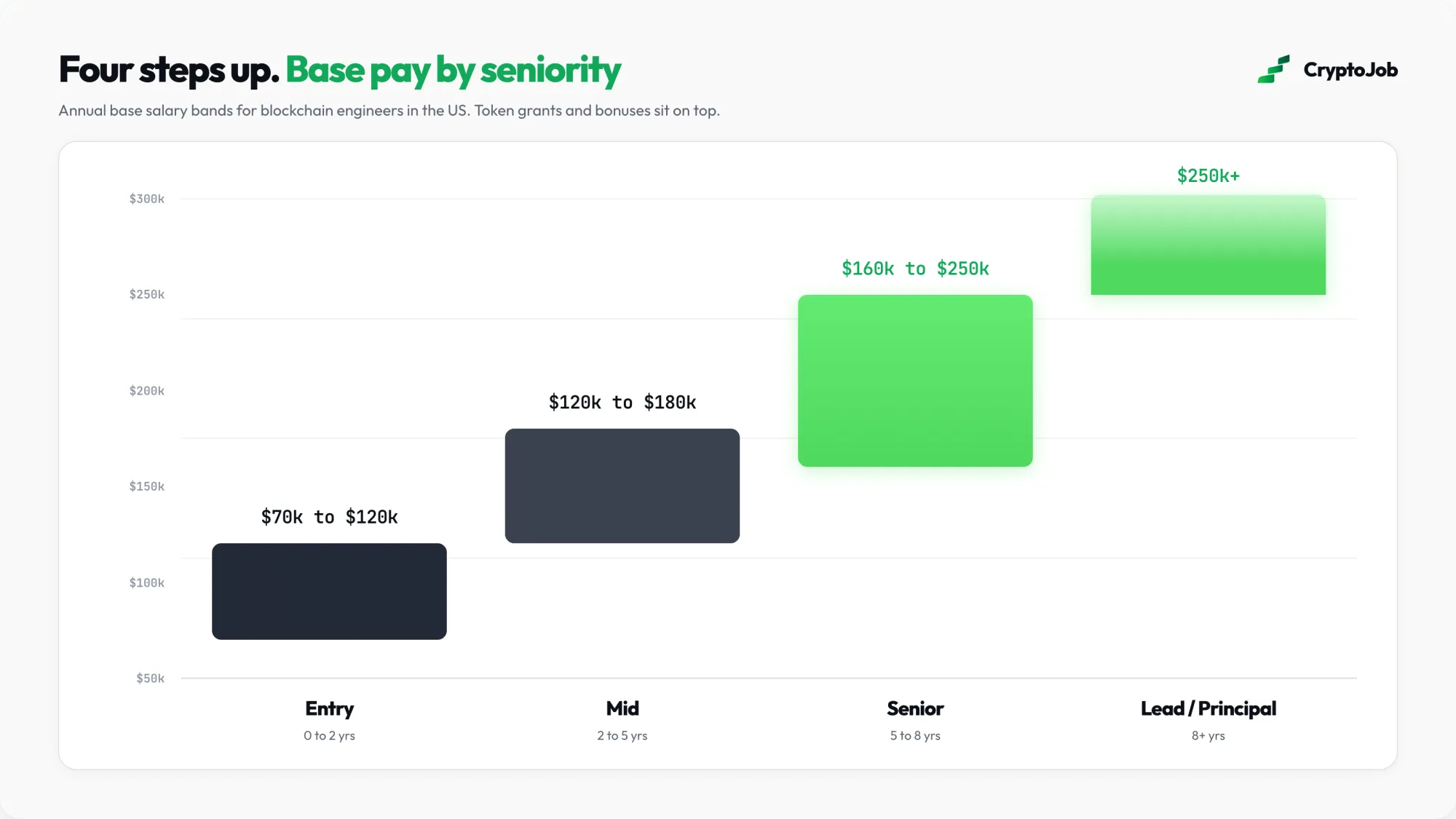
Senior developers with 5+ years typically earn $160,000 to $250,000 and smart-contract seniors at major protocols can exceed $300,000 once tokens are included. Protocol and security specialists sit at the very top because the failure mode of their work is catastrophic and the qualified pool is tiny. For a fuller picture of where these peaks are, see the web3 developer salary guide.
How do blockchain developer jobs compare to traditional software roles?
Blockchain roles generally pay a premium over comparable web2 jobs, and the gap is widest at the senior level. Senior web2 software engineers in the US typically earn somewhere between $87,000 and $179,000, a band that often takes five to fifteen years to reach. In web3, a strong developer can hit similar numbers faster, because the qualified pool is so much smaller.
The premium comes from scarcity and risk. Fewer people can write secure on-chain code, and the cost of a mistake is measured in drained contracts rather than a rolled-back deploy. Traditional finance firms entering the space have pushed pay higher still, sometimes offering up to 30% more than crypto-native startups for the same skills.
What are the most in-demand blockchain skills?
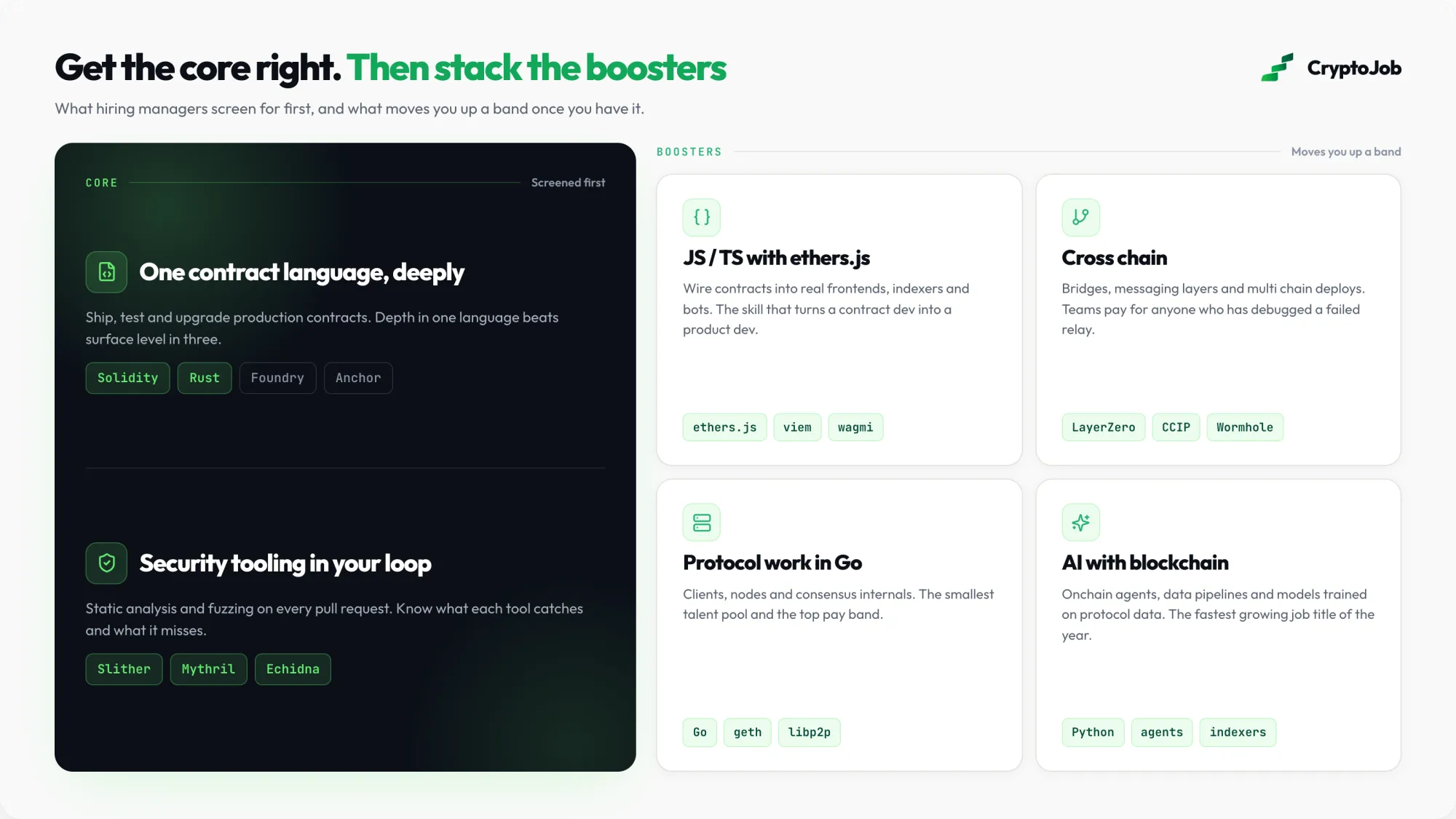
The in-demand blockchain skills stack starts with a smart-contract language, Solidity or Rust, plus the security tooling that surrounds it. Employers increasingly screen for practical security ability: threat modeling, fuzzing and tools like Slither, Mythril and Echidna show up constantly in job posts. Gas optimization and rigorous testing separate strong candidates from ones who copy templates.
Beyond the core, several skills raise your value:
- Front-end integration: JavaScript/TypeScript with libraries like ethers.js for dApp work.
- Cross-chain fluency: comfort with both EVM and non-EVM architectures.
- Protocol fundamentals: consensus, cryptography basics and client code (often Go).
- AI + blockchain: a fast-emerging, high-paying hybrid as teams bridge ML and on-chain systems.
How do you become a blockchain developer in 2026?
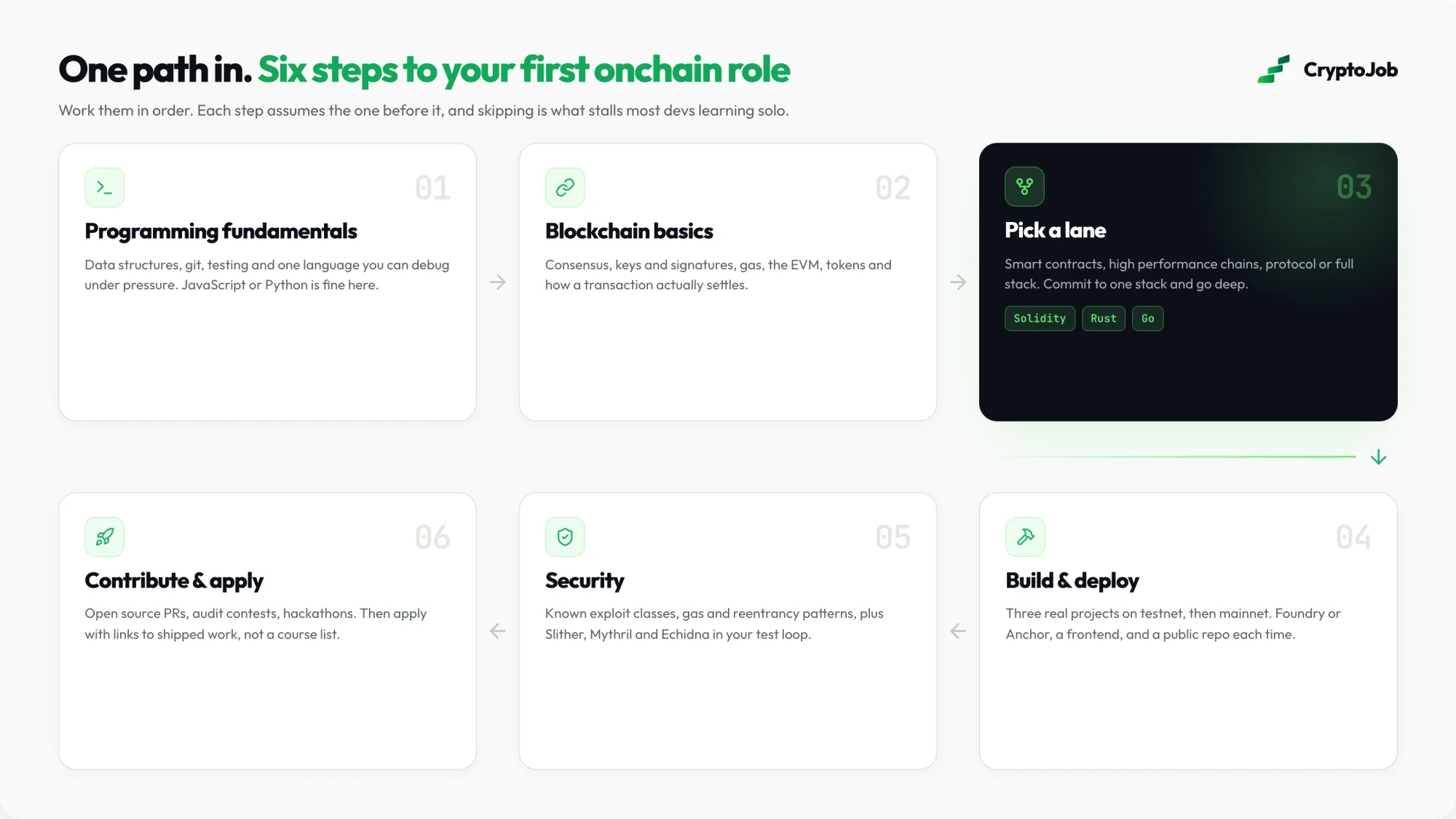
The path is more about output than credentials, and it's the same shape whether you're a career-switcher or a new grad. Learn a solid programming base, then blockchain fundamentals, then pick a lane and go deep. The single highest-leverage move is to ship and deploy something real.
A realistic sequence looks like this:
- Master fundamentals, JavaScript/TypeScript or Rust, plus data structures.
- Learn blockchain basics, accounts, transactions, gas and how contracts execute.
- Pick a lane, Solidity/EVM for the broadest market or Rust/Solana for the premium.
- Build and deploy: a token, an NFT contract or a small DeFi app on a testnet, then mainnet.
- Get security-literate, practice on CTFs and learn common vulnerability classes.
- Contribute and apply, open-source commits and bounties become your résumé.
Compare the two main on-ramps directly with our guides to Solana developer jobs and Solidity developer jobs before you commit to a stack.
Where are the blockchain developer jobs and how do you get hired?
Blockchain developer jobs concentrate on crypto-native boards, protocol and exchange career pages and on-chain bounty platforms. Established companies like Coinbase, Binance and the larger DeFi protocols hire continuously and the remote-first norm means geography rarely blocks you. What blocks people is a thin portfolio.
Demand also reaches well beyond crypto-native startups. Financial services, gaming and NFT studios, enterprise and supply-chain teams and infrastructure providers all hire blockchain developers, which widens your options if you're open on domain. Enterprise and traditional-finance roles in particular tend to value web2 discipline alongside on-chain skills, so a hybrid background can be an advantage rather than a gap.
To get hired, make your work legible: a public GitHub, at least one deployed and documented project and a short write-up of a bug you found or prevented. Recruiters and maintainers overlap heavily, so open-source contribution is one of the most efficient ways in. When you're ready, browse web3 jobs and filter by the lane and seniority that match your portfolio.
Frequently asked questions
Is blockchain development a good career in 2026?
Yes. Demand still outpaces supply, and pay sits well above general software roles. National averages cluster around $110k to $145k, with senior specialists earning considerably more.
Do you need to know Solidity to get a blockchain developer job?
Not necessarily. Solidity opens the most doors on Ethereum and its Layer 2s, but Rust (Solana, Polkadot) and Go (protocol layer) are strong alternatives. Pick the lane that matches your target ecosystem.
How long does it take to become a blockchain developer?
For an existing programmer, roughly four to eight months to job-ready with a deployed project. Beginners should plan a year or more. Shipping real projects matters more than course hours.
Can you get a blockchain developer job with no experience?
It's possible but hard. Entry roles are limited and usually require a deployed contract, an audit or a notable open-source contribution to stand in for professional experience.
Which pays more, Solidity or Rust?
They're close, with Rust often edging ahead on scarcity. Solidity has the deepest market, while Rust carries a language premium because the qualified pool is smaller.
The bottom line
Blockchain developer jobs pay from around $70,000 at entry to well past $250,000 for senior specialists and the lane you choose matters more than the title. Learn a smart-contract language, get genuinely security-literate and deploy real work you can show. When your portfolio is ready, browse web3 jobs and target the roles that fit your stack.