Chainlink Careers 2026: Oracle Roles and How to Apply
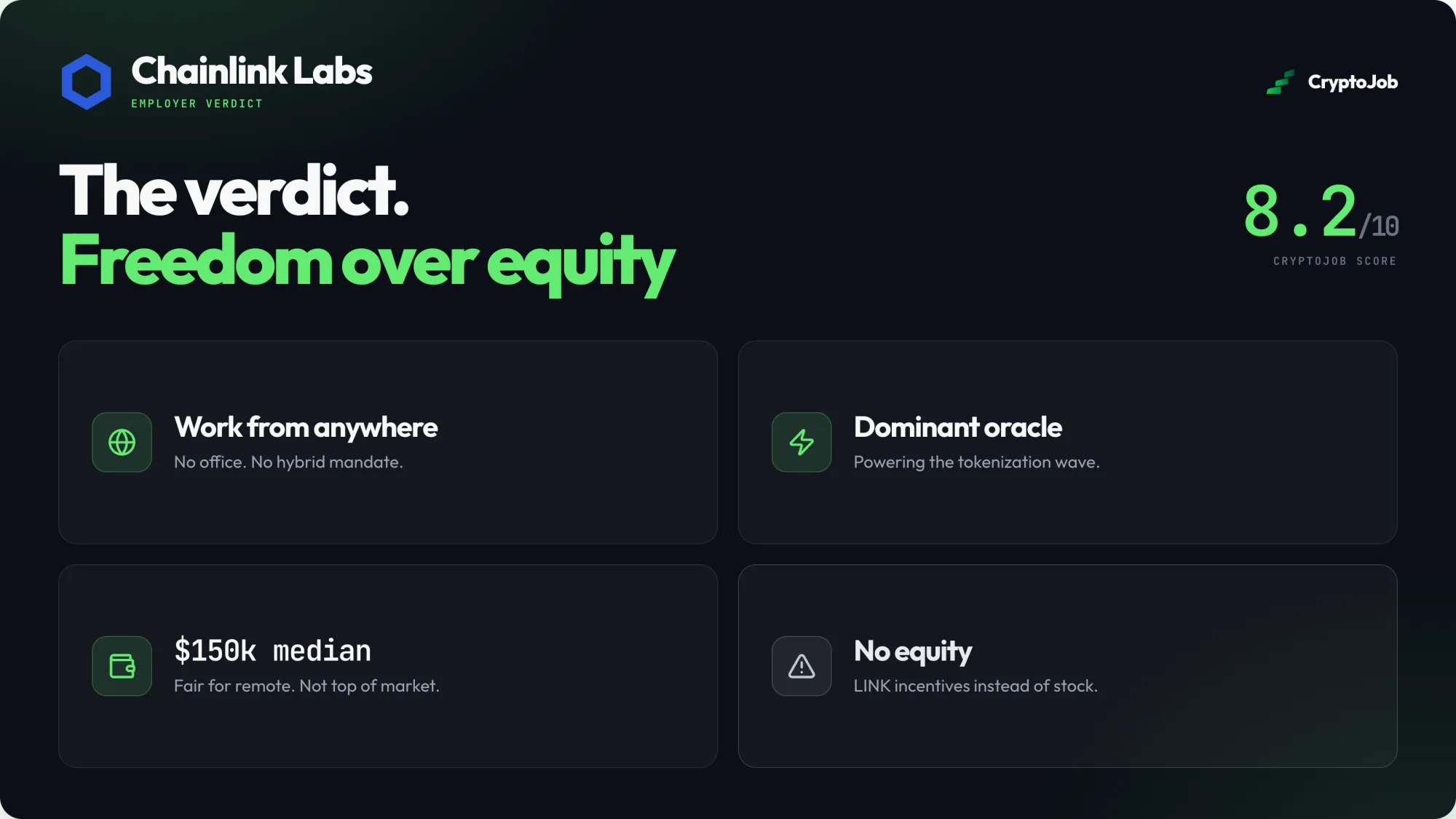
Chainlink Labs hires fully remote worldwide and pays base salary plus LINK tied incentives instead of equity. Here's the pay data, the Web3 Bar Raiser and the 6 to 7 week process.

TLDR
- Chainlink jobs are fully remote worldwide, with a co working stipend and hardware allowance
- No traditional equity: pay is local currency base plus LINK tied long term incentives
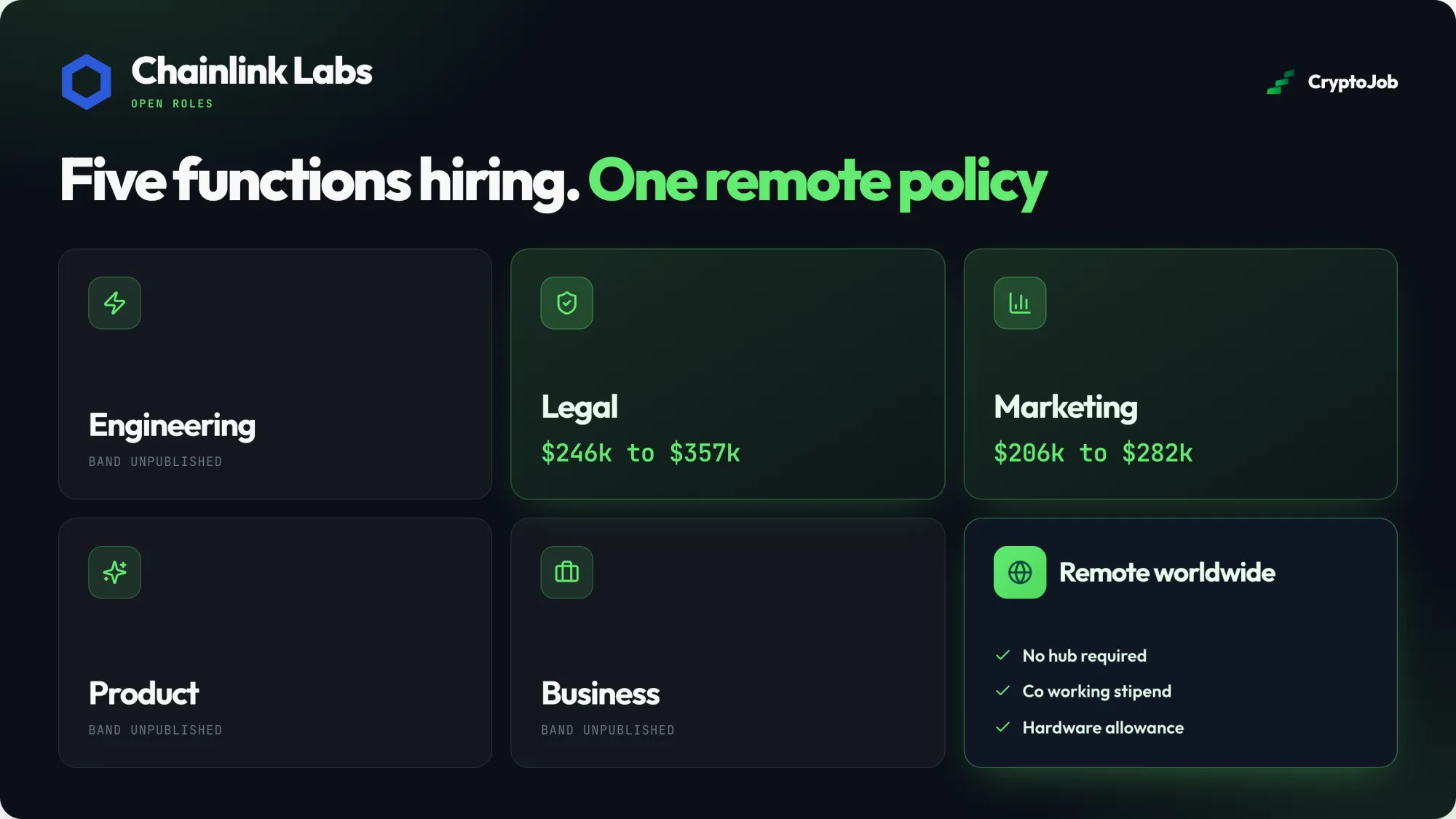
- Median total comp ~$150k; US legal runs $246k to $357k, marketing $206k to $282k
- Official process takes 6 to 7 weeks over Zoom, including a "Web3 Bar Raiser" round
- Expect depth: candidates commonly report 6 to 8 rounds plus a take home
Chainlink jobs offer something almost no other major crypto employer does: genuinely work from anywhere remote roles at the company behind the industry's dominant oracle network. Chainlink Labs builds the infrastructure that lets smart contracts access off chain data, web APIs and bank payments. The plumbing behind the tokenization wave now reaching institutions like DTCC and major banks.
This guide covers the pay data by function, the one compensation fact every candidate must understand before an offer and the long but transparent interview process Chainlink Labs publishes itself. To keep the wider market in view while you read, browse web3 jobs on CoinTerminal.
That compensation fact, upfront: Chainlink Labs does not offer traditional company equity. You get base salary in your local currency plus a long term incentive program tied to LINK, the network's token. Whether that's a feature or a bug depends entirely on your view of the network.
Why Are Chainlink Jobs Worth a Look in 2026?
The thesis is simple: as real world assets and markets move on chain, someone has to feed those contracts trustworthy data and connect them to existing finance. And Chainlink is the default answer. Chainlink Labs frames this as a technology shift comparable to finance first moving online, and it hires people who want to build at that seam between banks and blockchains.
The working model is the practical draw. The careers page is explicit that the company operates fully remotely worldwide, backed by a monthly co working stipend and a generous hardware allowance. Unlike "remote first" employers with hub gravity (compare Coinbase's Surge weeks), Chainlink Labs has no office to drift back to.
Culturally, it describes itself as a meritocracy "designed for the bold," operating on three principles, ownership, dialogue and focus, that structure both daily work and, as you'll see, the interview process itself.
What Roles Is Chainlink Labs Hiring for in 2026?
Hiring runs across:
- Engineering: core protocol, integrations, security and UI/platform work. Go and distributed systems experience feature heavily, alongside Solidity for on chain components
- Solutions & technical account management: helping enterprises and banks integrate data feeds, CCIP cross chain messaging and proof of reserve tooling
- Business development & partnerships: the institutional and capital markets push
- Legal & policy: among the best paid functions, reflecting the regulatory surface of bank integrations
- Marketing, research and operations: including paid research internships (~$58/hour reported)
Where do you find official Chainlink Labs careers listings?
The official Chainlink Labs careers page at chainlinklabs.com/careers is the source of truth and unusually, the company also publishes a full interview guide at chainlinklabs.com/interviewing describing every stage. Read it before applying. It tells you exactly what will be evaluated.
How Much Do Chainlink Jobs Pay?
Solid but not exchange topping. The remote flexibility and token upside are part of the package. From Levels.fyi and Glassdoor (93 US salary reports):
| Function | Reported total comp (US unless noted) |
|---|---|
| Company wide median | ~$150k |
| Software Engineer | ~$137k (Glassdoor median) |
| Senior Software Engineer | ~$177k (Glassdoor median) |
| Software Engineer (UK) | ~£131k median, up to ~£210k |
| Marketing | ~$206k to $282k |
| Legal | ~$246k to $357k |
Employees rate compensation 3.9/5. Note the inversion versus most tech companies: legal and marketing report higher totals than mid level engineering, a signature of a company whose hardest problems are institutional adoption as much as code.
How does Chainlink salary work without equity?
This is the section to read twice. Full time compensation is base pay plus a long term incentive program tied to LINK. There is no company stock, because the value Chainlink Labs creates is designed to accrue to the network. Practically: your upside is exposure to a liquid, volatile token rather than illiquid startup equity or public RSUs. Model your offer at multiple LINK prices before signing, ask exactly how the incentive program vests and settles and compare against equity paying peers. Our Circle jobs guide covers the clearest RSU based contrast.
What Is Chainlink Labs' Hiring Process?
Long, and unusually transparent about being long. The company's own interviewing guide states the process typically takes 6 to 7 weeks, entirely over Zoom. Published stages include:
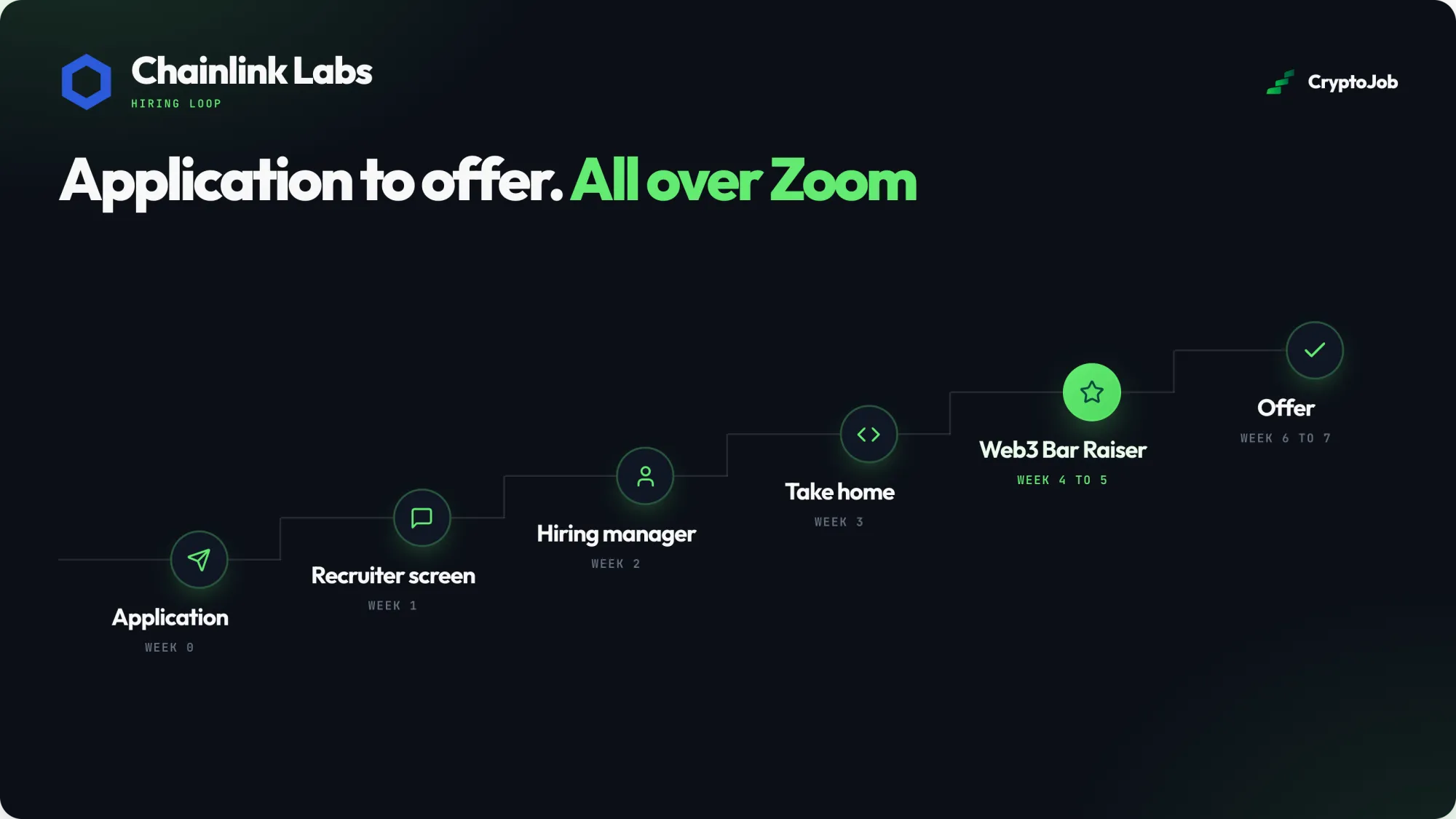
- Talent screen. 30 minutes on the role and the three principles
- Web3 Bar Raiser. A distinctive 30 minute round testing your fluency with Web3 concepts, trends and hands on experience, explicitly separate from role skills
- Practical exercise. A take home simulating real work (engineering reports mention third party code challenges; some candidates report paid assignments)
- Cross team conversation. 90 minutes, non technical, with a senior member of a different team
- Advisor interview. 60 minutes on management style and growth for leadership track roles
Candidate reports match: 6 to 8 rounds plus a take home is common, hiring averages about 30 days from first contact per Glassdoor and an NDA is required along the way. Experience ratings are mixed. Around 46% positive, with praise for structure and communication alongside reports of late stage ghosting and slow scheduling. Budget emotional runway for a marathon, and keep other processes running in parallel.
How do you pass the Web3 Bar Raiser?
Treat it as a fluency exam, not trivia. Reported question themes include how blockchains work at a mechanical level, what problem Bitcoin actually solved, what makes an optimistic rollup "optimistic," and where oracle data comes from. If you can explain Chainlink's data feeds, CCIP and proof of reserve to a smart non crypto colleague, you're ready.
How should you handle the take home?
Two practical notes from candidate reports. Some practical exercises are compensated, candidates have reported paid assignments ranging from gift card honoraria to multi thousand dollar case work, so ask upfront whether yours is and what the expected time budget looks like.
Then treat scope discipline as part of the test. The exercise simulates working together, and Chainlink Labs' own guidance encourages asking your recruiter questions mid exercise. Use that channel: a tightly scoped solution with clear written reasoning reads better than an unbounded one, and silence isn't stoicism. It's a missed signal on the dialogue principle they screen for.
What are blockchain oracle jobs like day to day?
Less exotic than they sound: oracle infrastructure work is high reliability distributed systems, node operations, data aggregation, cross chain messaging, with the added constraint that errors move real money on chain. Engineers from fintech, market data or telecom reliability backgrounds translate well, which widens the funnel beyond crypto natives.
How Do Chainlink Jobs Compare with Other Remote Crypto Jobs?
Among remote crypto jobs, Chainlink Labs is the purest work from anywhere setup this side of Tether. No offices, stipended home setups, global hiring. The differences: Tether pays cash heavy with no incentive program and minimal process, while Chainlink Labs runs a structured, principle driven organization with token linked upside. See the contrast in full in our Tether jobs guide.
The remote model also makes Chainlink Labs unusually accessible from smaller markets. A Baltic or Eastern European engineer competes on equal footing with one in San Francisco. If that's you, our guide to remote web3 jobs pairs well with this one.
Final Take: Is a Chainlink Job Worth Chasing in 2026?
Yes, for a candidate who wants three specific things: true location freedom, exposure to the institutional tokenization wave and token denominated upside instead of equity. The costs are a 6 to 7 week gauntlet, mixed candidate experience reviews and engineering pay that trails the exchanges unless LINK performs.
Go in with the incentive structure fully understood, prep for the Bar Raiser like an exam and keep your pipeline full, browse web3 jobs so a seven week process never leaves you with zero alternatives.
FAQ
Does Chainlink Labs pay equity?
No. And this is the most important thing to understand. Full time employees receive local currency base pay plus a long term incentive program tied to LINK, the network's token, instead of traditional company equity. Model offers at multiple LINK prices before accepting.
Is Chainlink Labs fully remote?
Yes. The company operates entirely remotely worldwide and supports it with a monthly co working stipend and hardware allowance. There are no office hubs to relocate to.
How long does Chainlink Labs' hiring process take?
The company's own guide says 6 to 7 weeks, all over Zoom; Glassdoor interview data averages about 30 days from first contact. Candidates commonly report 6 to 8 rounds including a take home practical exercise.
What is the Web3 Bar Raiser interview?
A dedicated 30 minute round assessing your fluency with Web3 concepts, trends and hands on experience. Deliberately separate from role specific skills. Be ready to explain how blockchains, rollups and oracles work mechanically.
How much does Chainlink Labs pay?
Median total compensation reported is around $150k, with US Glassdoor medians of ~$137k for software engineers and ~$177k for seniors. Legal ($246k to $357k) and marketing ($206k to $282k) report the highest US totals.