Crypto Jobs vs Web3 Jobs: What's the Difference and Which Pays More
Crypto jobs and web3 jobs overlap but aren't the same. Here's the real difference, which side pays more and how to break into either.

TL;DR
- Crypto jobs are a subset of web3: exchanges, trading and token projects
- Web3 adds DAOs, NFTs, gaming and decentralized apps
- Top base pay: security and protocol roles, $150k to $300k+
- Engineering runs roughly $90k to $280k, marketing $120k to $165k
- Token grants can add 30% to 100% on top
Here's the short answer: crypto jobs and web3 jobs overlap heavily, but they're not the same thing. Crypto jobs sit inside companies whose product is a cryptocurrency, an exchange or a trading product. Web3 jobs cover the broader decentralized internet, including NFTs, DAOs, decentralized identity and blockchain gaming. Pay is similar at the top, but the highest base salaries cluster in crypto-native roles like smart contract security, where top auditors can clear $300k.
If you're already hunting, you can browse web3 jobs on CoinTerminal while you read. The rest of this guide breaks down where the two categories actually differ, what each one pays in 2026 and which side of the line you should aim for.
What's the Difference Between Crypto Jobs and Web3 Jobs?
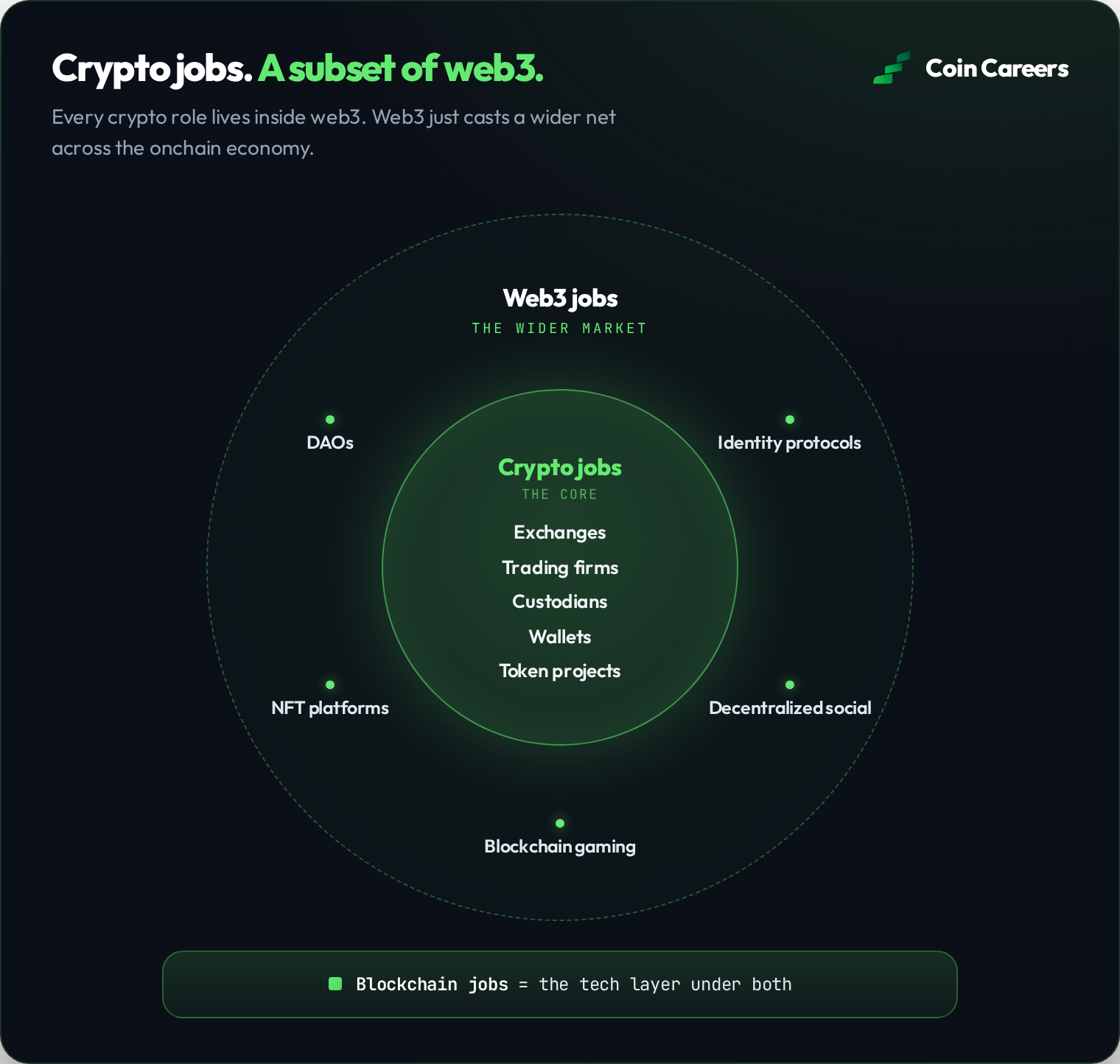
Think of it as a circle inside a bigger circle. Crypto jobs are the inner circle: exchanges like Coinbase and Kraken, custodians, trading firms, wallet companies and token projects. If the business would not exist without a tradeable digital asset, it's a crypto job.
Web3 jobs are the outer circle. They include everything in crypto plus roles at DAOs, NFT platforms, decentralized social apps, blockchain gaming studios and identity protocols. A community manager at a DAO holds a web3 job even if the project barely touches trading.
In practice, hiring managers use the terms loosely. The same Solidity developer posting might be tagged "crypto" on one board and "web3" on another. What actually changes your day-to-day is the type of company, not the label.
Where do blockchain jobs fit in?
Blockchain jobs are the technical layer underneath both. A blockchain engineer might work on a Layer 1 protocol, an enterprise supply chain pilot at a bank or the infrastructure behind an NFT marketplace.
That last example matters for your job search. Banks and consultancies post "blockchain" roles that have nothing to do with tokens or DeFi. They usually pay like traditional fintech, not like crypto-native startups, so read the job description before assuming the salary band.
Are Cryptocurrency Jobs and Web3 Jobs Paid Differently?
At the senior end, not really. Both markets pay for the same scarce skills: Solidity and Rust engineering, protocol design and security. Industry salary trackers like web3.career put the average North American web3 salary at roughly $143k to $144k, with engineering bands running from about $90k at junior level up to $280k or more at staff level.
The real pay differences show up in three places. First, crypto-native companies (exchanges, DeFi protocols, trading firms) tend to pay higher base salaries than NFT or gaming startups, because they generate real revenue. Second, security roles command the biggest premium anywhere in the industry. Third, token compensation varies wildly and can swing total comp by 30% to 100% in either direction.
How does token compensation change the math?
Almost every offer in this industry includes some form of token grant on top of base salary. A $150k base with a $100k token grant sounds like $250k, but the token half depends entirely on vesting schedules, lockups and whether the token holds its value.
Established crypto companies usually pay base in fiat or stablecoins with tokens as upside. Earlier-stage web3 projects and DAOs lean harder on tokens, sometimes paying most of the package that way. Treat token comp as a lottery ticket with a floor of zero, and negotiate your base as if the tokens don't exist.

Which Crypto Jobs Pay the Most in 2026?
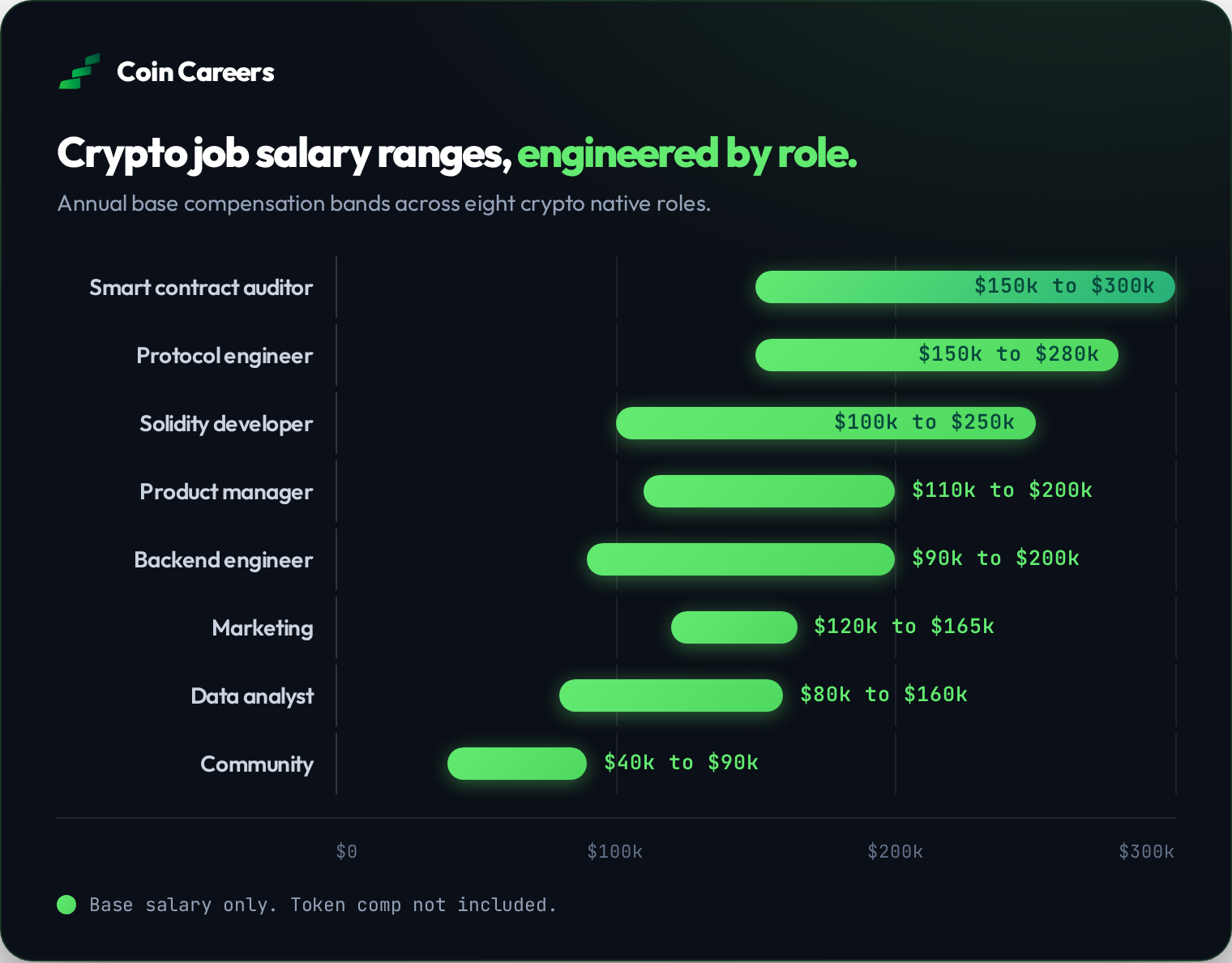
The table below shows realistic base salary ranges pulled from current job boards and salary trackers. Actual offers vary by company stage, location policy and how the market is doing when you sign. Token comp comes on top of everything here.
|
Role |
Typical base range (USD) |
Crypto, web3 or both? |
|
Smart contract auditor |
$150k to $300k+, top independents higher |
Both, premium in DeFi |
|
Solidity / smart contract developer |
$100k to $250k, median around $150k |
Both |
|
Protocol engineer (L1/L2, ZK) |
$150k to $280k+ |
Crypto-native |
|
Backend / full-stack engineer |
$90k to $200k |
Both |
|
Product manager |
$110k to $200k |
Both |
|
Marketing / growth |
roughly $120k to $165k mid-level |
Both |
|
Community manager |
$40k to $90k, senior roles higher |
Mostly web3 |
|
Data / on-chain analyst |
$80k to $160k |
Both |
Two patterns worth noticing. Security pays the most because a single exploit can cost a protocol hundreds of millions of dollars, so companies happily pay to prevent it. And non-technical roles pay closer to normal tech-industry rates, with the crypto premium concentrated almost entirely in engineering and security.
Do web3 salaries beat traditional tech?
Generally yes, by around 10% to 30% at the same seniority level according to salary guides like web3vacancy. A senior backend engineer earning $180k at a large tech company might get $200k to $220k base at a well-funded protocol, plus token upside.
The trade-off is volatility. Crypto companies hire aggressively in bull markets and cut hard in bear markets, so the premium partly compensates you for job-security risk.
How Do You Start a Crypto Career Without Experience?
You don't need to be a developer. Salary trackers like Crypto Jobs List note that most roles in the industry are non-technical, spanning support, marketing, operations, compliance and community.
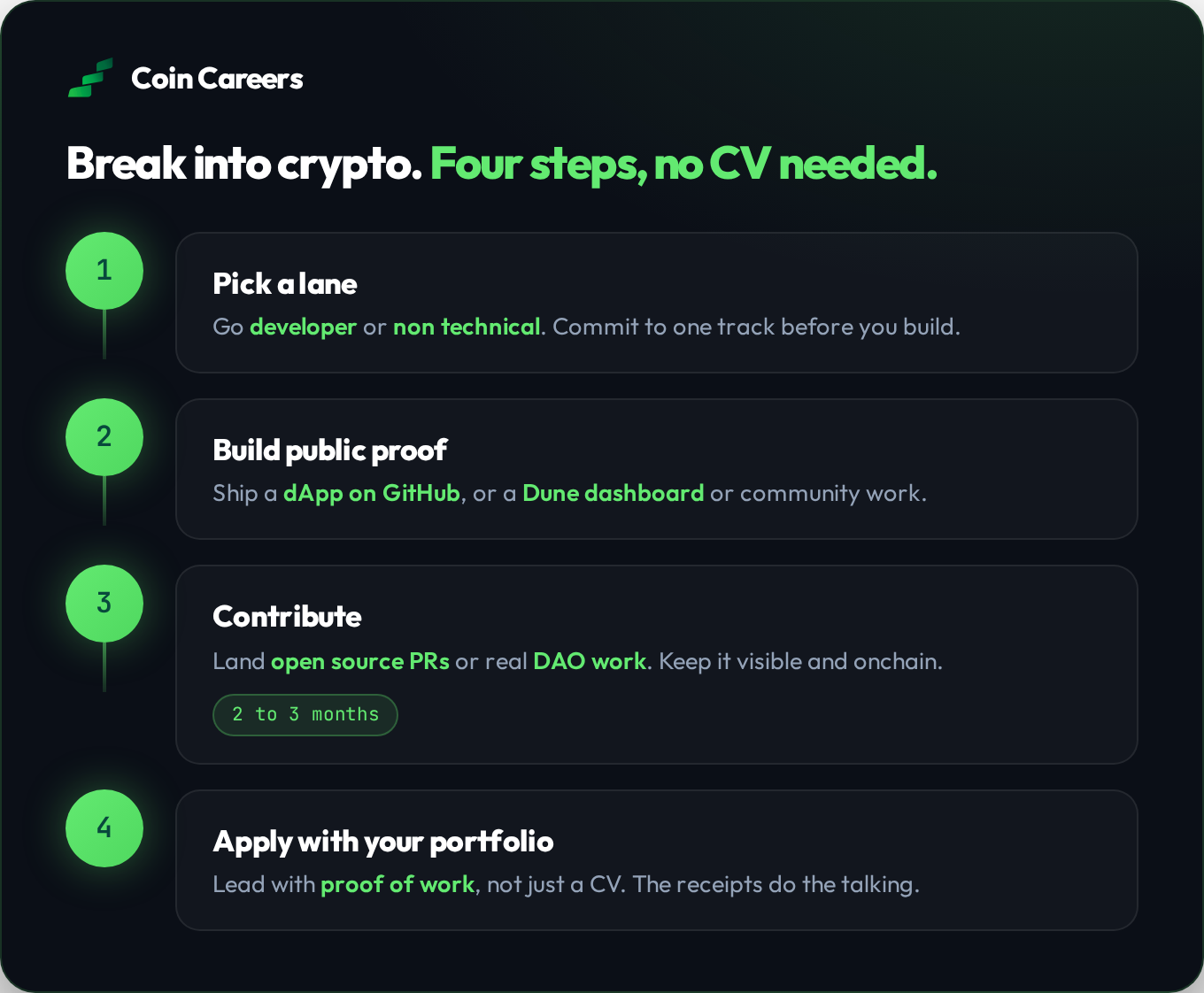
The fastest proven paths in 2026 look like this. For developers, ship something public: deploy a real dApp on a testnet or Layer 2, write tests and put it on GitHub, then contribute to open-source protocols. Several protocols hire junior engineers purely off public GitHub work.
For non-developers, build proof of work in your existing skill. Analysts publish Dune Analytics dashboards, writers publish protocol breakdowns and marketers run a small community or newsletter. In this industry a visible portfolio beats a polished CV, because hiring managers want evidence you can operate on-chain.
What skills do blockchain jobs actually require?
For engineering roles the core stack is Solidity or Rust, plus tooling like Foundry or Hardhat and a working knowledge of common vulnerabilities such as reentrancy and access control bugs. Frontend web3 roles add React with ethers.js or similar libraries.
For everything else, the bar is fluency, not code. You should be able to use a wallet confidently, explain how DeFi lending or an NFT mint works and follow on-chain activity. That baseline alone puts you ahead of most applicants coming from outside the industry.
Crypto Jobs vs Web3 Jobs: Which Should You Apply For?
Apply to both, but target by company type rather than label. If you want the highest base salary and more stability, aim at revenue-generating crypto companies: exchanges, custodians, established DeFi protocols and audit firms. If you want equity-style upside and broader creative work, earlier-stage web3 startups and DAOs offer more token exposure and more ownership.
Remote work is standard across both. Most listings are remote-first, which means you're competing globally but also that a strong candidate in a lower-cost region can land a top-of-market package without relocating.
Whatever side you pick, the market in 2026 rewards proof over potential. Build something visible, learn to talk about token compensation like an adult and start applying. You can browse web3 jobs on CoinTerminal right now and filter by role, salary and remote policy.
FAQ
Are crypto jobs and web3 jobs the same thing?
They overlap but aren't identical. Crypto jobs focus on companies built around digital assets, like exchanges and trading products. Web3 jobs include all of that plus DAOs, NFTs, blockchain gaming and decentralized apps. Job boards often use the terms interchangeably.
Which pays more, crypto or web3?
Base salaries are highest at crypto-native companies with real revenue, especially in security and protocol engineering where senior roles run $150k to $300k or more. Earlier-stage web3 startups often pay lower base but larger token grants, so total comp depends on how those tokens perform.
Can I get a crypto job with no experience?
Yes, and most roles in the industry are non-technical. The reliable route is building public proof of work: a deployed project for developers, or dashboards, content or community work for everyone else. Entry-level pay varies widely, so expect to start below the headline figures.
Do crypto jobs pay in cryptocurrency?
Some do. Most established companies pay base salary in fiat or stablecoins like USDC, with tokens as a bonus layer. Fully decentralized DAOs sometimes pay entirely in crypto. Always confirm the split before signing, and never value unvested tokens at face value.
Are web3 jobs remote?
Overwhelmingly yes. The industry is remote-first by default, and the majority of listings are fully remote with globally distributed teams. Some larger exchanges have moved toward hybrid setups, but remote roles remain the norm, especially in engineering.