Entry Level Crypto Jobs: 10 Roles That Hire Beginners
From community moderator to junior developer: the 10 entry level crypto jobs that hire beginners, what they pay and how to land them.
TLDR
- 10 entry level crypto jobs hire beginners, from community manager to junior developer
- Non-technical roles typically start around $40,000 to $70,000, technical roles $60,000 to $90,000
- Community, support and content roles have the lowest barriers to entry
- Most roles are remote and value proof of work over degrees
If you want to break into web3, the fastest path is targeting entry level crypto jobs where enthusiasm and basic skills matter more than a resume full of blockchain experience. Roles like community manager, customer support agent, content writer and junior analyst regularly hire people with zero industry background. Pay usually starts in the $40,000 to $70,000 range for non-technical work and higher if you can code.
This guide covers 10 roles that genuinely hire beginners, what they pay, what you need to land them and where to apply. You can browse web3 jobs right now to see which of these roles are open this week.
One thing to know upfront: crypto companies care less about credentials than almost any other industry. A GitHub repo, a Twitter thread that got traction or an active Discord presence can beat a degree.
Which entry level crypto jobs actually hire beginners?
Here are the 10 roles where crypto companies routinely hire people without industry experience.
1. Community Manager
You run the project's Discord and Telegram, answer questions, organize events and keep the vibe alive. If you already spend time in crypto communities, you're halfway qualified. Typical pay runs $45,000 to $80,000, with experienced managers at larger projects earning more.
2. Community Moderator
The step below community manager and the single easiest way in. Many projects recruit moderators directly from their most active community members, sometimes starting part-time or paid in tokens. Full-time roles typically pay $30,000 to $50,000.
3. Customer Support Agent
Exchanges and wallet apps need people to help users recover accounts, understand transactions and resolve issues. You need patience, clear writing and a working knowledge of how wallets and exchanges function. Base salaries generally sit between $40,000 and $70,000.
4. Content Writer
Crypto projects publish constantly. Blog posts, documentation, newsletters and social threads all need writers who can explain complex topics simply. Freelance rates vary widely, while full-time junior roles typically pay $45,000 to $75,000.
5. Social Media Manager
You run the project's X account, plan content calendars and jump on trends. Crypto Twitter is its own culture, so genuinely understanding it is the core qualification. Entry pay is usually $40,000 to $70,000.
6. Junior Research Analyst
You track protocols, summarize tokenomics and write market reports for trading firms, media outlets or the project itself. Strong candidates show up with published research, even if it's just a personal Substack. Entry salaries commonly range from $50,000 to $80,000.
7. Junior Blockchain Developer
The highest-paying entry point if you can code. Solidity is the most in-demand language, but Rust is growing fast on Solana and other chains. Junior developers typically start around $60,000 to $90,000, and US-based mid-level developers often clear $100,000 within a few years.
8. QA Tester
You test dApps, wallets and smart contract interfaces before they ship, documenting bugs and edge cases. It requires attention to detail more than deep technical skill and it's a proven springboard into development or product roles. Pay generally runs $45,000 to $70,000.
9. Business Development Associate
You find partnership leads, do outreach and support senior BD staff on deals. Sales experience from any industry transfers well here. Base pay is often $50,000 to $75,000 plus commission or token incentives.
10. Compliance / KYC Analyst
Exchanges and fintech-adjacent crypto firms hire analysts to review customer verifications and flag suspicious activity. It's one of the few crypto roles where a traditional finance or legal background is a direct advantage. Entry salaries typically fall between $45,000 and $70,000.
How do these roles compare?
|
Role |
Typical entry salary (US) |
Technical skills needed |
Barrier to entry |
|
Community Moderator |
$30k–$50k |
None |
Very low |
|
Customer Support |
$40k–$70k |
Basic wallet knowledge |
Low |
|
Social Media Manager |
$40k–$70k |
None |
Low |
|
Content Writer |
$45k–$75k |
None |
Low |
|
Community Manager |
$45k–$80k |
None |
Low |
|
QA Tester |
$45k–$70k |
Light technical |
Medium |
|
Compliance/KYC Analyst |
$45k–$70k |
None |
Medium |
|
BD Associate |
$50k–$75k + commission |
None |
Medium |
|
Junior Research Analyst |
$50k–$80k |
Data literacy |
Medium |
|
Junior Blockchain Developer |
$60k–$90k |
Solidity or Rust |
High |
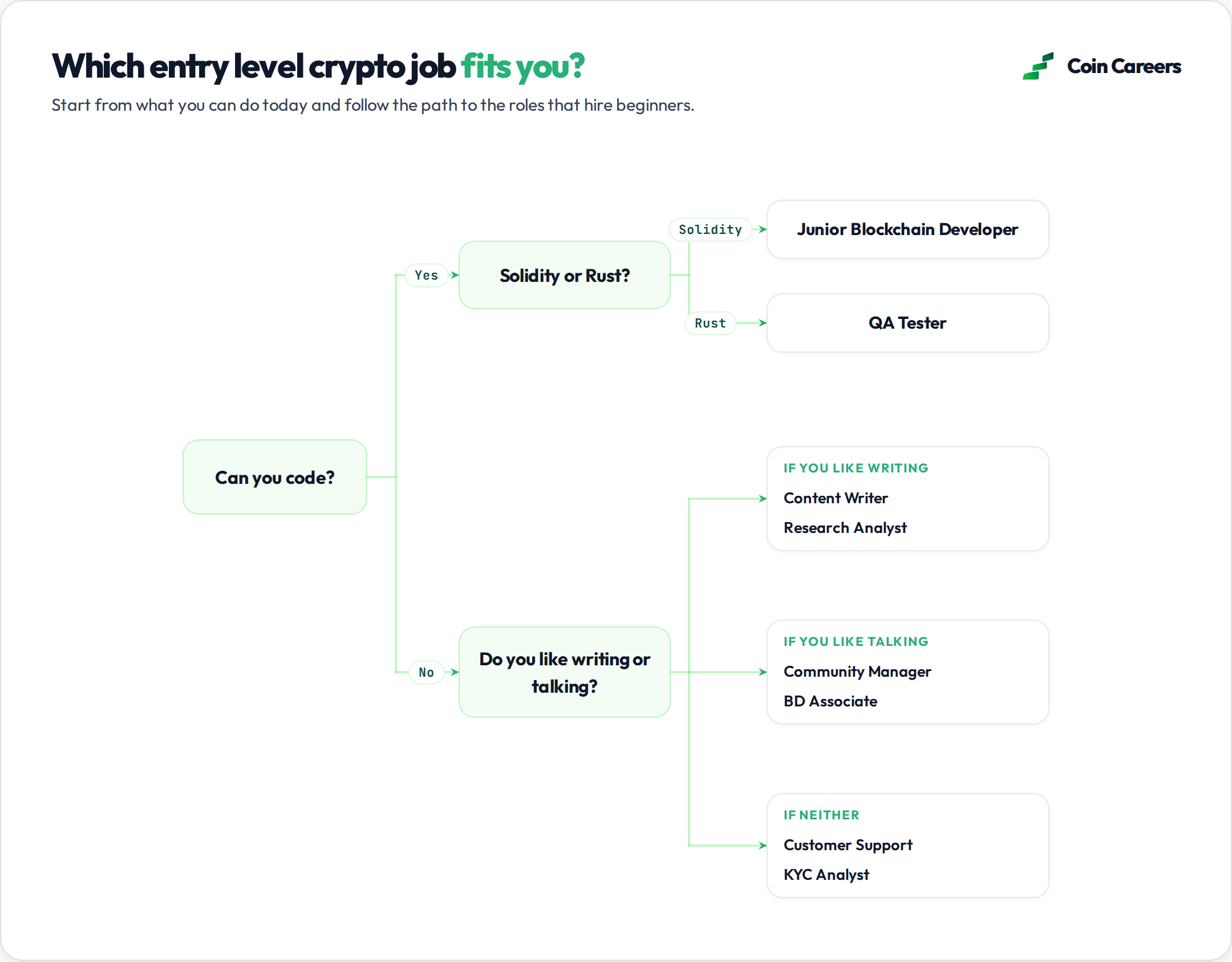
Salaries vary by company size, funding stage and location. Remote roles at global startups sometimes pay below these ranges, while US exchanges and trading firms often pay above them.
What do entry level blockchain jobs pay?
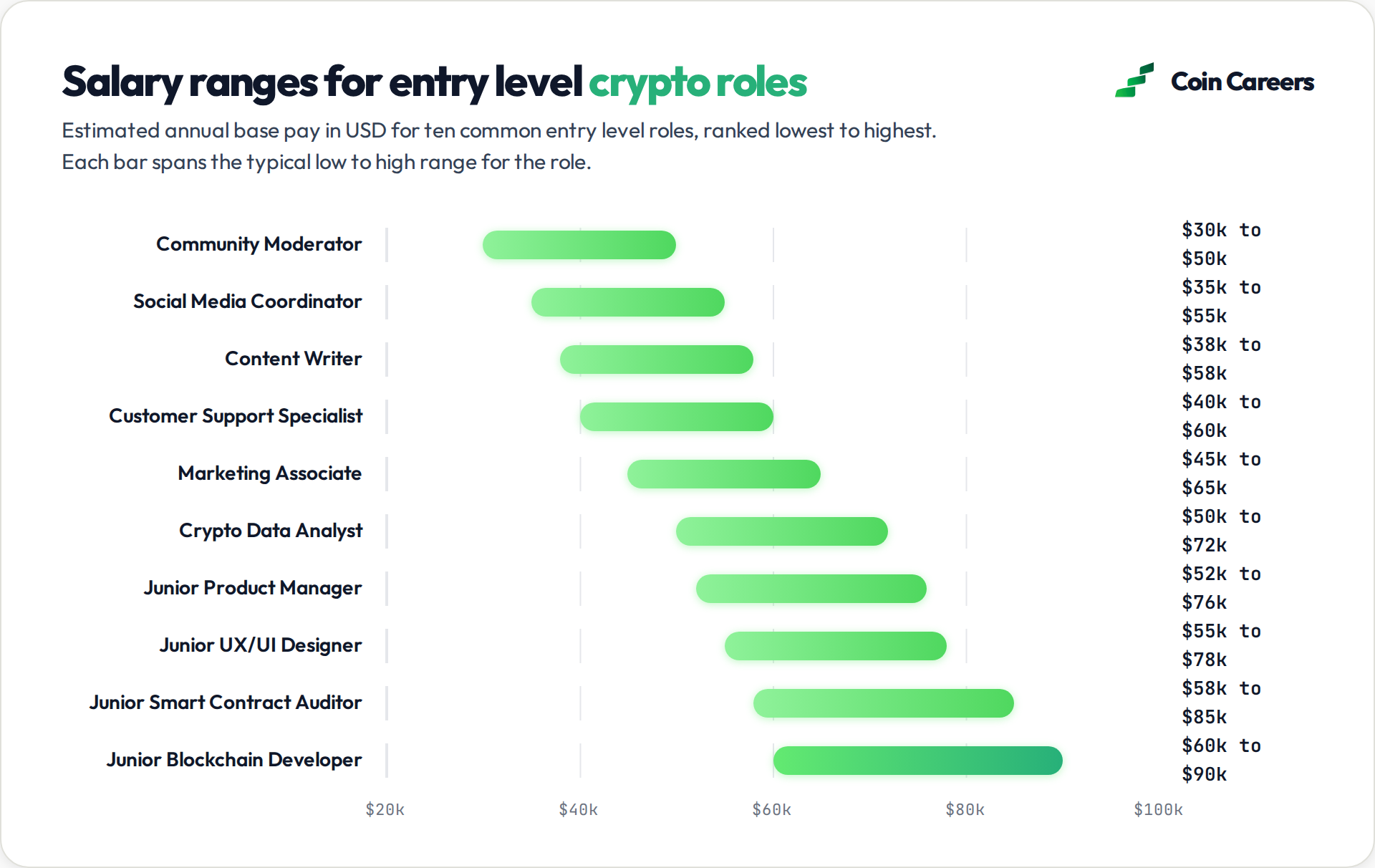
Entry level blockchain jobs pay more than equivalent roles in most industries, but less than the headline numbers you see for senior engineers. Aggregate salary data from crypto job boards puts the global average for entry level roles around $60,000 to $65,000 per year. That figure blends high-paying US technical roles with lower-paying remote positions worldwide.
Three factors move the number most. Technical roles pay 30 to 50 percent more than non-technical ones at the same level. US-based and in-office roles pay more than remote-global. And well-funded exchanges pay more than early-stage startups, though startups often add token allocations.
A note on tokens: many offers include token compensation with vesting schedules. Treat tokens as a bonus, not guaranteed income, and negotiate your base salary as if the tokens were worth zero.
How do you get crypto jobs for beginners with no experience?
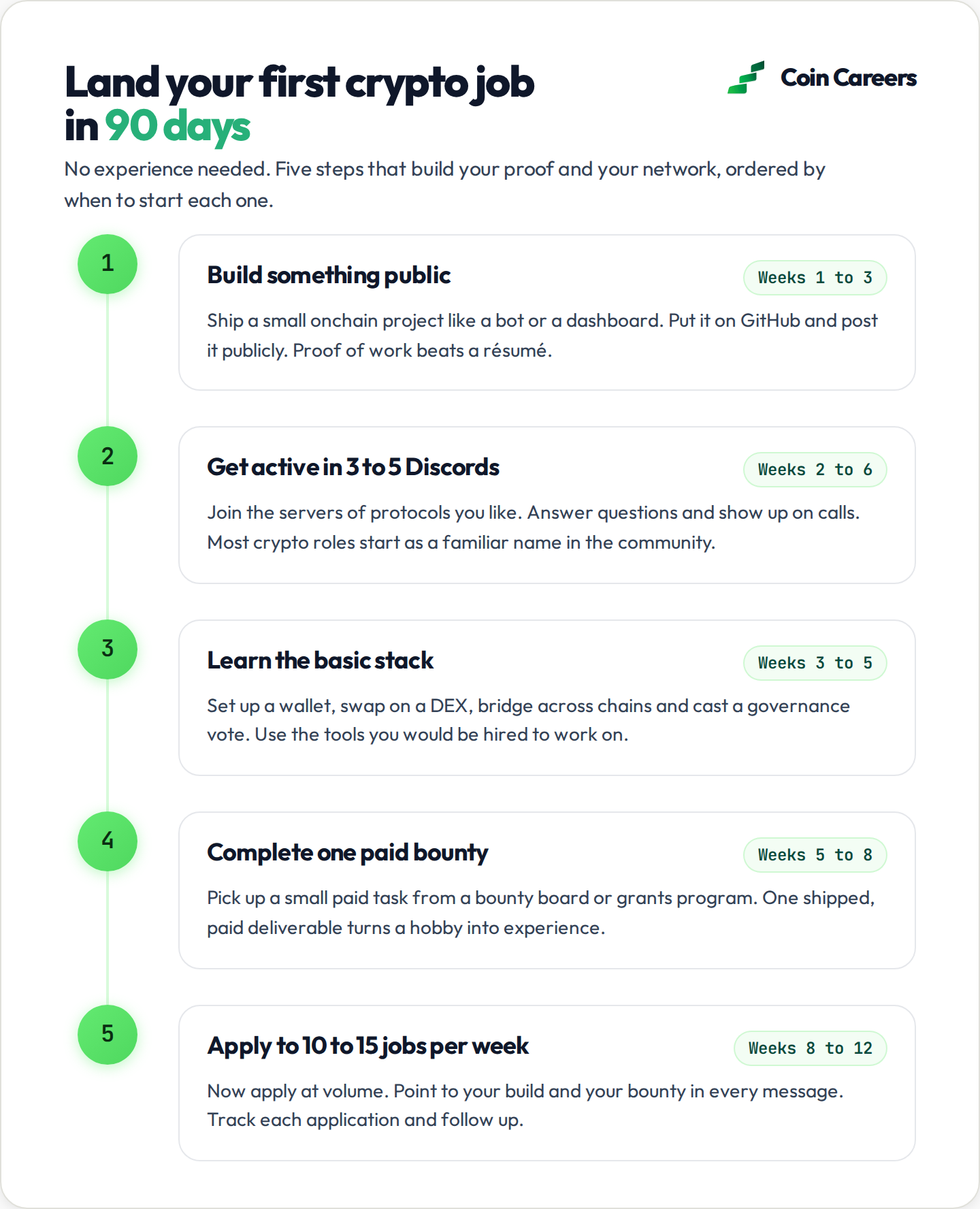
Crypto jobs for beginners go to people who show proof of work, not people with the best cover letter. Here's the playbook that actually works.
Build something public. Write three articles explaining DeFi concepts, contribute to an open source repo or publish a tokenomics breakdown. One visible artifact beats ten applications.
Get active in communities. Join the Discords of projects you admire and be genuinely helpful for a few weeks. Many moderator and community roles are filled from inside the server before they're ever posted.
Learn the basic stack. Set up a wallet, use a DEX, bridge assets between chains and try a governance vote. Interviewers can tell within two minutes whether you've actually used the products.
Do a small freelance gig or bounty. Platforms and DAOs post paid bounties for writing, testing and design work. A completed bounty is a paid credential you can point to.
Then apply in volume. Crypto hiring moves fast and roles close quickly, so apply within the first few days of a posting and follow up on X or Discord where founders actually respond.
Most people can go from zero to hireable in 60 to 90 days following this sequence. The bottleneck is rarely knowledge. It's having something public to show.
Where do you find entry level crypto jobs?
Dedicated web3 job boards beat LinkedIn for crypto roles because listings are current and employers there expect beginner applicants for junior postings. Start with a crypto-native board, then set alerts so you catch new roles early.
Beyond job boards, three channels consistently surface unlisted roles. Project Discords often have a #jobs or #contributors channel. Founders post openings directly on X before HR ever writes a job description. And crypto conferences, including free local meetups, remain the highest-conversion networking in the industry.
Track your applications like a pipeline. Aim for 10 to 15 targeted applications a week with a customized first line, not 50 copy-paste submissions.
Is now a good time to get into crypto?
Honestly, it's competitive. Some recruiters report that companies have become pickier about junior hires and lean toward experienced talent. That's exactly why proof of work matters so much right now.
The flip side is that the industry keeps expanding into payments, gaming, AI and real-world assets, which creates new junior roles that didn't exist two years ago. People who enter during quieter hiring periods tend to be well positioned when the next expansion cycle hits.
Start with the lowest-barrier role you're qualified for, then move up internally. The community moderator who becomes community manager and then head of growth is one of the most common career arcs in web3. Ready to start? Browse web3 jobs and filter for entry level and junior roles.
FAQ
Can I get a crypto job with no experience?
Yes. Community, support, content and moderation roles regularly hire people with no industry experience. What you need is demonstrated interest: an active community presence, published writing or hands-on familiarity with wallets and dApps.
Do I need a degree for entry level crypto jobs?
Usually not. Most crypto companies hire on skills and proof of work rather than credentials. Compliance and some analyst roles at regulated exchanges are the main exceptions where a finance or legal degree helps.
What is the easiest crypto job to get?
Community moderator. Many projects hire moderators directly from their active Discord members, sometimes starting part-time. It pays the least but converts into community manager and marketing roles quickly.
How much do entry level crypto jobs pay?
Non-technical entry roles typically pay $40,000 to $70,000 per year in the US, while junior developer roles start around $60,000 to $90,000. Global remote roles can pay less, and figures vary by company size and funding.
Are entry level crypto jobs remote?
Most are. The majority of crypto companies operate remote-first or hybrid, though exchanges and trading firms in hubs like New York, Miami, London, Dubai and Singapore increasingly want office presence for some roles.