Web3 Jobs Without Coding: 12 Non-Technical Blockchain Careers
You don't need to code to work in web3. Here are 12 non-technical blockchain careers, their real pay ranges and the playbook to land one.
TLDR
- Web3 jobs without coding exist across marketing, community, operations and design
- Typical salaries run $50k to $150k+, with BD and product roles at the top
- Most roles need 3 to 6 months of crypto immersion, not a CS degree
- Community manager and customer support are the easiest entry points
You do not need to write a single line of Solidity to get paid in crypto. Web3 jobs without coding make up a large share of listings at most blockchain companies, covering everything from community management to business development. This guide breaks down 12 real roles, what they pay, what skills you need and how to land your first one. If you want to see what's open right now, browse web3 jobs on Coin Careers.
The short answer to "can I work in web3 without being a developer": yes, and the demand is real. Every protocol, exchange and NFT project needs people who can write, sell, organize and build communities. The technical bar is crypto literacy, not programming.
Why do web3 companies hire so many non-technical people?
Crypto products are confusing by default. Wallets, gas fees and bridges scare off normal users, so companies pay well for people who can translate the tech into plain language.
Web3 projects also live or die by their communities. A protocol with great code and a dead Discord fails. That creates constant demand for community, content and growth roles.
Finally, most web3 teams are small and remote. A 20-person startup cannot afford specialists for everything, so generalists who understand crypto culture get hired fast.
What are the best web3 jobs without coding?
Here are 12 roles, grouped roughly from easiest to hardest to break into. Salary ranges are typical for full-time remote roles at funded projects. Actual pay varies a lot by company stage, region and whether tokens are part of the package.
1. Community Manager
You run the Discord and Telegram, answer questions, organize events and keep the vibe alive. It is the classic entry point because active community members often get hired from within.
Typical pay: $50k to $90k. Skills: writing, moderation, genuine crypto knowledge and thick skin.
2. Customer Support Specialist
Exchanges and wallets need people to help users recover accounts, understand fees and troubleshoot transactions. It is less glamorous than community work but often easier to land because it maps directly to web2 support experience.
Typical pay: $40k to $70k. Skills: patience, clear writing and basic understanding of how transactions work.
3. Content Writer
You write blog posts, docs, newsletters, whitepaper summaries and educational threads. Projects that can explain themselves clearly win users, so good crypto writers stay booked.
Typical pay: $55k to $100k full time, or $0.10 to $0.50+ per word freelance. Skills: research, SEO basics and the ability to make DeFi sound simple.
4. Social Media Manager
You own the X account, plan the content calendar and jump on narratives fast. In crypto the official account often is the marketing department.
Typical pay: $50k to $95k. Skills: meme fluency, timing and knowing when not to post.
5. Marketing or Growth Manager
You run campaigns, partnerships with KOLs, airdrop and quest programs and track what actually brings users. This role pays better than pure social because it ties directly to growth numbers.
Typical pay: $80k to $140k. Skills: campaign planning, basic analytics and knowledge of crypto-native channels like quests and incentive programs.
6. Business Development Manager
You source partnerships, get the token listed, close integrations with other protocols and open doors. BD is one of the highest-paid non-technical tracks because deals move the needle.
Typical pay: $90k to $160k plus bonuses or tokens. Skills: networking, negotiation and a real map of who's who in the ecosystem.
7. Product Manager
You decide what gets built, talk to users, write specs and coordinate designers and engineers. You need to understand how blockchains work conceptually, but you will not write contract code.
Typical pay: $100k to $170k. Skills: prioritization, user research and enough technical literacy to earn engineers' respect.
8. UX/UI Designer
You design wallet flows, dApp interfaces and onboarding that doesn't terrify newcomers. Crypto UX is famously bad, which means good designers stand out fast.
Typical pay: $80k to $150k. Skills: Figma, user research and understanding crypto-specific patterns like signing and approvals.
9. Project or Operations Manager
You keep the team shipping: sprints, timelines, hiring logistics, DAO proposals and vendor management. Many DAOs hire "ops leads" who essentially run the organization day to day.
Typical pay: $70k to $130k. Skills: organization, tooling like Notion and comfort with chaos.
10. Recruiter or Talent Partner
Web3 companies fight hard for talent and generalist recruiters who understand the space are rare. Sourcing a senior Rust engineer requires knowing where crypto devs actually hang out.
Typical pay: $70k to $120k, often with placement bonuses. Skills: sourcing, screening and speaking enough crypto to assess candidates.
11. Compliance or Legal Operations
Regulation is tightening everywhere, so exchanges and DeFi projects hire compliance analysts, KYC specialists and legal ops staff. A law or finance background helps but is not always required for analyst roles.
Typical pay: $70k to $140k. Skills: attention to detail, familiarity with KYC/AML basics and comfort reading regulatory updates.
12. Research Analyst
You analyze protocols, tokenomics and market trends for funds, media outlets or the projects themselves. Strong public research, even a free Substack, is the usual door in.
Typical pay: $70k to $130k. Skills: on-chain data tools like Dune or Nansen, writing and independent thinking.
How do salaries compare across non technical crypto jobs?
|
Role |
Typical salary (USD) |
Entry difficulty |
Best for |
|
Customer Support |
$40k–$70k |
Easy |
Web2 support pros |
|
Community Manager |
$50k–$90k |
Easy |
Active community members |
|
Social Media Manager |
$50k–$95k |
Easy–Medium |
Terminally online creatives |
|
Content Writer |
$55k–$100k |
Medium |
Writers and journalists |
|
Project/Ops Manager |
$70k–$130k |
Medium |
Organizers and PMs |
|
Recruiter |
$70k–$120k |
Medium |
HR and agency recruiters |
|
Research Analyst |
$70k–$130k |
Medium |
Finance and data people |
|
Compliance Analyst |
$70k–$140k |
Medium |
Legal and finance backgrounds |
|
Marketing/Growth |
$80k–$140k |
Medium |
Performance marketers |
|
UX/UI Designer |
$80k–$150k |
Medium–Hard |
Product designers |
|
BD Manager |
$90k–$160k |
Hard |
Sales and partnerships pros |
|
Product Manager |
$100k–$170k |
Hard |
Experienced web2 PMs |
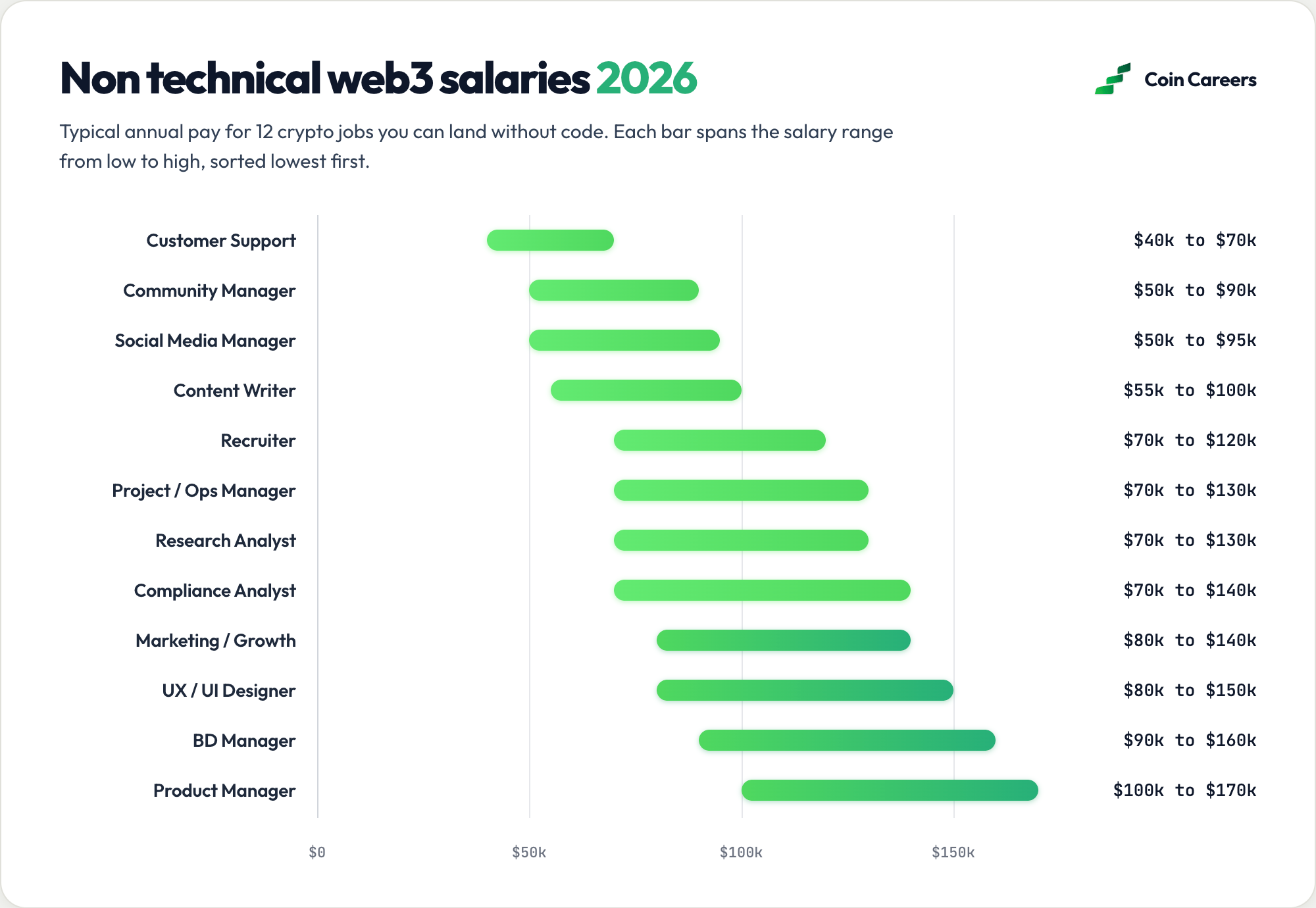
Ranges reflect typical full-time remote offers at funded projects and vary by region, company stage and token compensation. Token grants can add meaningful upside but also carry real risk.
How do you get crypto jobs with no coding experience?
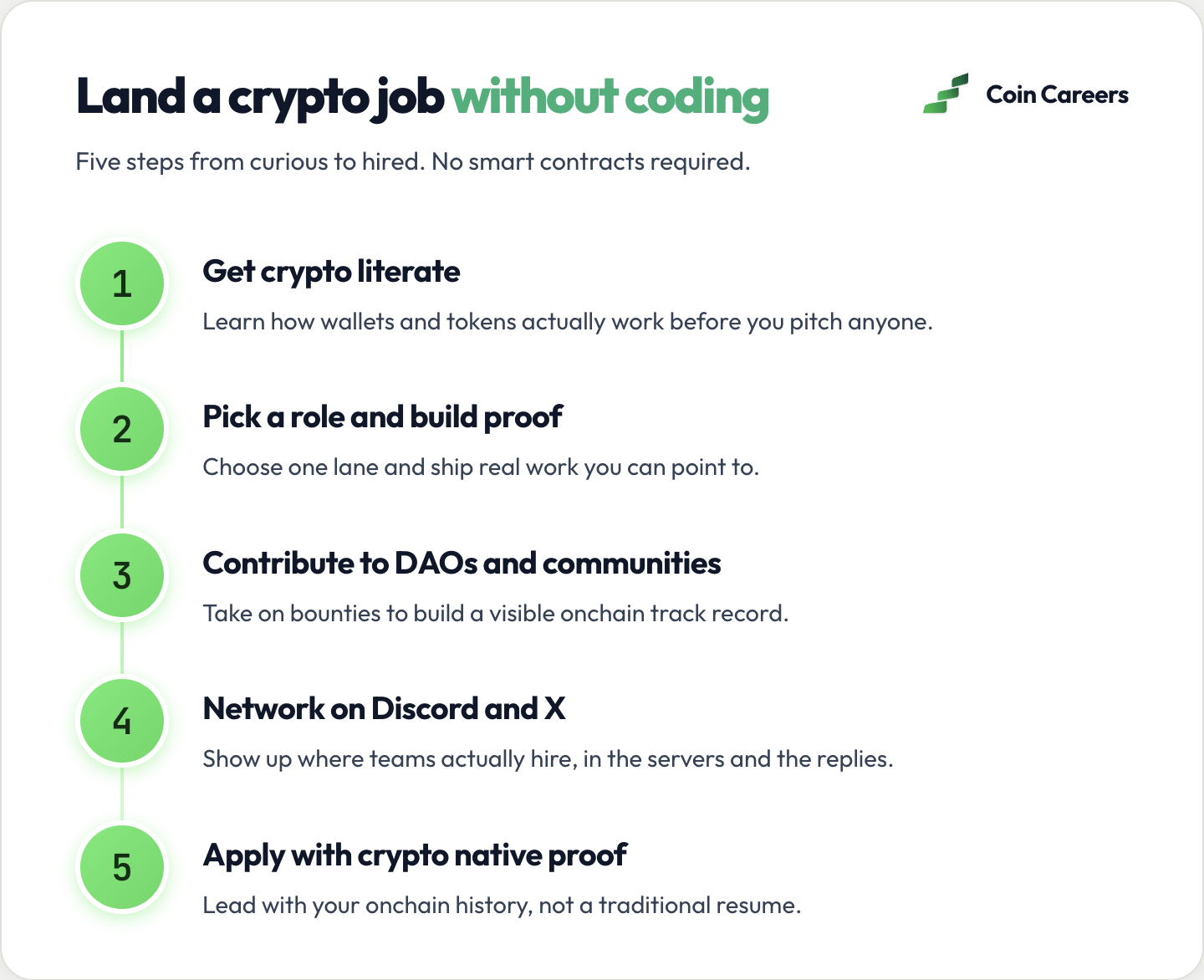
The playbook is the same across roles. Give yourself 3 to 6 months and follow these steps.
1. Get genuinely crypto-literate. Use a wallet, make a swap, mint an NFT and try a few dApps. You cannot fake this in interviews.
2. Pick one role and build proof. Writers publish threads or a Substack. Community people become active mods in a project's Discord. Designers redesign a clunky dApp flow and post the case study.
3. Contribute before you apply. DAOs and open communities let you earn bounties, write proposals or run events. Paid or unpaid contributions become your web3 resume.
4. Show up where hiring happens. Most web3 hires come through Discord servers, X and referrals rather than cold applications. Being visible in a community for two months beats 50 anonymous CVs.
5. Apply with crypto-native proof. Lead with contributions, not your old job title. A single well-received governance proposal or viral educational thread says more than a cover letter.
Which web3 jobs without coding pay the most?
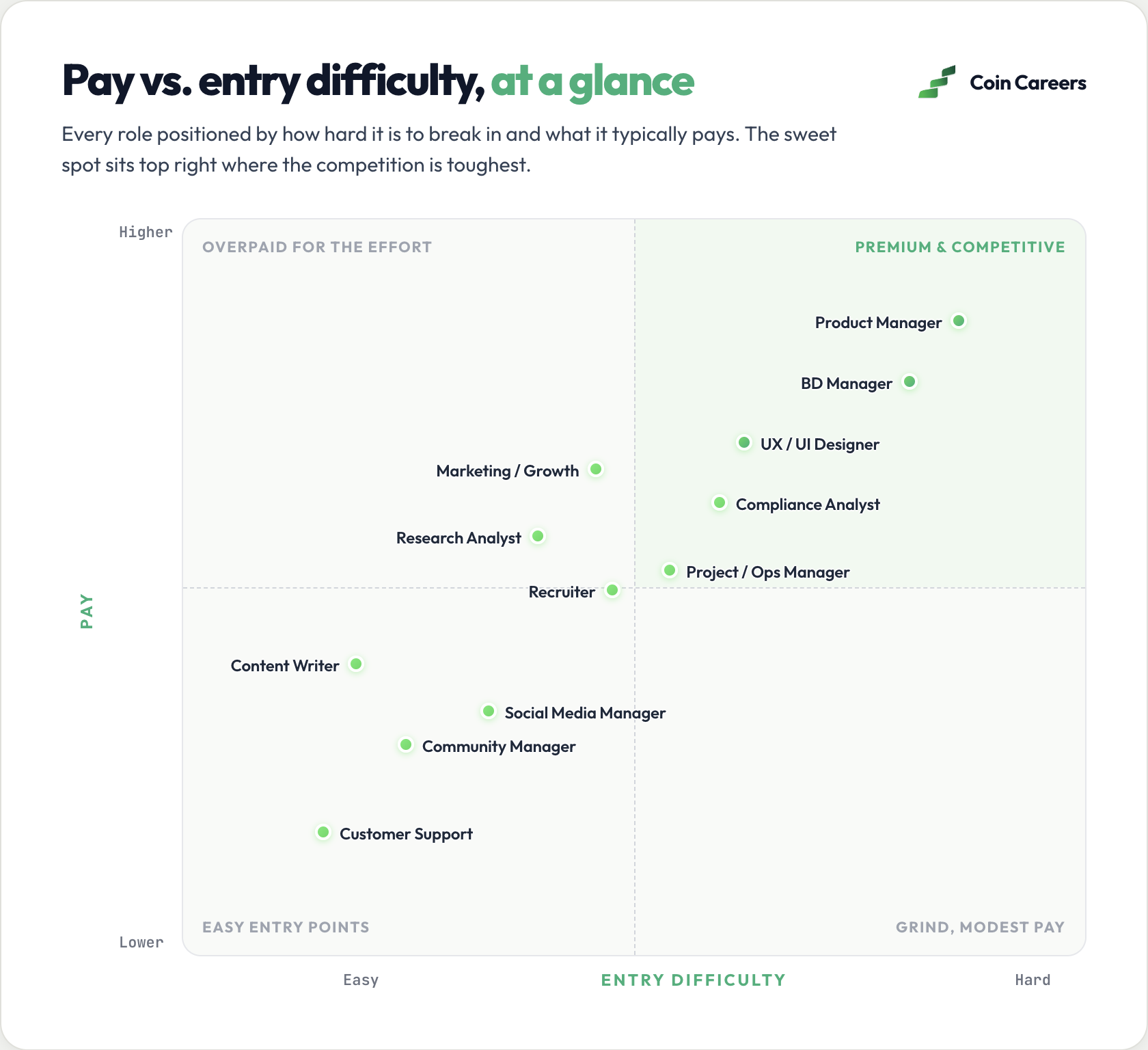
Business development and product management sit at the top, with senior roles clearing $150k plus tokens at well-funded projects. Both reward experience you may already have from web2 sales or product work.
Growth marketing and design come next. If you already run paid campaigns or ship product design in web2, you can often transfer over with a pay bump within a few months of focused learning.
Community and support pay the least but hire the fastest. Many people start there, prove themselves and move into marketing, ops or product within a year.
FAQ
Do I need a degree for non-technical web3 jobs?
No. Web3 hiring is unusually credential-blind. Proof of work like published content, community contributions or shipped campaigns matters far more than a diploma. Compliance and legal roles are the main exception.
Can I get a remote web3 job from anywhere?
Mostly yes. The majority of web3 roles are remote-first, though some companies restrict hiring to certain time zones or regions for legal reasons. Pay is often benchmarked globally rather than to your local market.
How long does it take to land a first role?
Plan for 3 to 6 months if you're starting from zero crypto knowledge. People who are already active in communities often get hired faster because they're visible before they apply.
Are web3 salaries paid in crypto?
It varies. Many companies pay base salary in fiat or stablecoins and add token grants on top. Always clarify the split, the vesting schedule and whether tokens are liquid before accepting an offer.
Is it too late to get into web3?
No. Hiring follows market cycles, but the industry keeps growing between them. Non-technical roles in compliance, product and growth have expanded as the space matures and regulation increases.
Ready to start applying?
You don't need to become a developer to build a career in crypto. Pick one of these 12 roles, spend a few months building visible proof and start conversations in the communities you want to join. When you're ready, browse web3 jobs on Coin Careers and filter for non-technical roles that match your background.