Solana Developer Jobs: The Complete 2026 Career Guide
What Solana developer jobs pay in 2026, the exact Rust and Anchor skills hiring teams want and how to break in: even without a CS degree.

TLDR: Solana developer jobs pay roughly $70k to $110k entry, $115k to $150k mid and $150k to $230k+ senior in the US.: Rust is the core language; Anchor is the standard smart-contract framework., Rare specialist and program-engineer roles at top firms can clear $300k to $500k., Demand outpaces the Rust talent pool, so a shipped project beats a résumé.
Solana developer jobs are among the best-paid entry points in crypto, and the bar to get one is more about proof than pedigree. Most US roles land between $70,000 and $230,000 depending on seniority, with rare specialist positions going far higher. You'll need Rust, comfort with Solana's tooling and ideally a program or dApp you've actually shipped.
Hiring is remote-first and global, so where you live matters less than a public track record. If you want to see what's live right now, you can browse web3 jobs while you work through this guide. Below is the full picture: pay, skills, where the roles are and how to break in.
What do Solana developer jobs actually involve?
Solana developer jobs split into a few lanes: on-chain program development (smart contracts) in Rust, dApp and full-stack work wiring front ends to programs and lower-level protocol or validator tooling. Most openings are for program developers who write, test and deploy on-chain logic. The common thread is performance, Solana's high-throughput design means code is judged on speed and safety, not just correctness.
Day to day, you'll build programs, run them against a local validator and harden them with Anchor's testing suite and static-analysis tools. Many roles overlap with cross-chain work, so comfort with both EVM and non-EVM architectures is a plus. Teams increasingly expect you to reason about exploits before they ship, not patch them afterward.
How much is the average Solana developer salary in 2026?
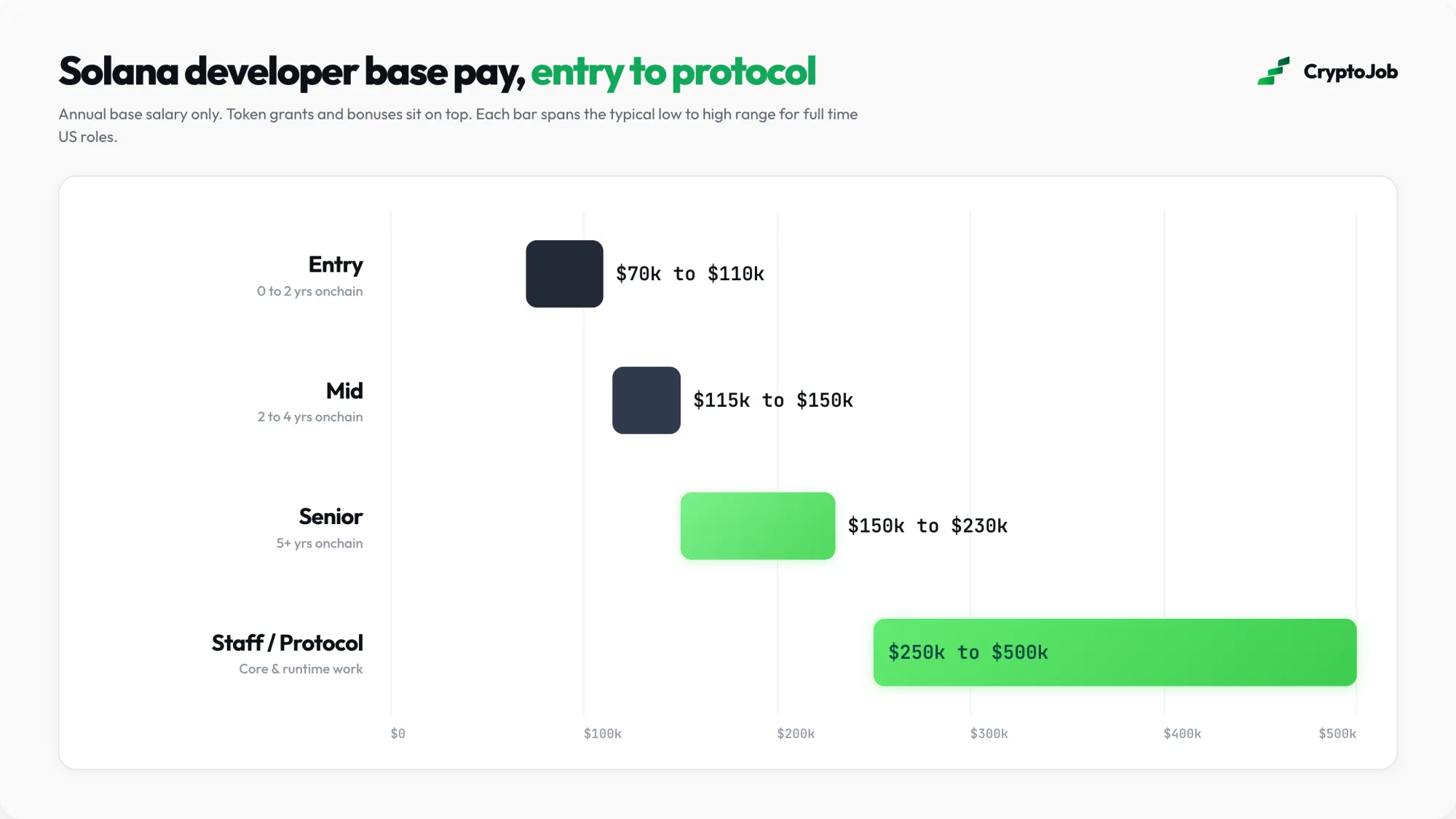
Numbers vary by source and by how "Solana developer" is defined, but the 2026 picture is consistent: this is six-figure territory for anyone past junior. General surveys put the average near $80,000 when they blend in early-career and global submissions, while specialist recruiters report averages closer to $148,000 for experienced US developers. The spread is wide because a junior dApp builder and a core program engineer are barely the same job.
Here's how pay typically breaks down by seniority. Treat these as ranges, not guarantees, funding stage, location and token grants move them significantly.
| Level | Experience | Typical base (US) | What sets the band |
|---|---|---|---|
| Entry / junior | 0 to 2 yrs | $70k to $110k | Usually needs a shipped program |
| Mid-level | 2 to 4 yrs | $115k to $150k | Solid Rust + Anchor, deployed work |
| Senior | 4 to 6 yrs | $150k to $230k | Security depth, mainnet track record |
| Staff / protocol | 6+ yrs | $250k to $500k | Rare; core program or protocol work |
What do entry-level Solana roles pay?
Entry-level Solana work generally starts around $70,000 to $110,000 in the US and genuinely junior openings are scarce. Most teams want to see a deployed program, a hackathon result or open-source commits before they'll take a chance on you. That project requirement is the real gate: not years of experience.
What about senior and specialized roles?
Senior developers with a mainnet track record and security depth command $150,000 to $230,000 or more. At the top, specialized program engineers at well-funded firms have been advertised in the $300,000 to $500,000 range for onsite roles in hubs like New York. Those numbers are rare and reflect the scarcity of people who can write safe, performant Rust at protocol scale.
What skills do you need for Solana developer jobs?
The skill stack is narrower and deeper than general web development. You need real Rust proficiency, fluency with Solana's CLI and SDK and a working grasp of accounts, rent and the SPL token standards. Security tooling and testing discipline are close to non-negotiable, because on-chain bugs are unforgiving and public.
A practical target for a portfolio-ready developer looks like this: Rust, Anchor, the Solana CLI and SDK, the SPL Token, Metaplex and Token-2022 standards, plus at least one security analyzer such as a Slither-style tool. Cover those and you touch most of what production teams actually use.
Why is Rust on Solana the core skill?
Solana programs are written primarily in Rust, and that single fact shapes the entire hiring market. Rust is prized for memory safety and performance, but the pool of engineers who write production-grade Rust for a blockchain is small, which is exactly why the language carries a pay premium. If you're arriving from another ecosystem, deep Rust is the highest-leverage thing you can learn.
Rust developers across crypto average roughly $120,000, with a reported spread from about $70,000 to $275,000 depending on depth and chain. On Solana specifically, that scarcity translates directly into stronger offers and faster interview loops.
How important are Anchor framework skills?
Anchor is the de facto framework for building Solana programs, and most job posts name it explicitly. Strong Anchor framework skills signal that you can ship idiomatic, testable programs rather than wrestling raw program architecture from scratch. Pair Anchor with the token standards above and you cover the vast majority of production work.
If you're still learning, building one complete Anchor project end to end, program, tests and a simple front end, teaches more than any course. It also doubles as the portfolio piece hiring managers ask for by name.
Where can you find Solana developer jobs and how do you get hired?
Solana developer jobs concentrate on crypto-native boards, ecosystem hiring pages and increasingly on-chain through bounties and grants. The Solana Foundation, Anza and hundreds of ecosystem projects hire continuously and much of the work is remote. Bounty programs let you earn and build reputation before you ever apply full time.
To actually get hired, lead with proof: a public GitHub, a deployed program and ideally a security-minded write-up of something you built. Contributing to open-source Solana repos matters because maintainers and hiring managers overlap heavily. For a sense of how this ecosystem compares to the other big one, our Ethereum developer jobs guide is a useful contrast and the highest-paying web3 jobs shows where Solana roles sit against the wider market.
What does the Solana developer career path look like?
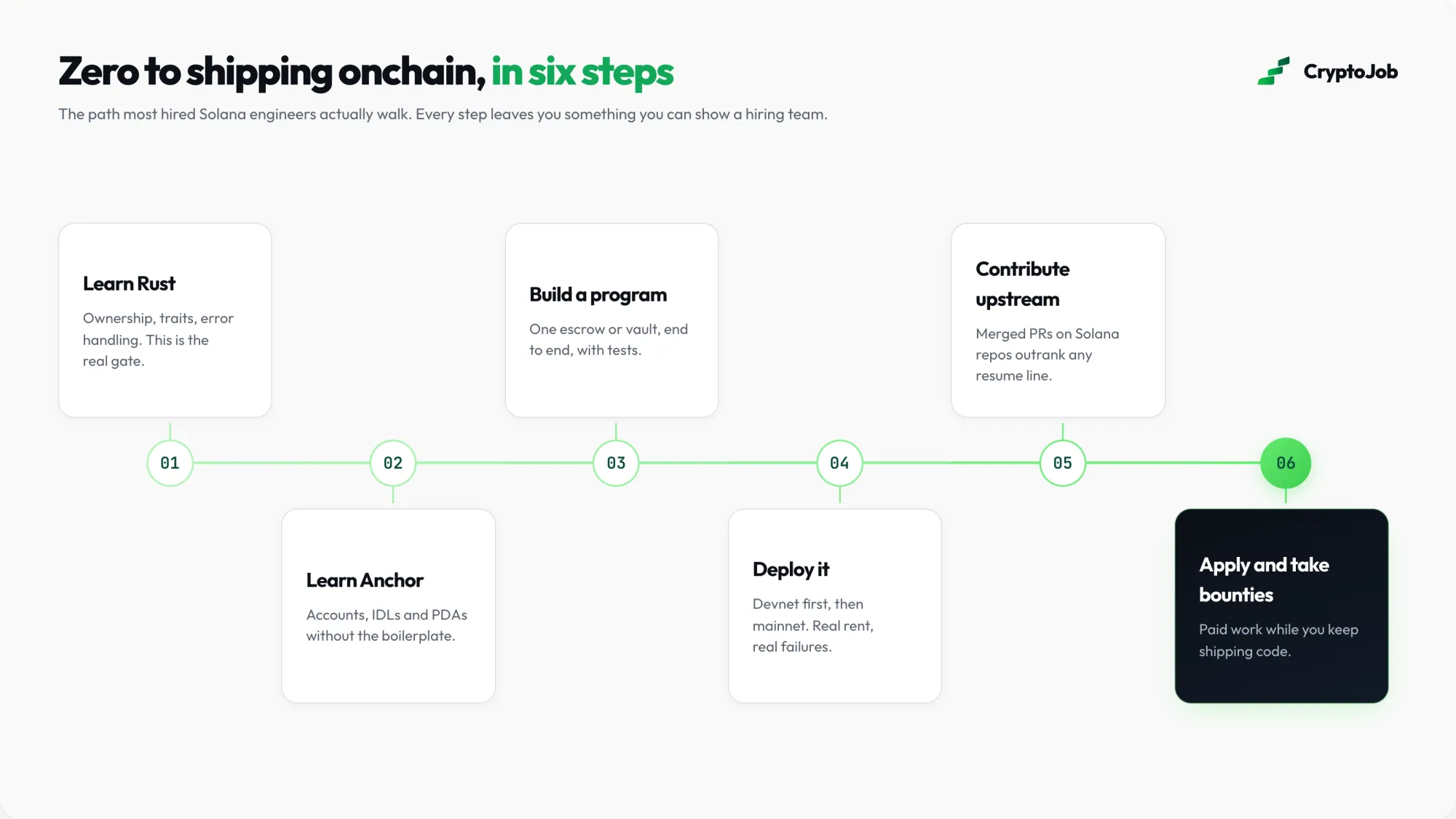
Most people start as a dApp or junior program developer, move into mid-level program work once they've shipped, then specialize, either deep into protocol and performance or sideways into security auditing. Auditing is a common and lucrative next step, because implementation experience is exactly what audit firms want. Leads and architects who own a protocol's on-chain design sit at the top of the range.
The fastest way up is security credibility. Developers who can rigorously reason about exploits, rather than copy a known-good program and hope, earn the biggest jumps. That one competency often separates a mid-level salary from a senior one, and it maps closely to adjacent smart contract developer roles.
Which companies hire Solana developers?
The Solana hiring market runs across the core organizations and a large, active ecosystem. The Solana Foundation and Anza handle protocol-level and core R&D work, while application teams do most of the day-to-day product hiring. Infrastructure providers, DeFi venues and consumer apps all compete for the same Rust talent.
In practice that means wallet teams, DeFi protocols such as Jupiter and infrastructure and tooling providers are all regular employers, alongside NFT and consumer projects. Many hire through bounties and grants first, so contributing to an ecosystem project is often the fastest route onto a payroll. Because the qualified pool is small, a strong open-source contributor is frequently approached rather than having to apply cold.
Frequently asked questions
Do you need a computer science degree for Solana developer jobs?
No. A degree helps, but a deployed program, hackathon results and open-source contributions carry more weight in practice. Teams hire on demonstrated ability far more than on credentials.
How long does it take to become a Solana developer?
For an experienced programmer, three to six focused months on Rust, Anchor and a shipped project is realistic. Complete beginners should plan closer to nine to twelve months. The real variable is how quickly you can produce something live on devnet or mainnet.
Is Rust or Solidity better for getting hired?
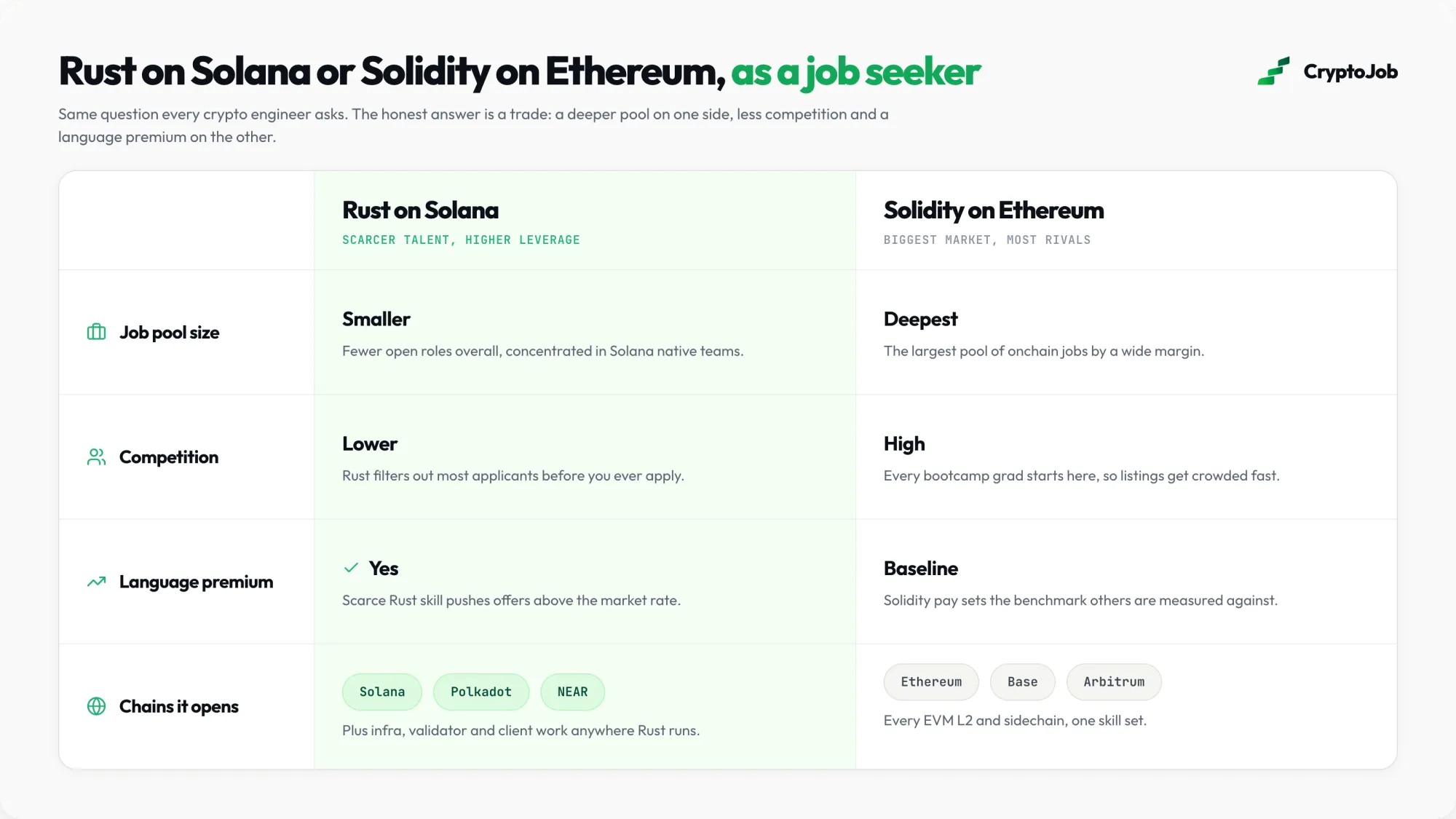
They serve different markets. Solidity has the deepest, most crowded pool across Ethereum and its Layer 2s, while Rust on Solana has fewer roles but less competition and a language premium. Learn the one that matches the ecosystem you want to build in.
Are Solana developer jobs remote?
Mostly yes. The ecosystem is remote-first and global, though a handful of senior and protocol roles are onsite in hubs like New York or Singapore. Location tends to affect pay more than availability.
What's the difference between a Solana program and a smart contract?
They're the same concept with different names. "Program" is Solana's term for on-chain code that other ecosystems call a smart contract. The mechanics and security concerns are broadly equivalent.
The bottom line
Solana developer jobs reward proof over paper: ship a Rust-and-Anchor project, get security-literate and the six-figure roles open up quickly. Pay scales from around $70,000 at entry to well past $200,000 for senior specialists, with rare roles going higher. When you're ready to make a move, browse web3 jobs and start with the remote-friendly listings.