Solana Jobs in 2026: The 3 Doors Into the Ecosystem
There's no company called "Solana" to apply to. There are three doors. Here's the map: Foundation, Anza and 360+ ecosystem roles, the Rust bar and why your GitHub is the real interview.

TLDR
- Solana jobs split across 3 doors: the Foundation, Anza (core R&D) and 360+ ecosystem roles
- The official board at jobs.solana.com listed ~361 openings in 2026
- Core engineering bar: 3+ years Rust or systems languages, Anchor, SPL/SVM
- Neither the Foundation nor Anza publishes salary bands. Comp is set in process
- Open source contributions to Solana repos function as the real first interview
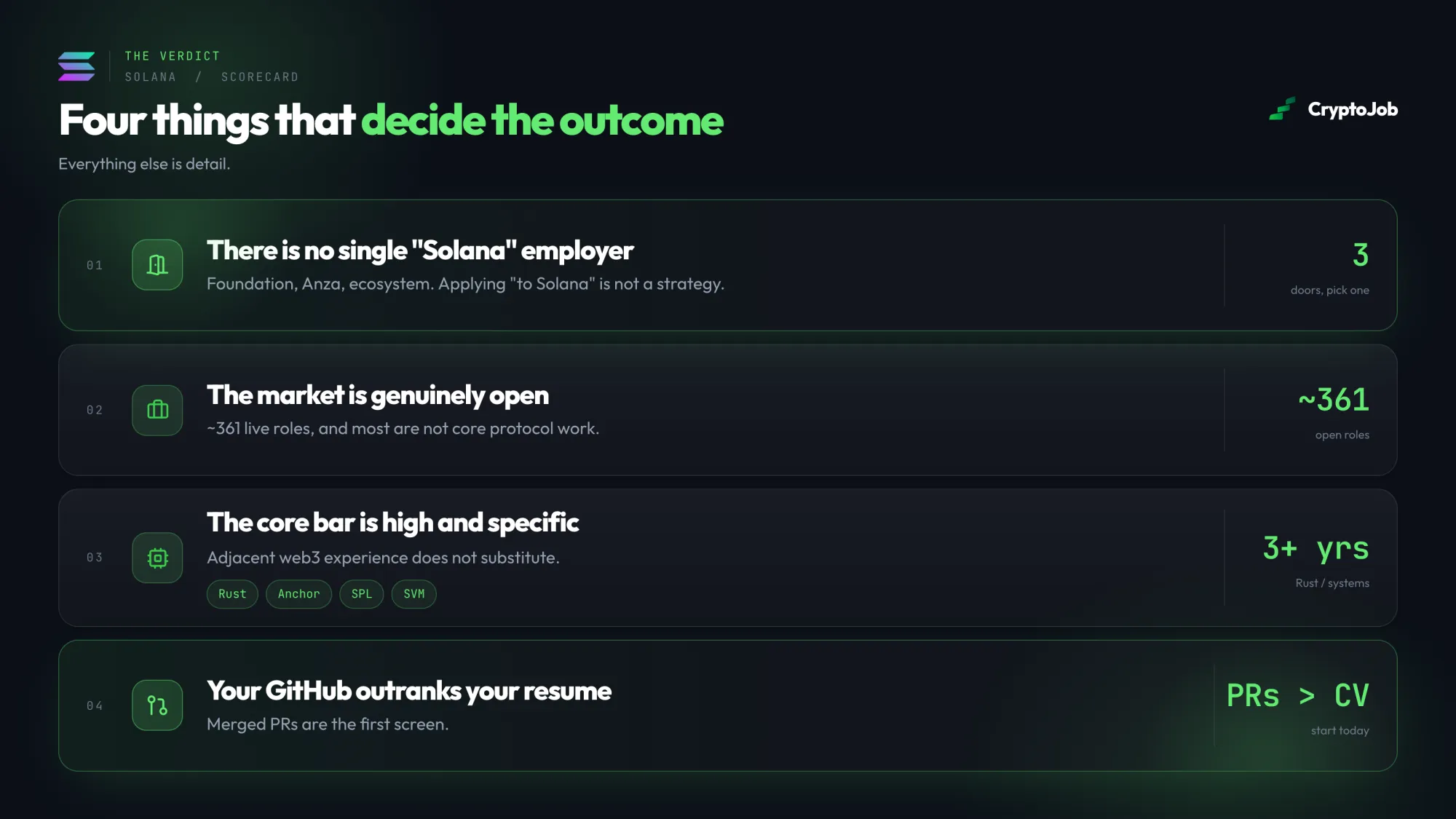
Solana jobs confuse more candidates than any other search in crypto, because there's no single company called "Solana" to apply to. The network's employment map has three doors: the Solana Foundation (a nonprofit in Zug, Switzerland focused on adoption and decentralization), Anza (the R&D lab building the Agave validator client) and a sprawl of ecosystem companies. With the official board at jobs.solana.com listing around 361 open roles across them in 2026.
This guide draws that map, shows which skills each door demands and explains why your GitHub matters more than your resume for the core roles. To see how these openings stack against the rest of the market, browse web3 jobs on CoinTerminal alongside it.
Read this first if you take nothing else: for protocol level Solana work, open source contributions to ecosystem repos are the real screening round. The listings say so almost verbatim.
Who Actually Hires for Solana Jobs?
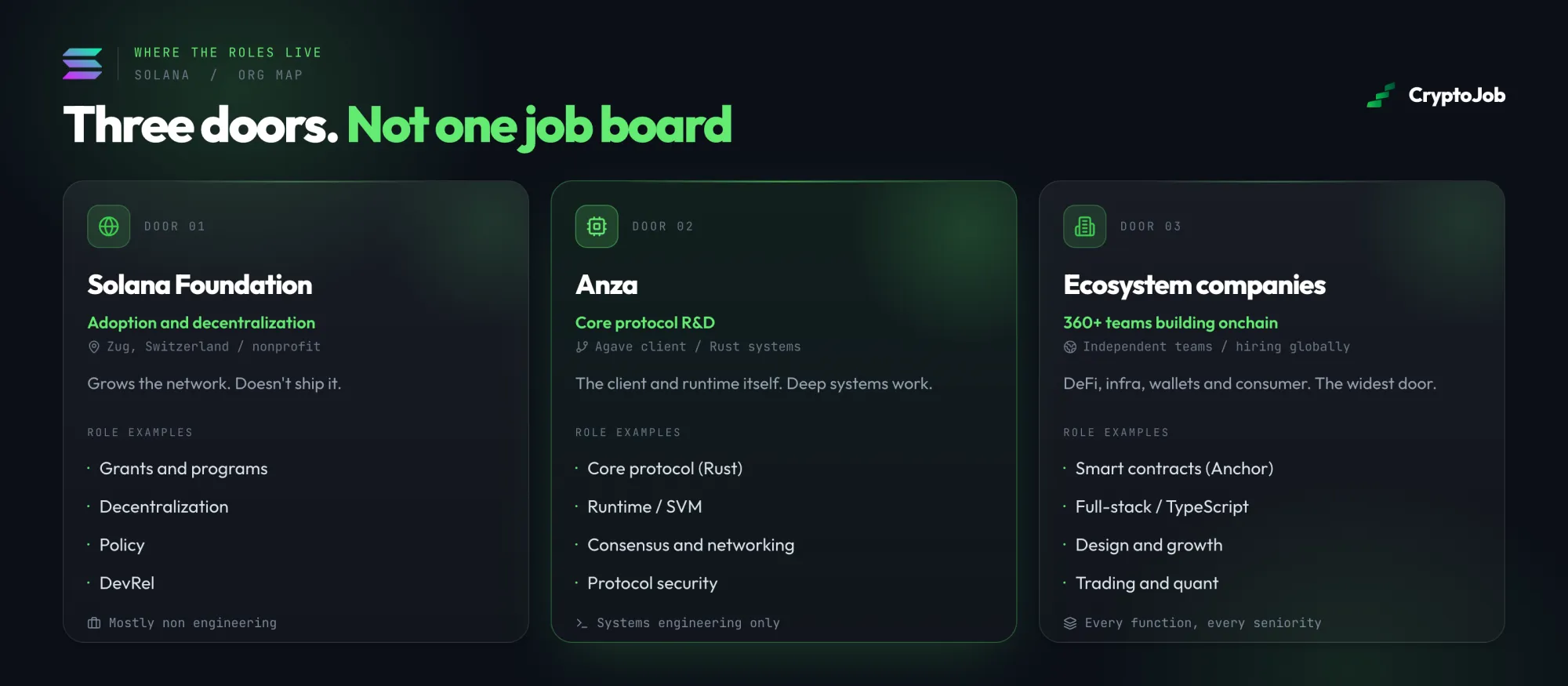
Three distinct employers with three distinct profiles:
The Solana Foundation is the Zug based nonprofit dedicated to the network's adoption, decentralization and security. It hires the ecosystem's connective tissue, business development, partnerships, growth, compliance and legal, plus a product team that builds developer facing tooling like the Solana Attestation Service and the Kora gasless relayer.
Anza is the core engineering door: a Solana R&D lab developing the Agave validator client and advanced developer tooling. Its 2026 openings, consensus engineers, runtime engineers working on JIT compilers, virtual machines and toolchain optimization, are among the deepest systems roles in crypto, driven by the Alpenglow consensus upgrade designed to cut finality to 100 to 150 milliseconds. (Firedancer, a second validator client, is built by a separate team at Jump. Another door for elite systems engineers.)
Ecosystem companies are where most Solana jobs actually live: custody firms, payment apps, infrastructure providers and trading shops hiring through the official board. Recent listers included Anchorage Digital, Douro Labs and Kast, spanning New York, London, Tampa and remote.
| Door | What it is | Hiring focus | Where to apply |
|---|---|---|---|
| Solana Foundation | Nonprofit, Zug | BD, partnerships, growth, compliance, product tooling | jobs.solana.com / solana.org |
| Anza | Core R&D lab (Agave client) | Consensus, runtime, JIT/VM, toolchain | anza.xyz careers |
| Ecosystem companies | 360+ roles across firms | Everything: eng, product, ops, legal | jobs.solana.com board |
What Roles Are Open in 2026?
Foundation listings this year skew commercial: a Trading Growth Lead for the Americas tasked with winning desks and exchanges onto Solana, a Business Development Lead for payments and fintech driving US adoption, a Product Partnerships Manager bridging inbound demand to product teams, plus KYC compliance and senior regulatory counsel roles. The signal is unmistakable. The Foundation is hiring to institutionalize the network, not just evangelize it.
Anza's listings are the mirror image: pure systems depth. Consensus and runtime engineers, compiler and linker work, VM security and performance. Roles where the job description reads like a systems programming syllabus.
Ecosystem roles cover the full spectrum, from mid senior engineering to director level positions, refreshed daily on the official board. Set a weekly check rather than a one time scan. Ecosystem listings turn over quickly, and the newest postings draw the least competition.
Where do you find official Solana careers listings?
jobs.solana.com is the canonical Solana careers hub, aggregating Foundation, Anza and vetted ecosystem openings in one place. Foundation roles frequently appear as US remote; Anza roles are remote friendly for the right systems background. Beware impersonators. Apply through the board or the entities' own domains, never through unsolicited DMs.
What Skills Do Solana Developer Jobs Require?
The Foundation's own engineering listings spell out the bar with unusual precision: 3+ years with Rust or comparable systems languages (C++, Go, Java), at least a year building Solana programs with Anchor or vanilla Rust, deep familiarity with the SPL token standard and the SVM and, stated outright, active open source contributions to ecosystem projects like Anchor, Pinocchio, Shank and Codama. AI code tooling familiarity appears as a bonus qualification, echoing what we found at Binance.
That open source line deserves emphasis: it converts hiring from resume screening into portfolio review. A merged PR into a core Solana repo is worth more than any cover letter, and it's an entry path that costs nothing but time.
How much do Solana jobs pay?
Here's the honest answer most listicles dodge: neither the Foundation nor Anza publishes salary bands. Anza's listings state compensation is determined through the interview process based on experience, skill and location. Aggregator estimates for "Solana Foundation" roles (one pegged an average near $81k, another a single listing at $34k to $80k) are unreliable, mixing in ecosystem adjacent postings and low ball estimates.
What you can bank on: senior Rust protocol engineers are among the scarcest profiles in crypto, ecosystem companies pay full market rates for them and comparable core protocol roles industry wide command strong six figures. Set your anchor from the broader market. Our exchange guides like Binance jobs show what the deep pocketed bidders pay. And negotiate Foundation or Anza offers against it. It varies; make the process name a number early.
How Do You Get Hired for Solana Jobs?
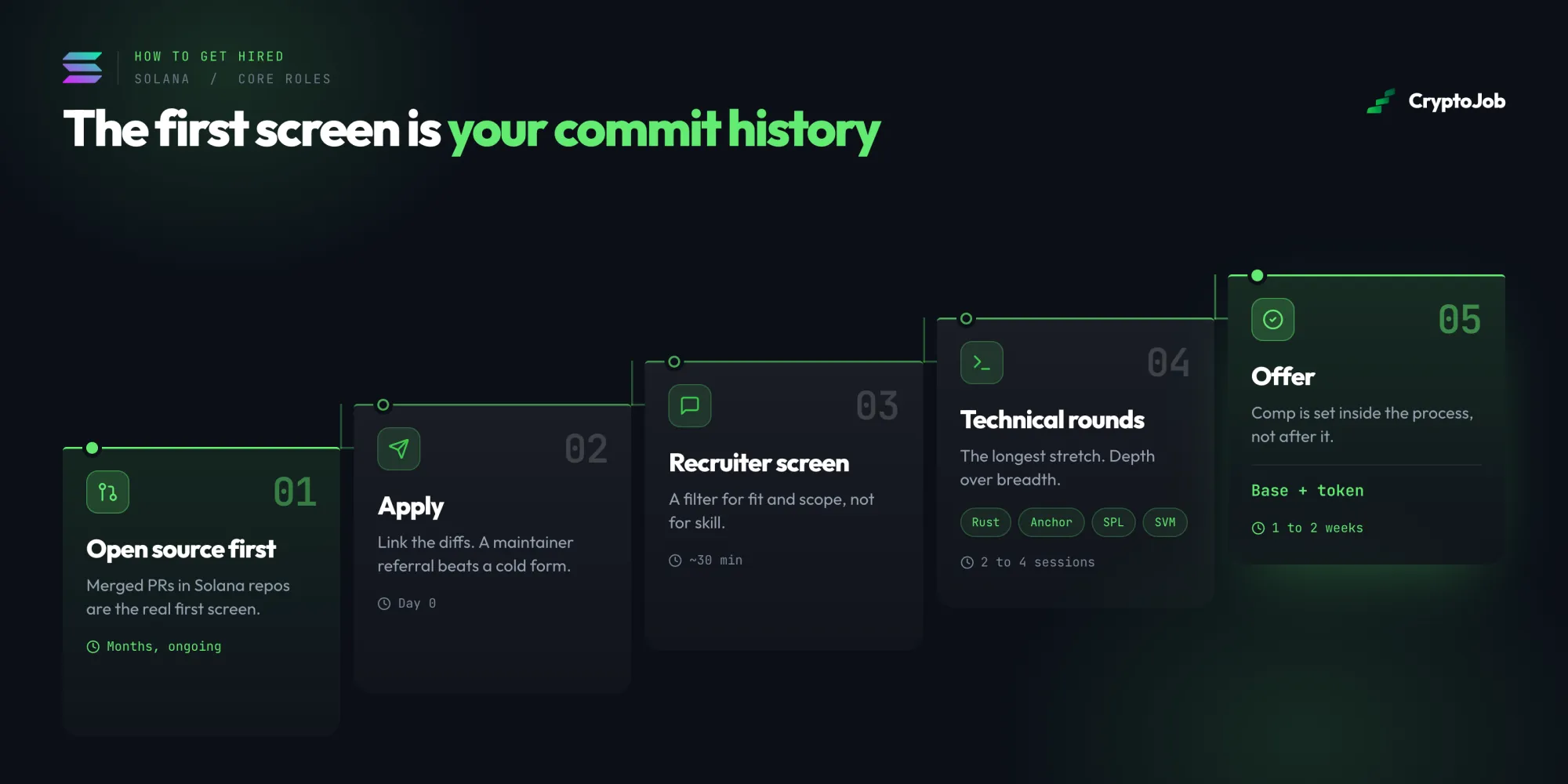
The process differs by door. Foundation commercial roles run conventional loops. Recruiter screen, hiring manager and stakeholder rounds, case style questions on how you'd grow adoption in your region. Anza and core engineering loops are portfolio first: expect deep technical conversations anchored to your open source work and systems experience, with the Alpenglow era roadmap (the Votor and Rotor components) as useful context to know cold.
What's the fastest path in for developers?
A concrete 90 day plan: learn Anchor and ship two small programs; pick one target repo (Anchor, Pinocchio or tooling like Codama) and land three meaningful merged PRs; write up what you built; then apply with the GitHub links leading. Hackathons compress this further. Solana's hackathon circuit has historically been a direct hiring and funding funnel into the ecosystem. Winning isn't the point; shipping is. Sponsor teams and ecosystem recruiters review submissions, and a finished project with a clean repo keeps circulating long after the event ends.
How do Solana jobs compare with other web3 jobs?
Against other web3 jobs, the Solana ecosystem trades salary transparency for openness of entry: pay bands are opaque, but the door is genuinely open to anyone whose code merges. It also skews harder toward Rust than EVM ecosystems' Solidity. A moat worth building, since Rust protocol skills transfer across modern chains. Engineers building that stack from cost effective bases have an edge; our guide to remote web3 jobs covers how engineers compete for those seats from anywhere.
For a structural contrast, the network's data layer is hiring too. Chainlink's oracle roles serve Solana among other chains, fully remote, profiled in our Chainlink jobs guide.
Final Take: Are Solana Jobs Worth Chasing in 2026?
Yes. With the right expectations for your door. Commercial candidates get a Foundation actively institutionalizing payments and trading adoption. Systems engineers get some of the hardest, most career defining protocol work in the industry at Anza, gated by a portfolio they can start building today for free. Everyone else gets 360+ ecosystem roles refreshed daily.
The opacity on pay is the one real friction: force numbers early, benchmark against the market and keep parallel options moving, browse web3 jobs so every Solana conversation happens with alternatives in hand.
FAQ
Can you work directly for Solana?
Not exactly. There's no single "Solana" employer. The Solana Foundation (nonprofit, Zug) hires for adoption, BD and compliance; Anza hires core protocol engineers building the Agave client; and 360+ ecosystem companies hire through jobs.solana.com.
What skills do Solana developer jobs require?
Foundation and core listings ask for 3+ years of Rust or comparable systems languages, experience building Solana programs with Anchor, SPL/SVM familiarity and active open source contributions to ecosystem repos. AI code tooling familiarity is an increasingly common bonus.
How much do Solana Foundation jobs pay?
The Foundation and Anza don't publish salary bands. Listings state compensation is set during the interview process by experience, skill and location. Aggregator estimates are unreliable; benchmark against market rates for senior Rust protocol engineers and ask for the band early.
Is the Solana Foundation remote?
Many Foundation roles list as US remote, and Anza roles are remote friendly for strong systems candidates. Ecosystem roles span remote, New York, London and other hubs. Check each listing.
What is Anza?
Anza is the R&D lab at the center of Solana core development, building the Agave validator client and developer tooling and driving upgrades like Alpenglow (targeting 100 to 150ms finality). Its consensus, runtime and JIT/VM roles are among crypto's deepest systems engineering jobs.