Solidity Developer Jobs: Salary, Skills and How to Get Hired
What Solidity developer jobs pay in 2026: base and tokens: the skills employers screen for, and how to break into EVM smart contract work.

TLDR: Solidity developer jobs pay about $90k to $120k junior, $140k to $175k mid and $180k to $230k senior base in the US., Senior total comp tops $250k once token grants are included; audit-focused contract work runs $150 to $300/hr., Audit experience is the single biggest lever on pay., It's the deepest smart-contract job market and the best on-ramp into web3.
Solidity developer jobs are the most abundant smart-contract roles in web3, because Solidity powers Ethereum and nearly every EVM chain. In the US, base pay runs from around $90,000 for juniors to $230,000 for seniors, with token grants pushing senior packages past $250,000. The market is deep but competitive, so what you can demonstrate matters more than what's on your CV.
This guide covers what the roles involve, what they pay by level, the skills employers screen for and how to break in. If you want to scan live openings first, you can browse web3 jobs and return for the specifics.
What do Solidity developer jobs involve?
Solidity developer jobs center on writing, testing and deploying smart contracts on Ethereum and other EVM chains. You'll build the on-chain logic behind DeFi protocols, NFT platforms, DAOs and infrastructure, then defend it against exploits. Because deployed code is immutable and holds real value, security and gas efficiency are the whole game.
The work usually spans the full contract lifecycle: design, implementation, testing with frameworks like Foundry or Hardhat, audits and post-deployment monitoring. Many developers also handle integration, connecting contracts to front ends. Over time, a lot of Solidity engineers move toward security auditing, where implementation experience is exactly what firms want.
Are Solidity developer jobs still in demand in 2026?
Yes, Solidity remains the deepest smart-contract market by a wide margin, spanning Ethereum, Polygon, Arbitrum, Optimism and the rest of the Layer 2 world. Demand for smart-contract developers grew sharply into 2026, and security-literate Solidity engineers are especially sought after as DeFi exploits get more sophisticated. That said, it's also the most crowded pool, so standing out takes real proof.
Solidity is also widely considered the best introduction to web3 development. That makes it a smart first language even if you later branch into other ecosystems.
What is the average Solidity developer salary in 2026?
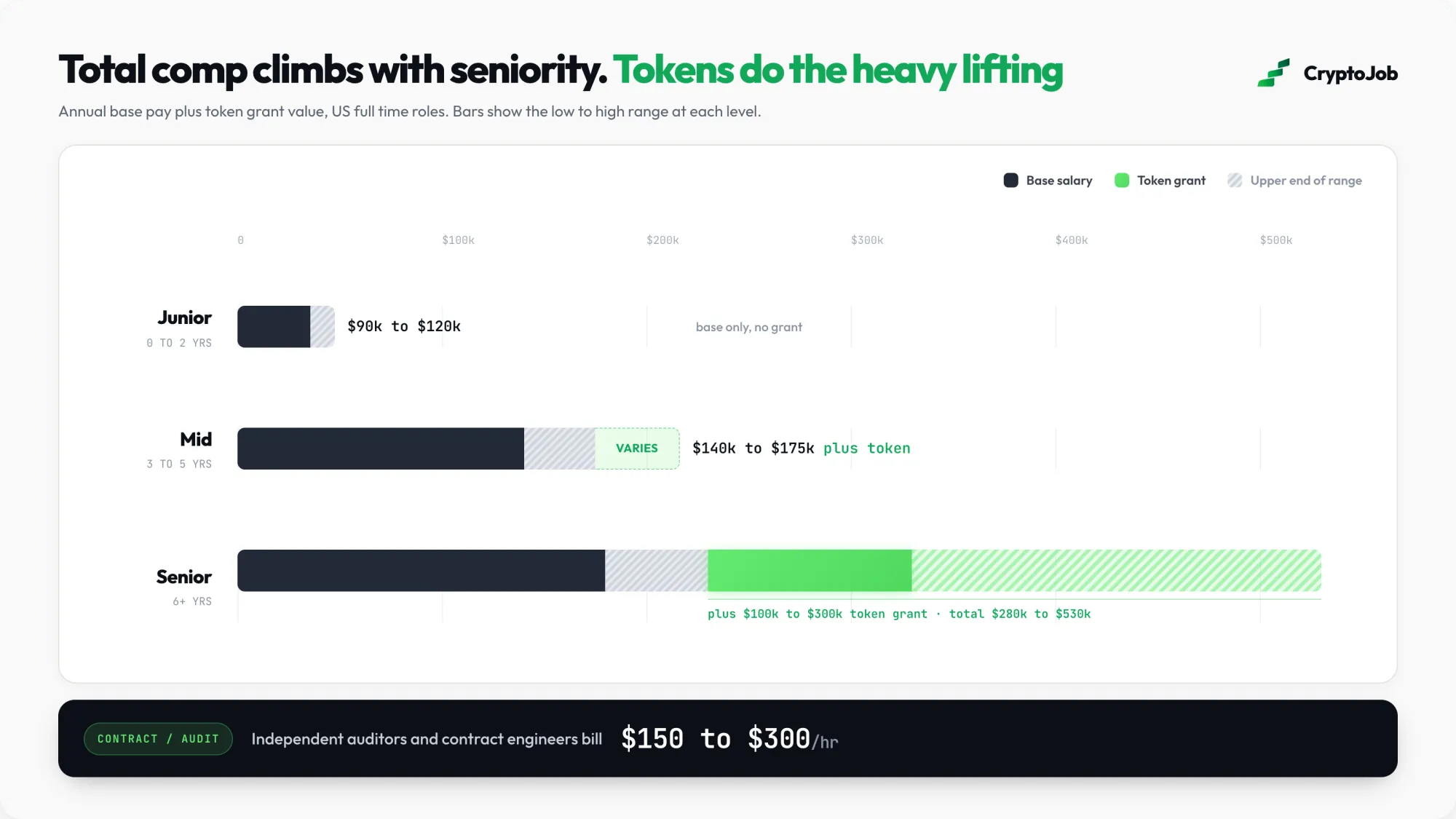
Reported averages sit around $150,000 to $175,000 for the US, but the number you'll actually see depends heavily on level, location and how comp is structured. Full-time base is only part of it, token grants and, for contractors, hourly audit rates can change the picture entirely. Global and remote averages run lower because they blend in lower-cost regions.
Here's the typical US breakdown by seniority. Token grants vest over several years, so treat total-comp figures as signals rather than cash in hand.
| Level | Experience | Base (US) | Token grant | Total comp signal |
|---|---|---|---|---|
| Entry / junior | 0 to 2 yrs | $90k to $120k | small or none | ~$100k to $130k |
| Mid-level | 2 to 4 yrs | $140k to $175k | vests 3 to 4 yrs | ~$175k to $220k |
| Senior / staff | 4+ yrs (audit) | $180k to $230k | $100k to $300k | $250k+ |
| Contract / audit | , | $150 to $300/hr | , | project-based |
What do junior Solidity roles pay?
Junior Solidity roles run roughly $90,000 to $120,000 in base pay and they're genuinely scarce. Employers almost always want a substitute for professional experience: a deployed contract on mainnet, a completed audit or a notable open-source contribution. Clear that bar and you can move to mid-level quickly.
What do senior and audit-focused roles pay?
Senior and staff engineers with audit experience earn about $180,000 to $230,000 base, with token grants worth $100,000 to $300,000 pushing total comp past $250,000. Audit experience is the biggest single lever here, it can add roughly a full seniority tier to your billing rate. Dedicated contract and audit work is typically priced at $150 to $300 per hour depending on protocol complexity and reputation.
How does location change Solidity pay?
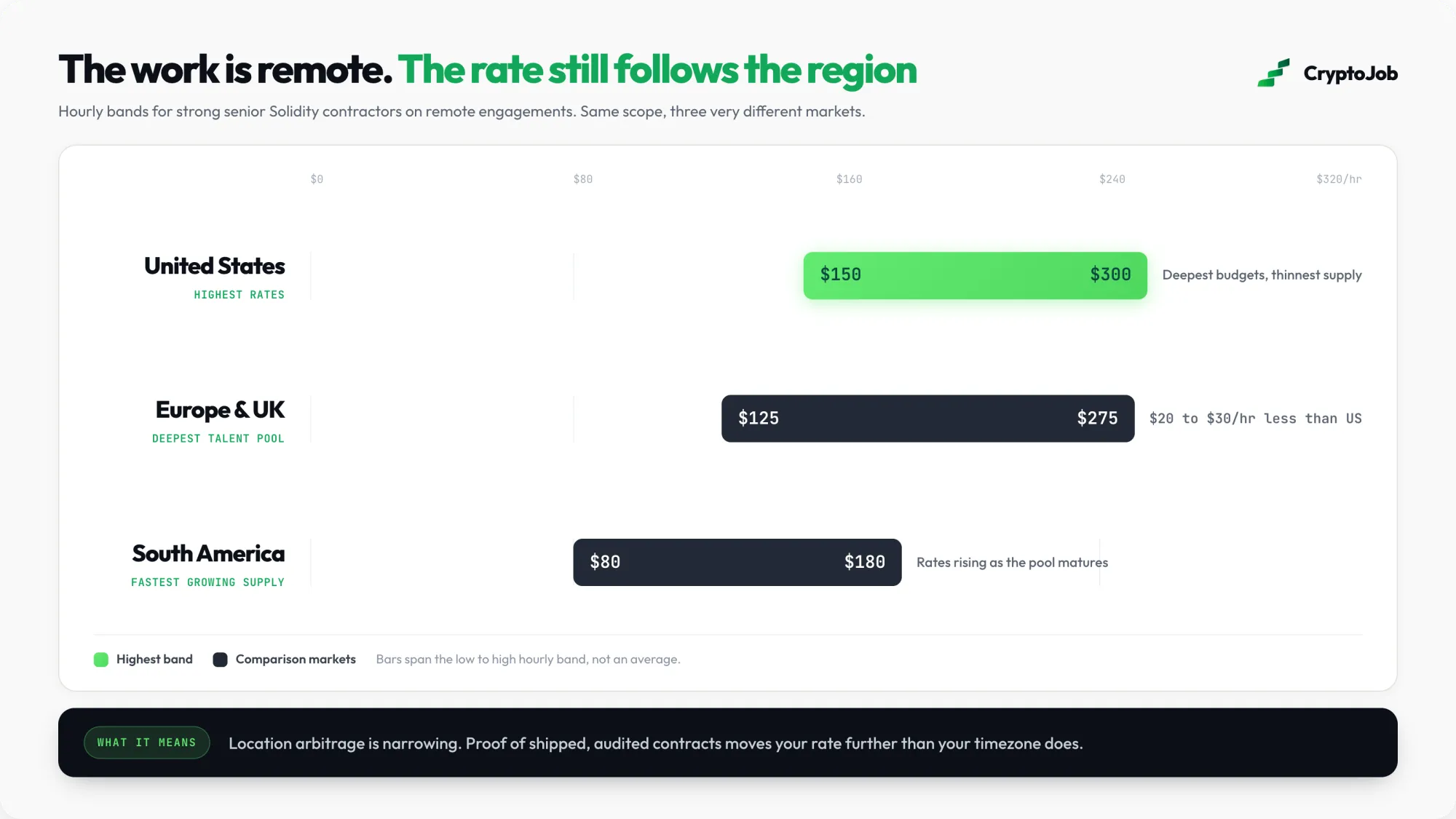
US roles pay the most, but the deepest remote talent pool sits in Europe and the UK, often at $20 to $30 per hour less for comparable quality. South America is the fastest-growing region for mid and senior supply. Because the work is remote-first, strong candidates outside the US compete effectively for the same roles.
What Solidity skills do employers want?
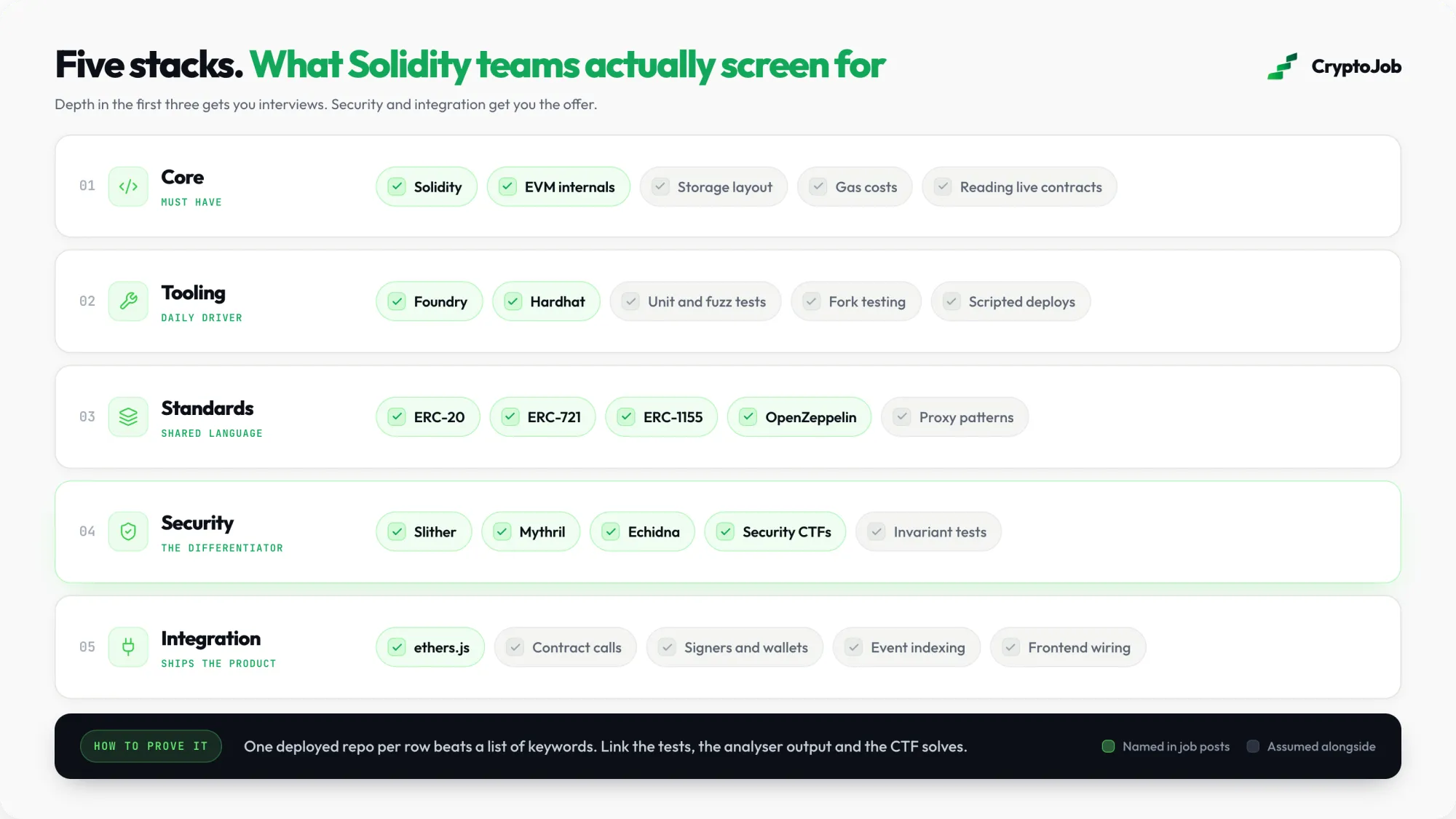
The Solidity skills that get you hired go well beyond writing contracts that compile. Employers screen hard for security: knowledge of common vulnerability classes, fuzz testing and tools like Slither, Mythril and Echidna. Gas optimization and disciplined testing separate professionals from people who copy a template and hope.
A competitive skill set typically includes:
- Core language: Solidity plus a real grasp of EVM internals and gas costs.
- Tooling: Foundry or Hardhat for testing and deployment.
- Standards and libraries: ERC-20/721/1155 and OpenZeppelin patterns.
- Security: auditing basics, threat modeling and CTF-style practice.
- Integration: JavaScript/TypeScript with ethers.js for front-end wiring.
How do you break into EVM smart contract roles?
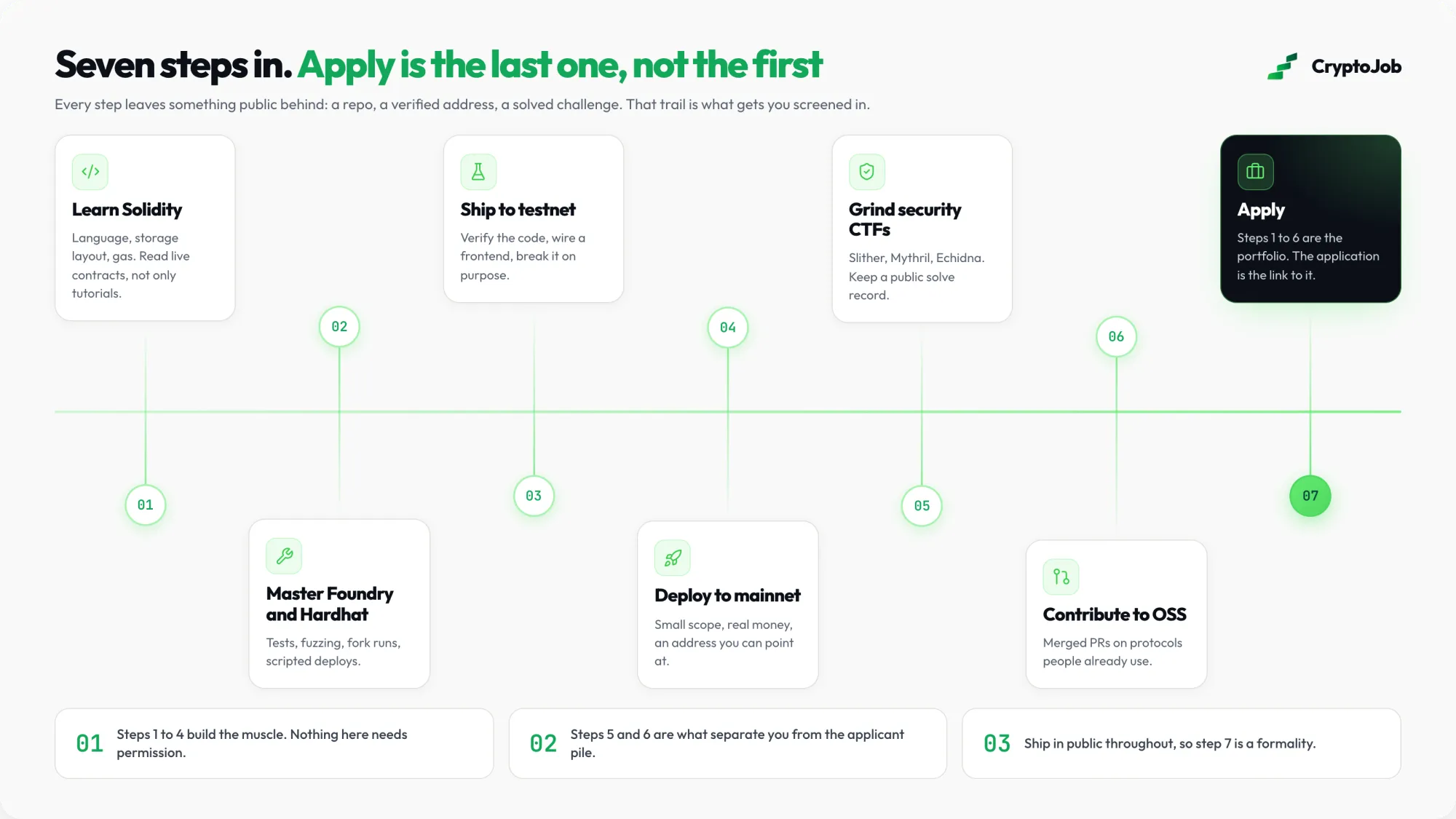
Breaking into EVM smart contract roles is a portfolio problem, not a paper one. The fastest route is to build, deploy and document real contracts, then prove you understand how they break. Security credibility is what converts a junior application into a mid-level offer.
A practical plan: ship a DeFi or NFT contract to a testnet and then mainnet, master Foundry or Hardhat and grind security CTFs like Ethernaut and Damn Vulnerable DeFi. Contribute to open-source protocols so your commits speak for you, and write up any bug you find. For adjacent paths and context, our guides to Ethereum developer jobs and DeFi developer jobs show where these skills lead.
Where can you find Solidity developer jobs and how do you get hired?
Solidity developer jobs cluster on crypto-native boards, DeFi and NFT project pages and audit-firm hiring lists. Established protocols and well-funded startups post continuously, and remote is the default. The bottleneck is rarely open roles, it's a portfolio that proves security judgment.
Beyond general boards, the highest-signal channels are protocol Discords, audit-firm career pages and hackathons, where teams scout contributors directly. DeFi, NFT, gaming and Layer 2 projects make up most of the demand and audit firms compete alongside them for the same senior talent. Applying through a warm contributor relationship beats a cold application in almost every case.
To get hired, lead with a public GitHub, at least one deployed and audited-style project and evidence you can reason about exploits. Because this pool is crowded, specificity wins: a documented mainnet deployment beats a dozen tutorials. When your work is ready, browse web3 jobs and filter for the seniority and chain that match it. For the wider landscape, see the blockchain developer jobs guide.
What companies and protocols hire Solidity developers?
Solidity hiring spans DeFi protocols, NFT platforms, Layer 2 teams, infrastructure providers and the audit firms that review all of them. Major DeFi venues and lending protocols hire continuously for contract work, while security firms recruit experienced developers into auditing. Because the same skills transfer across EVM chains, a strong Solidity engineer isn't locked to one employer or ecosystem.
Audit and security work deserves special attention, since it carries the highest pay and the clearest progression. Chainlink Labs, Ondo Finance and established DeFi protocols have posted senior smart-contract roles into the low $200,000s plus tokens. Many of these teams hire through referrals and open-source reputation, so visible contributions often matter as much as a formal application.
Frequently asked questions
How much do Solidity developers earn in 2026?
Base pay runs about $90k to $120k junior, $140k to $175k mid and $180k to $230k senior in the US, with token grants pushing senior total comp past $250k. Contract and audit work runs $150 to $300 per hour.
Is Solidity still worth learning in 2026?
Yes. Solidity remains the deepest smart-contract job market across Ethereum and its Layer 2s, and it's widely considered the best on-ramp into web3 development.
Do Solidity developer jobs require an audit background?
Not for junior and mid roles, but audit experience is the single biggest lever for senior pay. It can add roughly a full seniority tier to your billing rate.
Can you work Solidity jobs remotely?
Yes: most roles are remote-first and global. US pay is highest, but Europe and the UK have the deepest remote talent pool, often at $20 to $30 per hour less for comparable quality.
What's the difference between a Solidity developer and a smart contract developer?
They heavily overlap. "Smart contract developer" is the broader title; on Ethereum and EVM chains that work is done in Solidity, so the terms are often used interchangeably.
The bottom line
Solidity developer jobs offer the widest smart-contract market in web3, with base pay from around $90,000 to $230,000 and senior packages past $250,000 once tokens vest. The winners aren't the ones with the most tutorials, they're the ones who ship secure, documented contracts and can prove it. When you're ready, browse web3 jobs and target roles that match your portfolio.