Web3 Developer Salary Guide 2026: What You'll Actually Earn
US web3 developers average around $110k with seniors at $200k+. See salary ranges by role, experience and region, plus how to value tokens.

TLDR
- Average web3 developer salary in the US: roughly $110k, with most offers between $84k and $135k
- Senior smart contract engineers earn $150k to $250k+ base
- Solidity specialists: median around $150k, top DeFi protocols pay $200k+
- Token grants can add 30% to 100% on top of base
- Global averages sit lower, around $80k to $84k
If you're job hunting right now, here's the short answer: the average web3 developer salary in 2026 lands around $110,000 in the US, based on ZipRecruiter data, with most offers falling between $84,000 and $135,000. Globally the average drops to roughly $80,000 to $84,000 because remote hiring pulls in every market on earth.
That average hides a huge spread though. Juniors can start as low as $60,000 while senior protocol engineers clear $300,000 with tokens included. This guide breaks down what you'll actually earn by experience, role and location, so you know what to ask for before you browse web3 jobs and start applying.
One note before the numbers: salary data in crypto is messier than in traditional tech. Figures below come from job boards and salary aggregators like web3.career, CryptoJobsList and ZipRecruiter, and real offers vary by company stage, chain and market conditions.
How much do web3 developers make in 2026?
Here's the market at a glance:
- US average: around $110,000, with the 25th to 75th percentile between $84,000 and $134,500
- Global average: $80,000 to $84,000 across all experience levels
- Top earners: $150,000+ base, and well past $250,000 for senior specialists at funded protocols
Web3 pay generally beats equivalent web2 roles. Several salary trackers put the premium at 10% to 30% for the same seniority level, mostly because demand for people who can ship secure on-chain code still outpaces supply.
The catch is volatility. Hiring budgets follow crypto market cycles, so the same role can pay noticeably more in a bull market than six months earlier. Negotiate accordingly.
What does a blockchain developer salary look like by experience level?
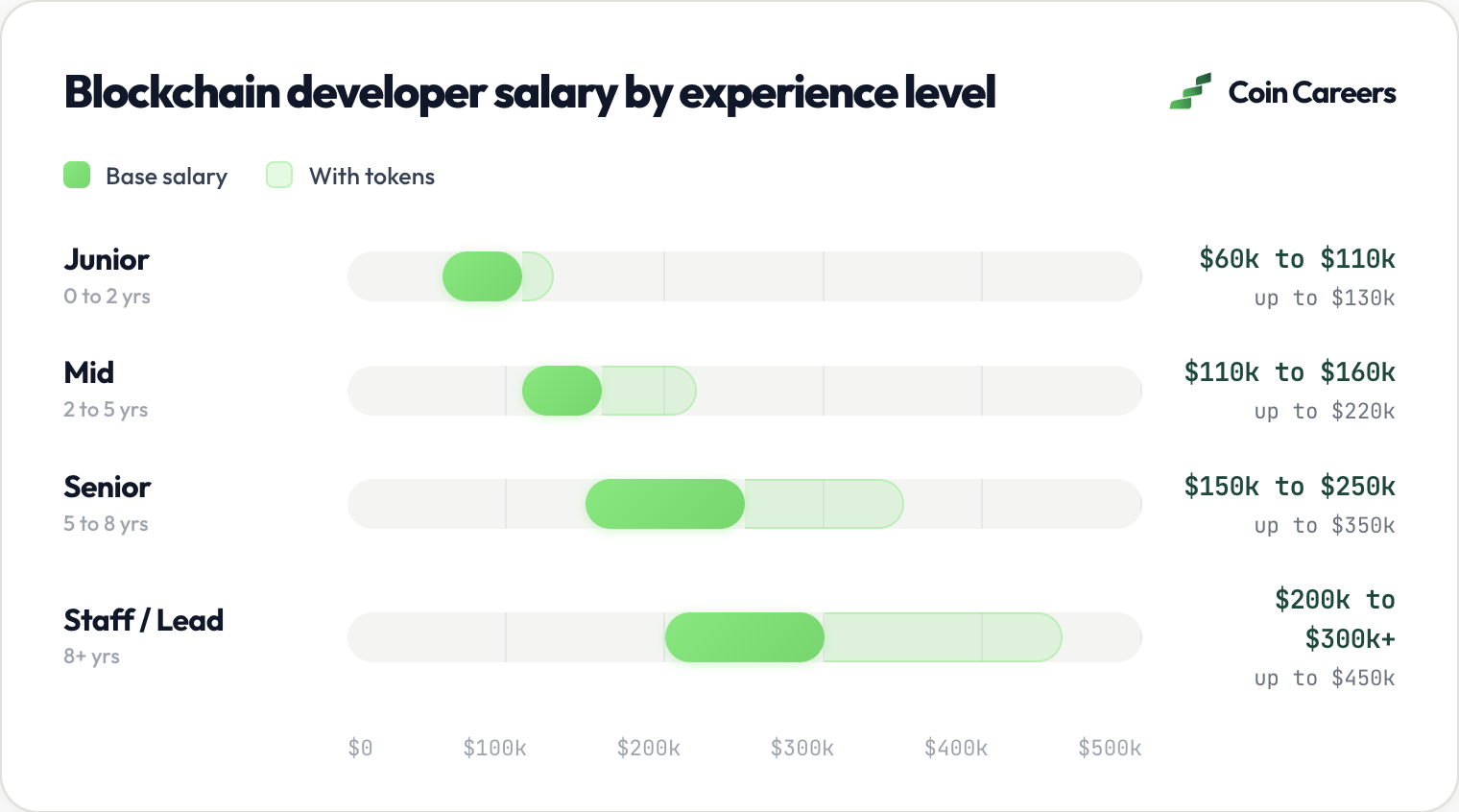
Experience matters, but portfolio matters more. A junior who has shipped a live DeFi protocol or contributed to a well-known codebase can out-earn a mid-level engineer with no on-chain track record.
Here's how base salaries typically break down in the US market in 2026:
|
Level |
Experience |
US base salary |
With tokens (est. total) |
|
Junior |
0 to 2 years |
$60,000 to $110,000 |
$70,000 to $130,000 |
|
Mid-level |
2 to 5 years |
$110,000 to $160,000 |
$130,000 to $220,000 |
|
Senior |
5+ years |
$150,000 to $250,000 |
$200,000 to $350,000 |
|
Staff / Protocol lead |
7+ years |
$200,000 to $300,000+ |
$300,000 to $450,000+ |
A few things to know about these ranges:
Junior roles are the hardest to land. Most teams are small and want people who can ship without supervision. Bounties, hackathon wins and open source contributions are how juniors prove themselves and skip to mid-level pay faster.
The senior jump is steep. Once you've led audits, designed protocol architecture or shipped production DeFi contracts, you move from candidate to commodity. Senior engineers routinely field multiple offers.
Blockchain developer salary data skews high at the top. Aggregators show CTO and lead roles averaging around $150,000 base with ceilings near $350,000, and that's before token upside.
How much can you earn as a Solidity developer?
Solidity remains the highest-demand language in the space because Ethereum and its L2s still host most of the value locked on-chain.
The typical Solidity developer salary in 2026 runs from $100,000 to $250,000, with the median around $150,000. Juniors with under a year of experience start around $80,000 to $100,000. Senior engineers at established DeFi protocols command $200,000+ base before any token grant.
Two specializations push those numbers higher:
Security and auditing. Billions were lost to exploits in 2025 alone, and there aren't enough auditors who deeply understand reentrancy, flash loan attacks and oracle manipulation. US companies pay $150,000 to $250,000+ for people who can prevent those disasters.
Rust for non-EVM chains. Solana, Polkadot and several newer L1s run on Rust. Because fewer developers know it well, Rust roles often pay a premium over comparable Solidity positions.
If you're choosing what to learn next, Solidity gets you the most job openings. Rust gets you less competition per opening.
Which web3 roles pay the most?
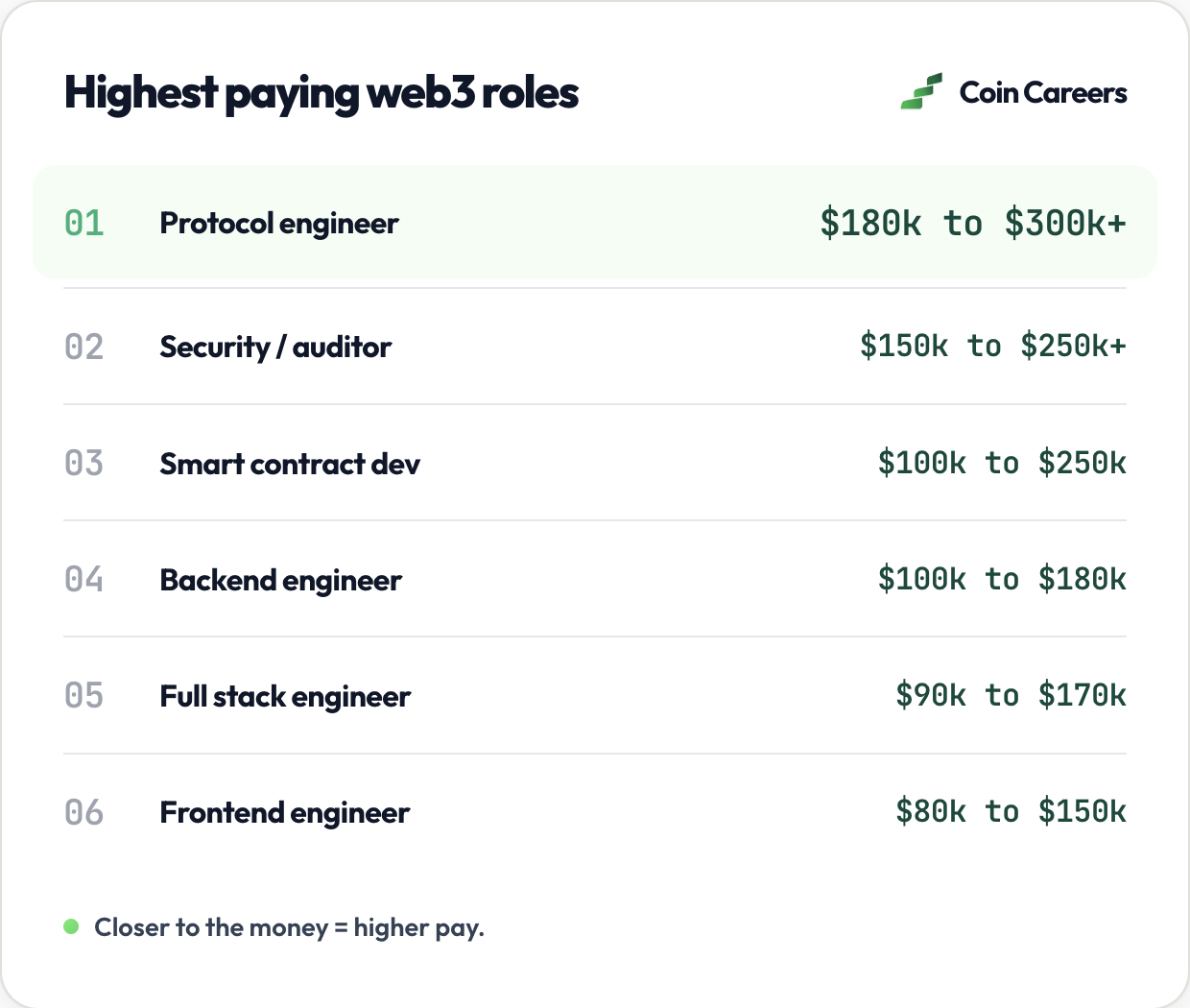
Rough ordering by typical US base salary, highest first:
- Protocol / core engineers ($180,000 to $300,000+): building L1s, L2s and ZK infrastructure
- Security engineers and auditors ($150,000 to $250,000+): the talent shortage here is the worst in the industry
- Smart contract developers ($100,000 to $250,000): Solidity, Vyper or Rust
- Backend web3 developers ($100,000 to $180,000): indexers, APIs, node infrastructure
- Full-stack dApp developers ($90,000 to $170,000): React plus contract integration
- Frontend web3 developers ($80,000 to $150,000): dApp UIs with ethers.js, viem or wagmi
The pattern is simple. The closer your work sits to funds that can be stolen, the more you get paid. Frontend bugs are embarrassing. Contract bugs are catastrophic, and compensation reflects that risk.
How does location affect your web3 developer salary?
Web3 is remote-first, but geography still moves the numbers. Companies often anchor pay to your local market even for fully remote roles, though plenty of protocols now pay location-independent rates.
Typical annual ranges by region in 2026:
- US and Canada: $120,000 to $300,000+, with SF, NYC and Miami paying 20% to 30% above other cities
- Western Europe: $90,000 to $220,000, Switzerland trending toward the top
- Eastern Europe: $50,000 to $120,000
- Asia: wide spread, roughly $25,000 in India up to $180,000 in Singapore
- Latin America and Africa: highly variable, though remote-global roles increasingly pay the same regardless of passport
If you're outside North America, your best move is targeting companies that advertise location-agnostic pay. DAOs and fully remote protocols are the most likely to offer it.
How does token compensation actually work?
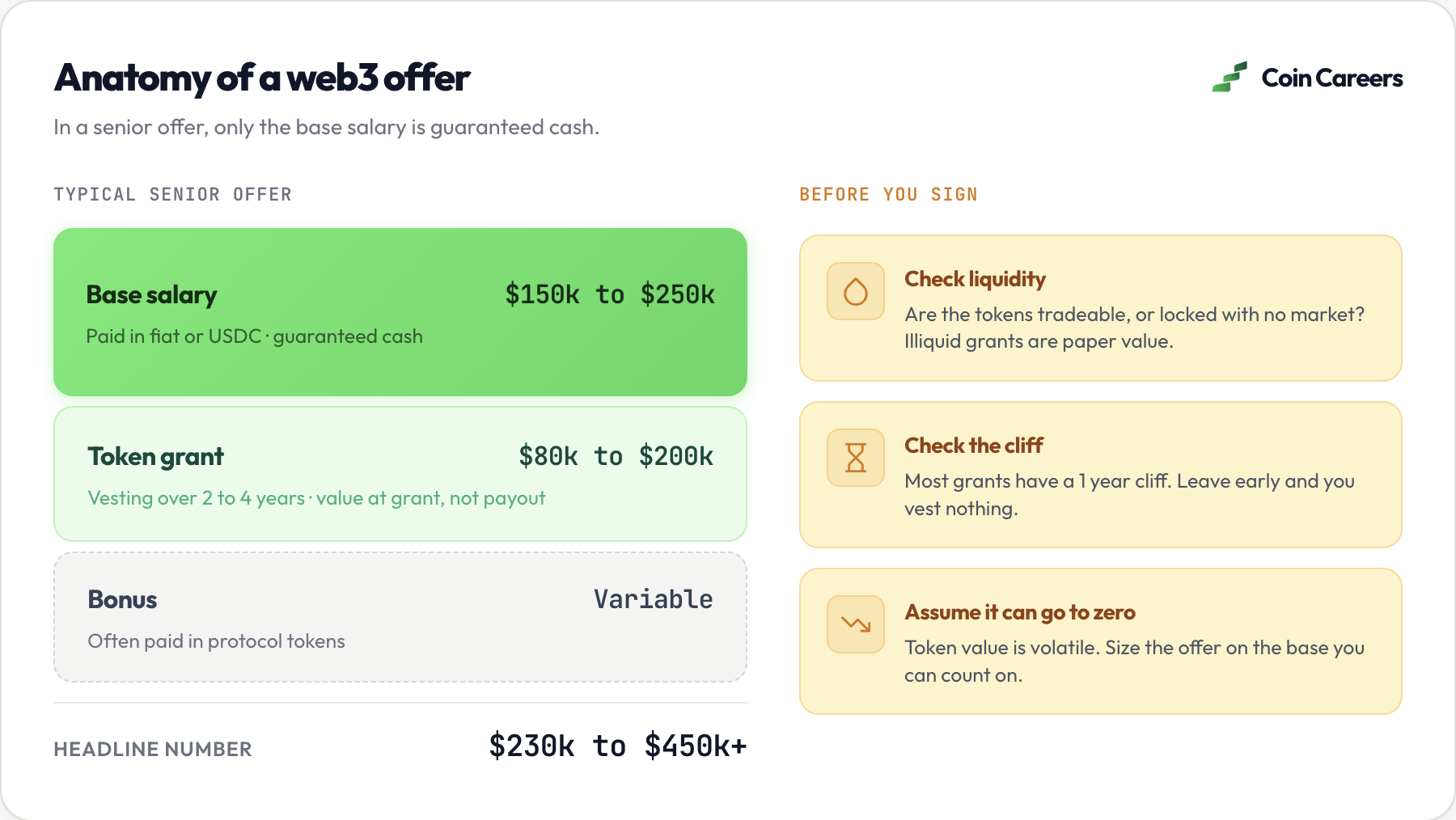
This is where web3 offers diverge from web2, and where candidates most often get it wrong.
A typical package has two or three parts. Base salary paid in fiat or stablecoins, a token grant vesting over 2 to 4 years, and sometimes performance bonuses paid in the protocol's token. Senior engineers at established protocols commonly see $80,000 to $200,000 in tokens on top of a $150,000 to $250,000 base.
Before you value a token grant at face value, check:
- Liquidity. A $150,000 grant in a thin-market token may be impossible to sell without tanking the price
- Vesting and cliffs. A 1-year cliff means you get nothing if you leave in month 11
- Whether the token even exists yet. Pre-launch grants are lottery tickets, not salary
A sensible rule: negotiate a base you could live on if the tokens went to zero. Treat everything else as upside.
How do you increase your web3 developer salary?
Fastest levers, based on what actually moves offers in 2026:
Ship something public. A deployed protocol, an audited contract or meaningful contributions to a known codebase beat any certificate. Hiring managers check GitHub before they check your CV.
Specialize in security. Completing audit contests on platforms like Code4rena or Sherlock creates a public track record that translates directly into higher offers.
Learn a second ecosystem. Cross-chain and L2 experience earns a premium over single-chain skills as multi-chain apps become the default.
Get comfortable negotiating tokens. Many candidates only negotiate base. Asking for a larger grant or shorter vesting often works because it doesn't hit the company's cash burn.
Apply during market upswings. Hiring budgets expand fast in bull conditions. The same skill set can command 20% more when funding is flowing.
The bottom line
Web3 development pays well above most software roles, but the spread is enormous and the compensation structures take real effort to evaluate. Know your level, price the tokens skeptically and anchor your ask to the ranges above rather than the first number a recruiter offers.
When you're ready to test the market, browse web3 jobs on CoinTerminal. New roles across smart contracts, security and infrastructure are posted daily.
FAQ
What is the average web3 developer salary in 2026?
Around $110,000 in the US, with most offers between $84,000 and $135,000. The global average is lower, roughly $80,000 to $84,000, because remote hiring spans lower-cost markets. Senior specialists earn $200,000+ before tokens.
Do web3 developers get paid in crypto?
Usually partly. Most companies pay base salary in fiat or stablecoins like USDC, with token grants vesting over 2 to 4 years as long-term incentive. Some DAOs pay entirely in crypto via streaming platforms.
Do I need a computer science degree to earn a web3 developer salary?
No. Plenty of well-paid web3 engineers are self-taught or came from web2 via bootcamps. What matters is proof of work: shipped dApps, audit contest results and open source contributions.
Is Solidity or Rust better for salary?
Both pay well. Solidity has far more openings since Ethereum and its L2s dominate on-chain activity. Rust roles on Solana and other non-EVM chains often pay a premium because fewer developers know it.
Are web3 salaries higher than web2?
Generally yes, by roughly 10% to 30% at the same seniority, plus token upside web2 rarely matches. The tradeoff is more volatility, since hiring and budgets track crypto market cycles.