

How to Get a Web3 Job With No Experience (2026 Guide)
No degree, no crypto CV, no problem. Here are the web3 roles that hire beginners in 2026, what they pay and a 30-day plan to land one.

TLDR
- Yes, you can land web3 jobs no experience required, mostly in community, support, content and junior dev roles
- Entry-level pay typically runs $35k to $80k, with junior devs at $60k to $120k
- Expect 4 to 12 weeks to build a portfolio that gets interviews
- Proof of work beats credentials: contributions, bounties and a public profile
Getting hired in web3 without experience comes down to one shift: stop selling your resume and start showing proof of work. Web3 companies hire people who are visibly active in the space, even if that activity is only a few weeks old. The fastest routes in are community roles, content, customer support and junior technical positions where a small portfolio beats a degree.
This guide covers which roles are realistic, what they pay, the skills to learn first and a step-by-step plan to go from zero to hired. You can browse web3 jobs on CryptoJob right now to see what companies are actually asking for, which is the best market research you can do.
One thing to know upfront: web3 hiring is faster and less formal than traditional tech. Many people get hired through Discord conversations and open-source contributions before a formal application ever happens.
1. Can You Really Get Web3 Jobs With No Experience?
Yes, and it happens constantly. The industry is young, so almost everyone working in it started with no web3 experience. What companies mean by "experience" here is different from traditional hiring.
They want proof you understand the space. That can be a wallet you actively use, a Discord community you help moderate, a few articles explaining DeFi concepts or a small dApp on your GitHub. Any of these counts as experience in the eyes of a web3 hiring manager.
The bar is real but low. Someone who spends a month genuinely using protocols, joining communities and building something small is already ahead of most applicants who only submit a resume.
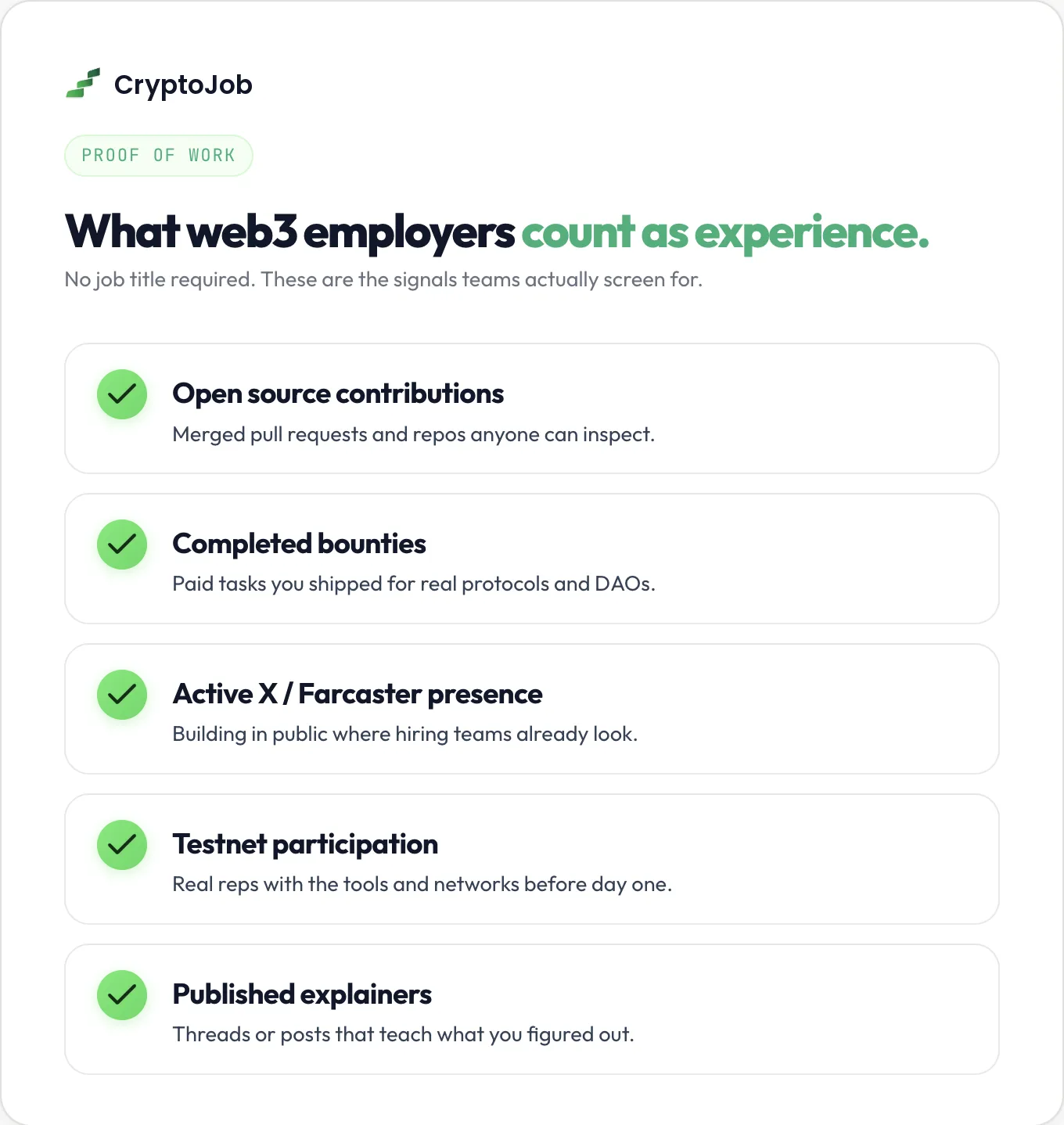
1.1 What counts as "experience" to web3 employers?
Hiring managers in this space look for signals, not job titles. Strong signals include:
- Open-source contributions, even small documentation fixes
- Completed bounties on platforms like Dework or Gitcoin
- An active, thoughtful presence on X or Farcaster
- Testnet participation and hands-on protocol use
- Content that explains crypto concepts clearly
None of these require anyone's permission. That is the core advantage of web3 job hunting: you can generate your own experience in weeks.
2. Which Crypto Jobs No Experience Candidates Can Actually Land?
Some roles are far more open to beginners than others. Community and support roles have the lowest barrier because the main requirement is genuine familiarity with crypto culture. Technical roles need more prep but pay considerably more.
Salaries below are realistic global ranges based on current job board data. Pay varies a lot by region, company stage and whether compensation includes tokens.
|
Role |
Typical entry pay (USD/yr) |
Time to job-ready |
Key skill |
|
Community moderator |
$35k to $55k |
2 to 4 weeks |
Discord, crypto culture |
|
Customer support |
$35k to $60k |
2 to 4 weeks |
Wallets, troubleshooting |
|
Content writer |
$45k to $80k |
4 to 8 weeks |
Clear writing, DeFi basics |
|
Community manager |
$50k to $80k |
1 to 3 months |
Growth, moderation, events |
|
Junior analyst |
$50k to $80k |
2 to 3 months |
Dune, on-chain data |
|
Junior developer |
$60k to $120k |
3 to 6 months |
Solidity or Rust, JavaScript |
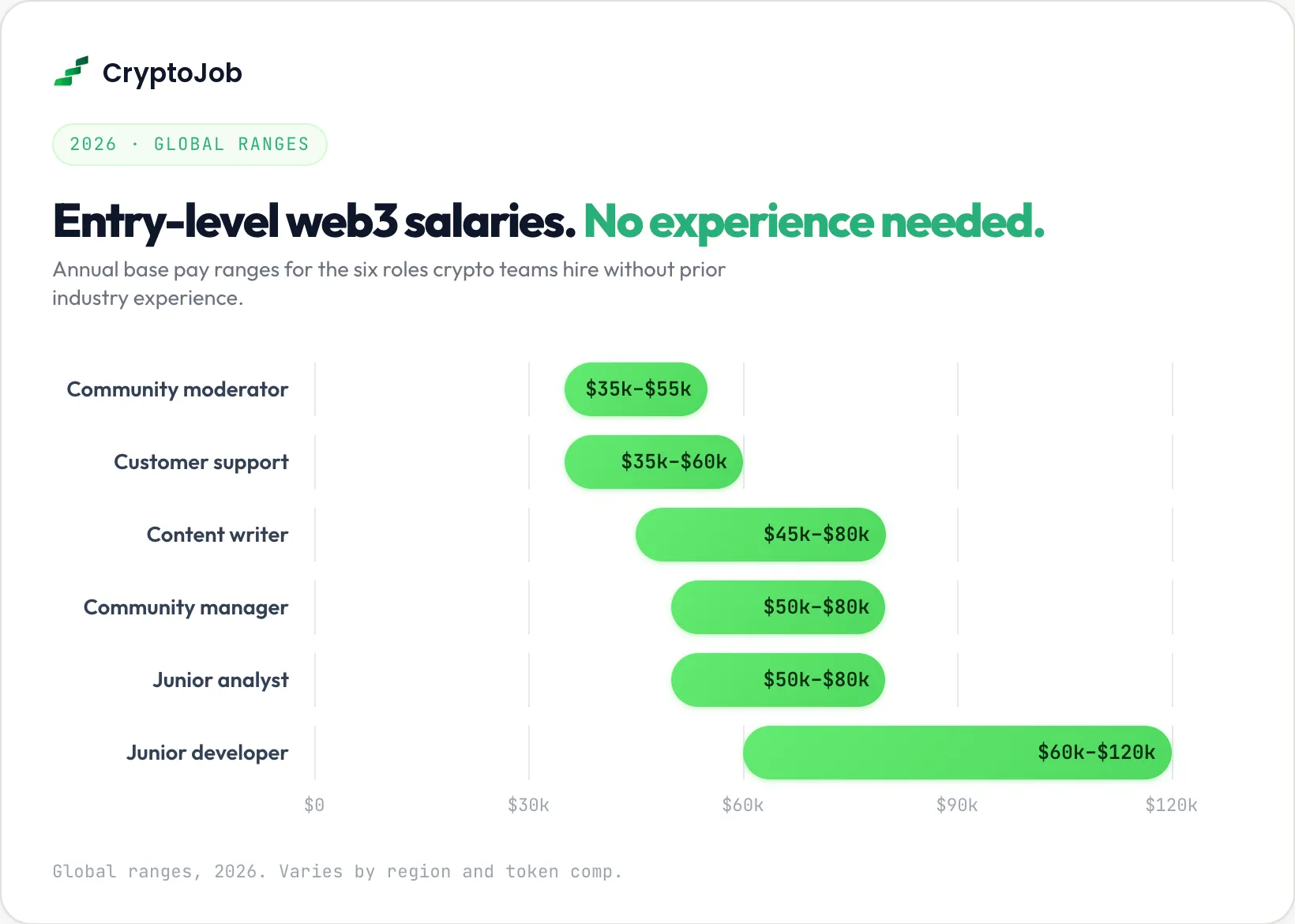
Entry-level web3 positions overall tend to start around $60k to $80k at funded companies, though smaller projects and DAOs often pay less in cash and more in tokens. Treat token compensation as upside, not salary.
2.1 Which role should you pick first?
Match the role to what you already have. Strong writer? Content is your fastest path. Comfortable in online communities? Moderation and community management. Have any coding background? Junior dev roles pay the most and web2 skills transfer faster than most people expect.
If you have none of the above, start with customer support. It teaches you the entire product surface of a crypto company and is a proven springboard into ops, community and product roles.
3. What Skills Do Blockchain Jobs for Beginners Actually Require?
Every entry-level role shares one requirement: fluency with the basics. Before anything else, you should be able to set up a wallet, bridge assets between chains, use a DEX and explain what gas fees are without googling.
That baseline takes about a week of hands-on practice and it is non-negotiable. Interviewers can tell within two minutes whether you have actually used the products or only read about them.
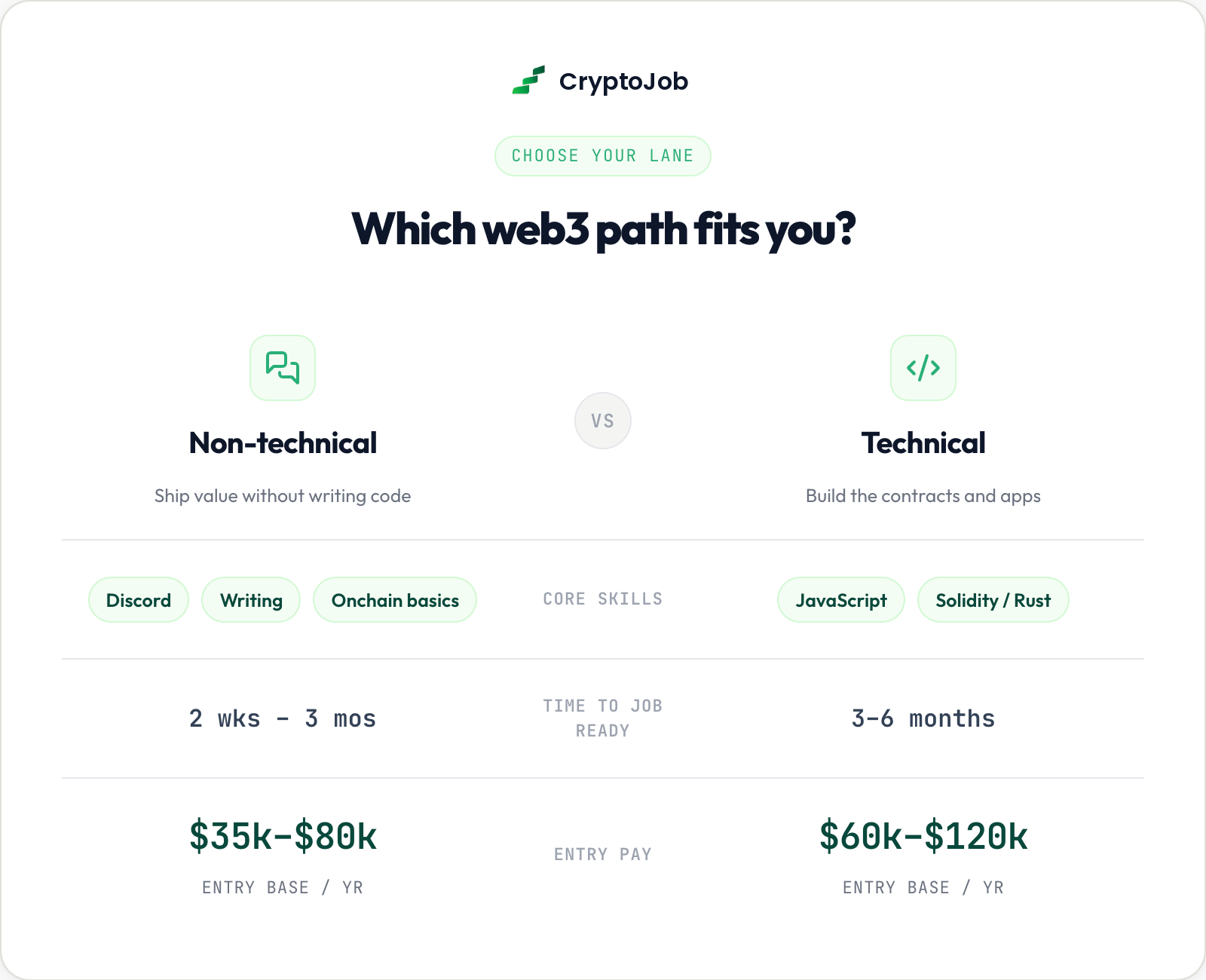
3.1 Non-technical skill stack
For community, content and support roles, focus on:
- Discord and Telegram at power-user level, including bots and moderation tools
- Writing that explains complex topics simply
- Basic on-chain literacy, meaning you can read a transaction on Etherscan
Add one differentiator. Learning to build simple Dune dashboards, for example, makes a community applicant stand out immediately.
3.2 Technical skill stack
For junior developer roles, the standard 2026 path is JavaScript or TypeScript first, then Solidity for Ethereum-compatible chains. Rust is worth learning if you want to target the Solana ecosystem, where competition for junior talent is a bit thinner.
You do not need a computer science degree. Plenty of working web3 developers are self-taught or came through bootcamps, and hiring managers care about your GitHub far more than your diploma.
4. How Do You Get Web3 Jobs With No Experience? A 5-Step Roadmap
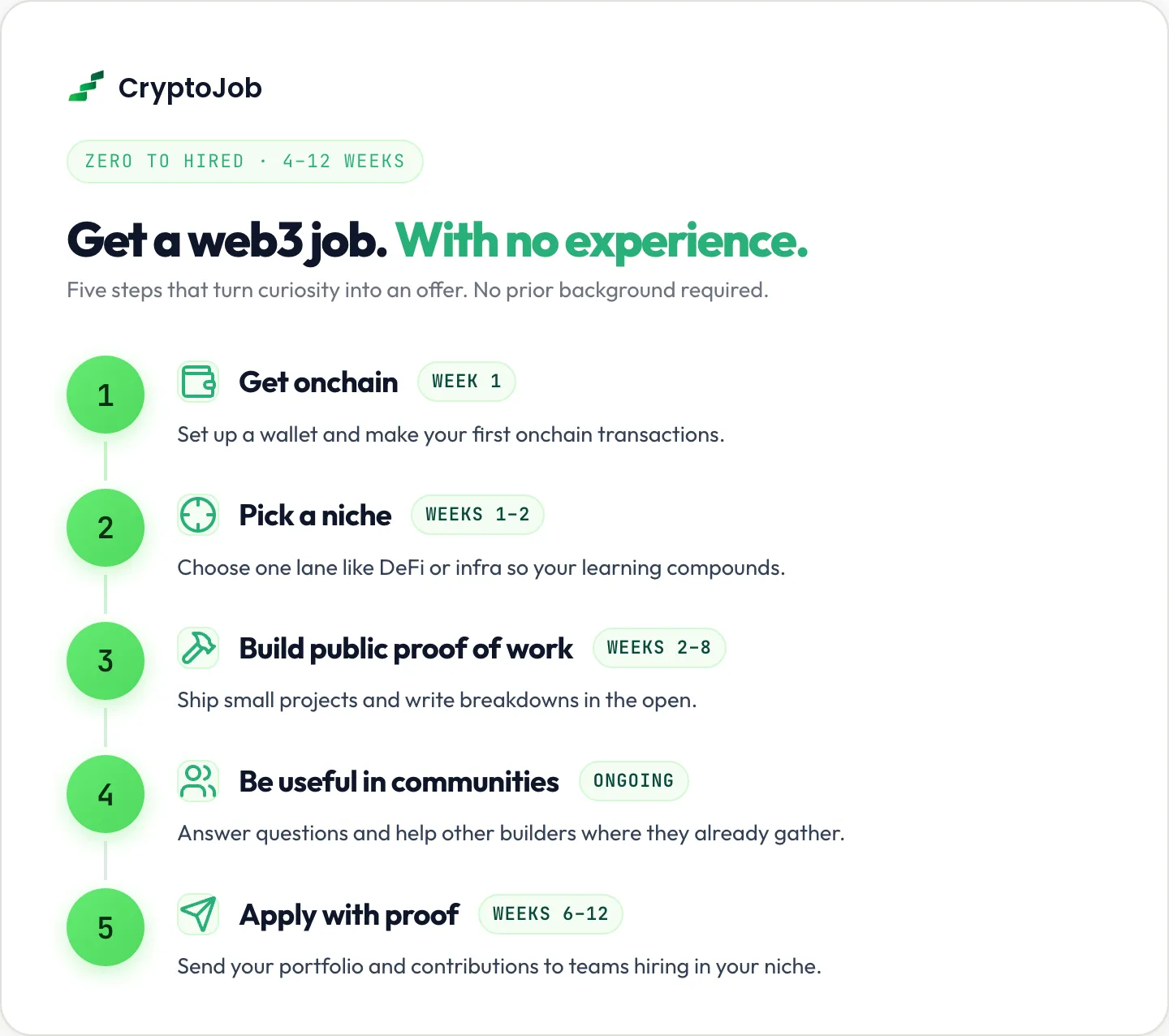
Here is the plan that reliably works, condensed into steps you can start today.
Step 1: Get on-chain (week 1). Set up a wallet, fund it with a small amount and use real protocols. Swap on a DEX, mint something, try a lending market. Keep the amounts tiny. The goal is fluency, not profit.
Step 2: Pick a niche and go deep (weeks 1 to 2). Choose one ecosystem like Ethereum L2s or Solana and one role type. Depth beats breadth. A focused "Base ecosystem community person" is more hireable than a generic crypto enthusiast.
Step 3: Build public proof of work (weeks 2 to 8). This is the step that gets you hired. Write two or three explainer articles, contribute to an open-source repo, complete a bounty or build a small project. Publish everything under one consistent handle.
Step 4: Join communities and be useful (ongoing). Pick 3 to 5 project Discords and genuinely help: answer newcomer questions, report bugs, give feedback. Many moderator and support hires come directly from active community members. This is the closest thing web3 has to a hidden job market.
Step 5: Apply with proof, not promises (weeks 6 to 12). Your application should lead with links: your writing, your dashboards, your GitHub, your community activity. A short, specific note about the project beats a formal cover letter every time.
Most people who follow this consistently see interview traction within 4 to 12 weeks. It varies with the role, the market cycle and how much time you put in.
5. How Do You Stand Out When You Apply?
Volume alone does not work in web3. Tailoring does. Before applying, spend 30 minutes actually using the company's product and note one thing you would improve. Mention it in your application.
Reference something specific and recent, like their latest governance proposal or product launch. It signals you are already part of their world, which is exactly what "experience" means here.
Timing matters too. Web3 roles often close fast because teams hire from their own communities. Apply within the first few days of a posting and follow up through the company's public channels where appropriate.
Finally, keep your public profiles clean and consistent. Hiring managers will check your X account and GitHub before they check your resume.
6. Final Thoughts: Your Lack of Experience Is Temporary
The entire premise of web3 hiring works in your favor. Experience is something you can manufacture in public, in weeks, without anyone's permission. Pick a role, build proof of work and show up where teams actually hire.
Start by seeing what companies want right now. Browse web3 jobs on CryptoJob, filter for entry-level and junior roles and reverse-engineer the top three requirements you see repeated. Then go build exactly those.
FAQ
How long does it take to get a web3 job with no experience?
Most beginners who work at it consistently land interviews within 4 to 12 weeks. Non-technical roles like support and community tend to be fastest. Junior developer roles usually take 3 to 6 months of skill-building first. Market conditions affect this, so timelines vary.
Do I need to know how to code to work in crypto?
No. Community management, content, support, marketing, business development and operations roles are all non-technical and make up a large share of web3 hiring. Coding unlocks the highest-paying entry roles but it is not a requirement for getting into the industry.
How much do entry-level web3 jobs pay?
Realistic ranges in 2026: $35k to $60k for support and moderation, $45k to $80k for content and community management and $60k to $120k for junior developers. Pay varies widely by region and company stage, and many roles add token incentives on top of base salary.
Are web3 jobs remote?
Mostly yes. Web3 remains one of the most remote-friendly industries, with distributed teams as the default. Some larger companies have offices in hubs like Dubai, Singapore and London, but the majority of roles you will see on job boards are remote or remote-first.
Is a certification worth it for blockchain jobs?
Sometimes, but proof of work matters more. A certificate from a recognized program can help structure your learning, yet hiring managers weight your GitHub, published writing and community contributions far more heavily. Spend money on certifications only after you have free proof of work in place.