Do You Need a CS Degree for Web3 Jobs?
Web3 hiring is portfolio-first. Here's which blockchain jobs need no degree, what they pay and the roadmap that replaces a CS credential.

TLDR
- No, most web3 jobs without a degree are realistic. Portfolios beat diplomas here.
- Self-taught web3 developers commonly earn $80k to $150k. Seniors can clear $200k.
- Non-technical roles (community, marketing, BD) typically pay $50k to $120k.
- Expect 6 to 12 months of focused learning before your first paid role.
Short answer: no, you do not need a CS degree to work in web3. The industry is one of the most credential-blind corners of tech. Hiring managers look at what you have shipped, not where you studied and many founders themselves are self-taught or dropped out.
That applies to web3 jobs without degree requirements across the board, from smart contract development to community management. What replaces the degree is proof of work: a GitHub profile, contributions to open source protocols, hackathon projects or a track record inside a DAO.
The rest of this guide covers which roles are open to you, what they pay, how long the path takes and where the degree still matters. When you are ready to test the market, browse web3 jobs on CoinTerminal to see what companies are actually asking for right now.
Why don't web3 companies care about degrees?
Three structural reasons, and none of them are hype.
First, the technology is too new for universities to keep up. Solidity launched in 2014 and most CS programs still teach little or no blockchain content, so a 2022 graduate and a self-taught developer often start from the same place.
Second, web3 hiring is global and remote-first. When a protocol hires from 40 countries, verifying and comparing degrees becomes impractical, so companies default to skills tests, take-home tasks and on-chain or GitHub history instead.
Third, the culture came out of open source. Pseudonymous developers have shipped major protocols without anyone knowing their name, let alone their education. If anons can earn core contributor roles, your missing diploma is not the obstacle.
Which web3 jobs without a degree pay the most?
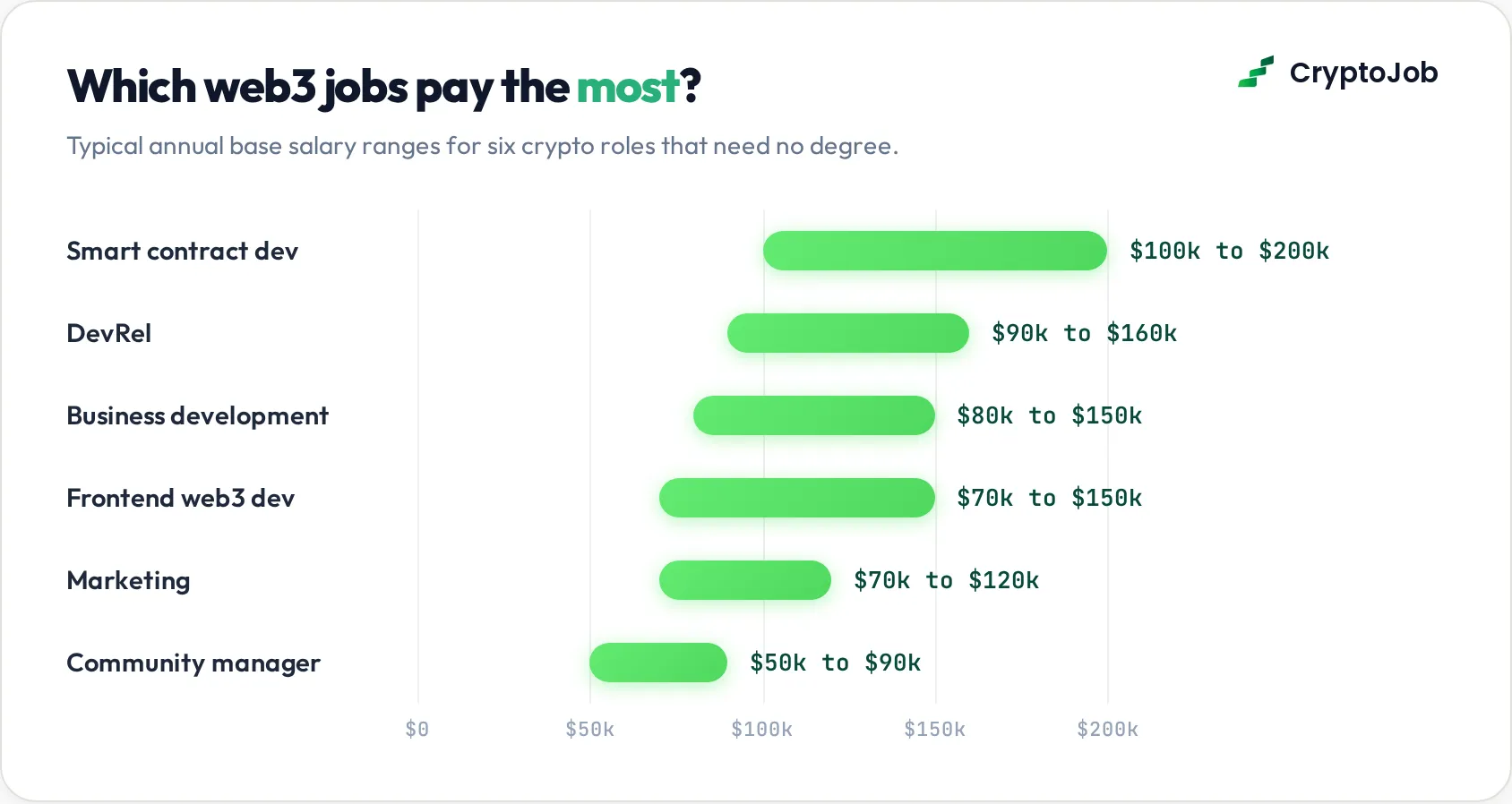
Technical roles pay best, and they are learnable without a classroom. Salary data varies a lot by source, region and market cycle, so treat these as realistic ranges rather than promises.
- Smart contract developer: roughly $100k to $200k in the US, with senior DeFi specialists reported at $250k or more. Solidity or Rust plus a portfolio of audited or deployed contracts is the entry ticket.
- Frontend web3 developer: roughly $70k to $150k. React plus ethers.js or wagmi. This is the most common entry point for self-taught developers because it builds on ordinary web skills.
- Blockchain security researcher: highly variable. Audit contest platforms like Code4rena and Sherlock pay per finding, and top independent auditors out-earn most salaried engineers. No one asks for a degree, only findings.
- Developer relations: roughly $90k to $160k. You need to code well enough to write tutorials and demos, plus communicate clearly in public.
Aggregate numbers back this up. Job boards report average web3 developer salaries anywhere from about $80k globally to $145k in the US, and total compensation at funded protocols often adds 30 to 50 percent in tokens or equity on top of base pay.
One honest caveat: pay swings with crypto market cycles. Bull markets inflate offers and bear markets compress them, so anchor your expectations to the low end of a range when planning.
Are there blockchain jobs with no degree that don't require coding?
Yes, and they are often the fastest way in. Blockchain jobs no degree seekers overlook tend to be the non-technical ones, where hiring is even more informal.
- Community manager: roughly $50k to $90k. Being a genuinely active, helpful member of a project's Discord is the most common route to getting hired by that project.
- Content and social media: roughly $50k to $100k. A crypto-native writing portfolio or an X account with real engagement is the CV.
- Marketing and growth: roughly $70k to $120k. Web2 marketing experience transfers well once you learn the culture and the compliance constraints.
- Business development and partnerships: roughly $80k to $150k, often with commission or token upside. Network and track record matter, degrees do not.
- Operations and project management: roughly $70k to $130k. DAOs constantly need people who can coordinate contributors and actually ship roadmaps.
Ranges here vary even more than developer pay because titles are inconsistent and many roles mix salary with token compensation. Always ask how much of an offer is stablecoin or fiat versus the project's own token.
How do you get crypto jobs without a CS degree? A 6 to 12 month roadmap
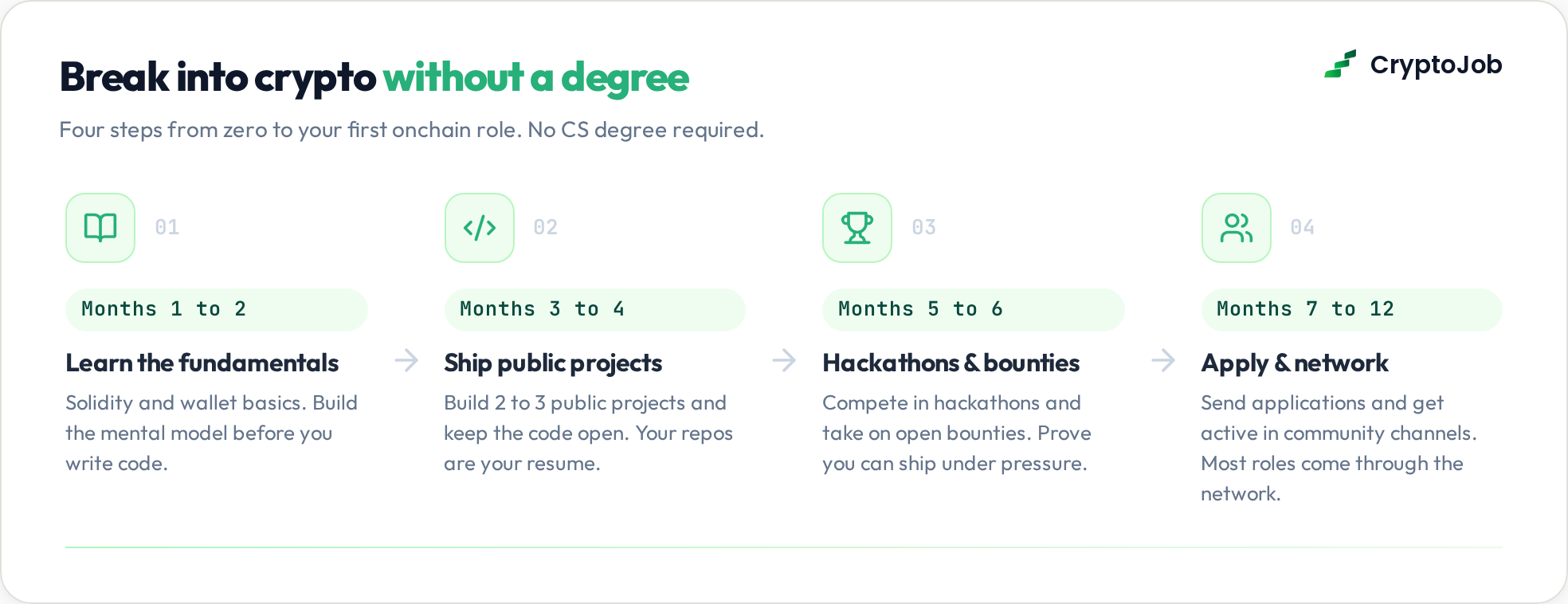
Here is the path that self-taught candidates actually follow for crypto jobs without CS degree credentials. Timelines assume 10 to 20 hours per week.
Months 1 to 2: learn the fundamentals. Understand wallets, transactions, gas, consensus and DeFi primitives by using them with small amounts. For technical tracks, learn JavaScript basics if you have zero coding background, then start Solidity through free resources like CryptoZombies, Alchemy University or freeCodeCamp.
Months 3 to 4: build in public. Ship 2 or 3 small projects: a token, an NFT mint page, a simple DeFi dashboard. Push everything to GitHub and write a short post explaining each build, because the explanation is what recruiters actually read.
Months 5 to 6: earn proof of work. Enter a hackathon (ETHGlobal runs them online year-round and prizes routinely reach $10k+ per sponsor track). Pick up bounties on platforms like Dework or contribute to an open source protocol repo. One merged pull request into a known project is worth more than any certificate.
Months 7 to 12: apply and network simultaneously. Apply to junior and internship-level roles, but spend equal time in Discords and at meetups, because a large share of web3 hires come through community referrals rather than applications. Non-technical candidates can compress this whole timeline to 3 to 6 months since the portfolio (writing, community work, campaigns) is faster to build.
CS degree vs self-taught: what actually gets you hired?
|
Factor |
CS degree path |
Self-taught path |
|
Time to job-ready |
3 to 4 years |
6 to 12 months |
|
Typical cost |
$40k to $160k+ (US) |
$0 to $3k (courses, gas fees) |
|
Web3-specific skills |
Rarely covered |
Learned from day one |
|
Proof employers see |
Diploma |
GitHub, deployed contracts, bounties |
|
Starting salary difference |
Minimal in web3 |
Minimal in web3 |
|
Strongest advantage |
CS fundamentals, big-company doors |
Speed, portfolio, community network |
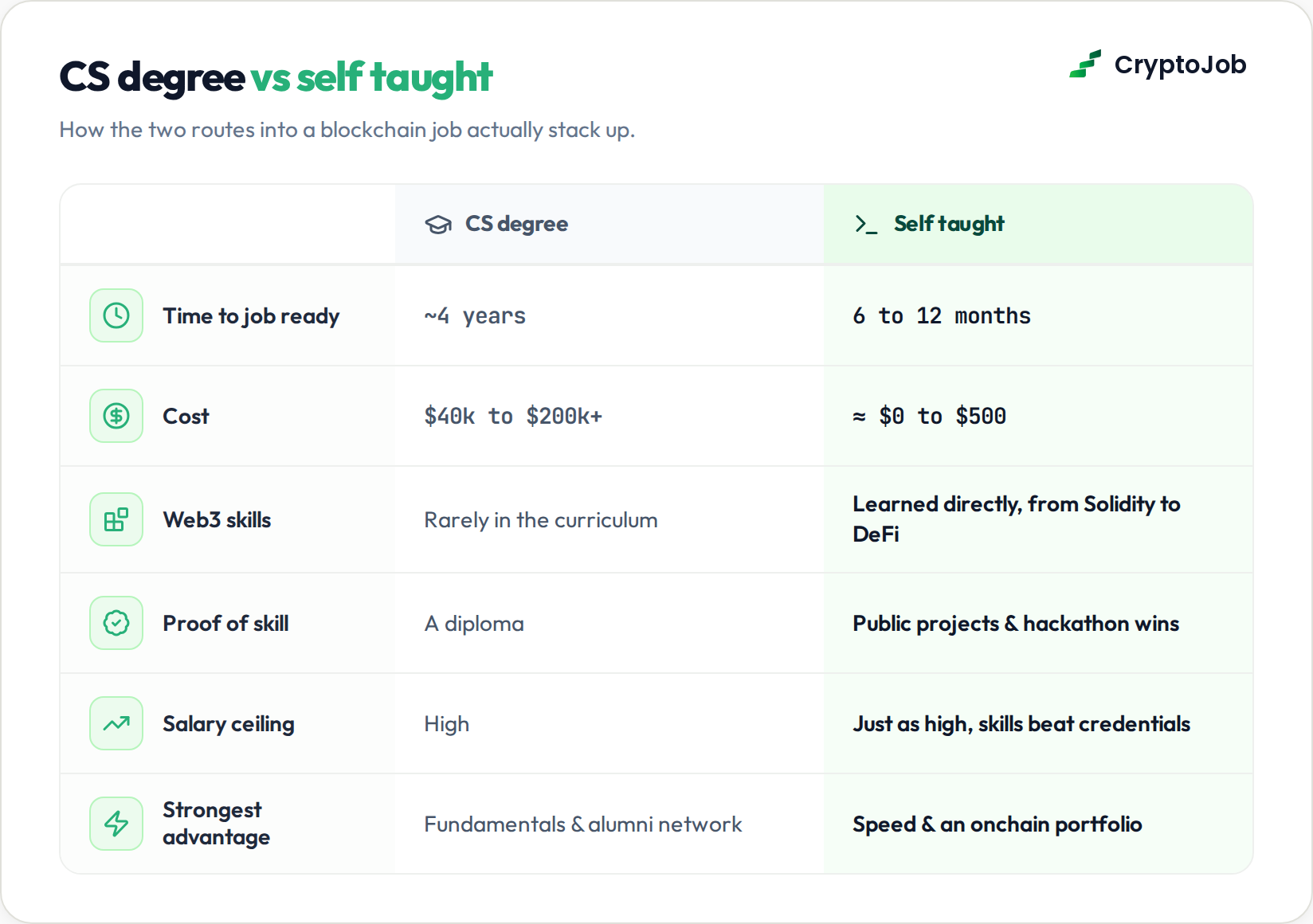
The salary column is the important one. Once you have 1 to 2 years of shipped work, web3 employers pay for output and the degree premium mostly disappears.
When does a CS degree still help?
Be honest with yourself about three cases.
Core protocol and cryptography roles. Layer 1 engineering, zero-knowledge proofs and consensus research lean on math and distributed systems theory that a degree (often a graduate one) genuinely teaches. These teams still hire brilliant self-taught people, but the bar is higher.
Big institutions entering crypto. Banks, exchanges with traditional corporate HR and Big Tech blockchain teams often keep degree requirements simply because their hiring pipelines were built that way.
Visa sponsorship. Some countries' skilled worker visas effectively require a degree, which matters if you want to relocate rather than work remotely. For everyone else, the portfolio path is not a consolation prize. It is the standard route.
The bottom line
You do not need a CS degree for the vast majority of web3 roles. You need proof: code, content, community contributions or closed deals, depending on your track. Give it 6 to 12 months of consistent building and you will have a stronger application than most graduates who never shipped anything.
Start by seeing what the market wants today. Browse web3 jobs on CoinTerminal, note the skills that repeat across listings you like and build toward those.
FAQ
Can I really get a web3 job with no degree at all?
Yes. Most web3 startups and DAOs never ask about education. They ask for a portfolio, a skills test or references from people you have worked with in the community. The main exceptions are banks, some exchanges and deep research roles.
How long does it take to get a web3 job without a degree?
Plan for 6 to 12 months of part-time learning and building for developer roles, or 3 to 6 months for non-technical roles like community and content. It varies with your starting skills, hours invested and the market cycle.
What do entry-level web3 jobs pay?
It varies widely by region and role. Junior developers commonly see $60k to $100k globally, with US offers often higher. Entry-level community and content roles typically fall between $40k and $70k, sometimes with token upside on top.
Which programming language should I learn first for blockchain jobs?
Solidity is the highest-demand entry point because Ethereum and EVM chains dominate job listings. Learn JavaScript alongside it for frontend and tooling work. Rust is the second priority if you are targeting Solana or core infrastructure.
Do web3 certifications replace a degree?
Not really. Certifications carry little weight on their own in web3 hiring. They are useful for structuring your learning, but a deployed project or a merged open source contribution will do far more for your application.