How to Write a Web3 Resume That Gets Noticed
Web3 recruiters spend under a minute per resume. Here's the structure, proof links and examples that get you into the interview pile.

TLDR
- Keep your web3 resume to one page and lead with on-chain proof: GitHub, deployed contracts, DAO contributions
- Quantify everything: users, TVL touched, audit findings, community growth
- Tailor keywords to each job post, ATS filters exist in crypto too
- Smart contract roles typically pay $120k to $225k, though it varies by experience and location
A web3 resume gets noticed when it shows proof of work, not job titles. Recruiters at crypto companies spend under 10 seconds on a first scan, so lead with things they can verify: a GitHub profile with real commits, contracts you deployed, a DAO you contributed to or a community you grew. Keep it to one page, quantify results and tailor the keywords to each posting.
That is the short answer. The rest of this guide covers structure, skills, salary benchmarks and real bullet examples you can adapt today.
If you want to test your resume against live openings while you read, browse web3 jobs on CoinTerminal and pick two or three postings to tailor it to.
What Makes a Web3 Resume Different From a Traditional One?
The biggest difference is verifiability. In most industries a recruiter has to take your word for what you did. In web3, your work often lives on-chain or in public repos and hiring managers will check.
The second difference is culture. Crypto teams are small, remote and move fast, so they care less about pedigree and more about whether you ship. A contributor with six months of visible DAO work often beats a candidate with five years at a bank and nothing public.
|
|
Traditional resume |
Web3 resume |
|
Proof of skill |
Job titles and references |
GitHub, deployed contracts, on-chain activity |
|
Length |
1 to 2 pages |
1 page, almost always |
|
Education |
Prominent, near the top |
Bottom, often optional |
|
Links |
LinkedIn only |
GitHub, portfolio, X, ENS or wallet if relevant |
|
Side projects |
Nice to have |
Frequently the deciding factor |
|
Keywords |
Corporate skills |
Protocol names, chains, tools (Solidity, EVM, Foundry) |
One thing has not changed: applicant tracking systems. Larger exchanges and infrastructure companies still filter by keyword, so mirror the exact terms in the job description.
How Do You Structure a Web3 Resume?
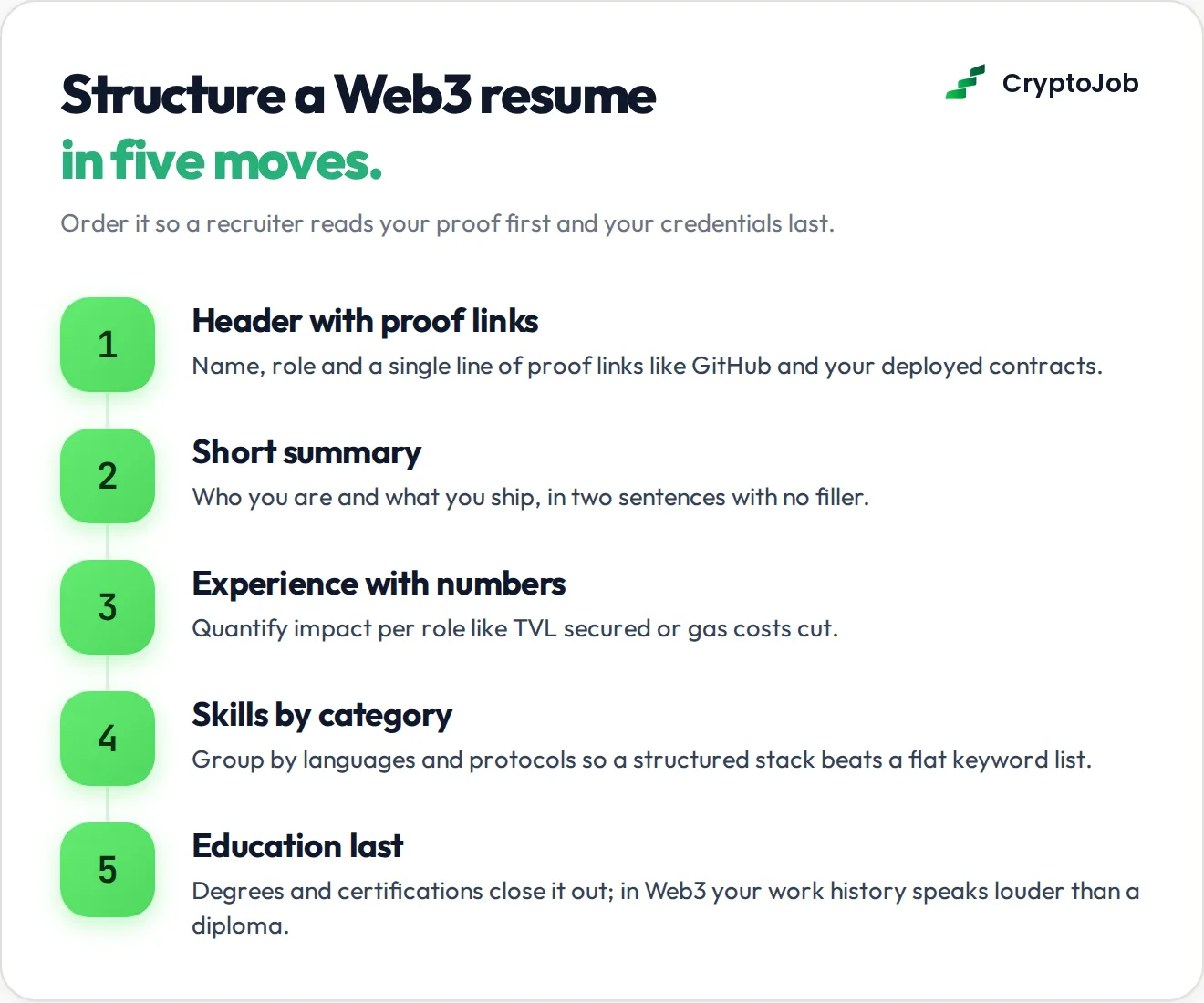
Use this order. It front-loads what crypto hiring managers actually look for.
1. Header with proof links
Name, location or timezone, email, then links: GitHub, portfolio or personal site, X or Farcaster if you are active there and LinkedIn last. For technical roles, GitHub is the single most clicked link on your resume, so make sure it is pinned with your best work.
2. A two-line summary, not an objective
Skip "seeking a challenging role in blockchain." Instead write what you are and what you have done: "Solidity developer with 3 deployed mainnet contracts and 2 completed audits. Previously backend engineer at a fintech handling 40k daily transactions."
3. Experience with numbers
Every bullet should follow a simple pattern: action, tool or context, measurable result. Web3 gives you great metrics to work with: TVL, wallet count, transaction volume, Discord members, gas savings, audit findings.
Contributions count as experience. If you shipped a Snapshot proposal, won a hackathon or maintained an open source repo, list it exactly like a job. Label it clearly, for example "Contributor, Arbitrum DAO (part-time)."
4. Skills grouped by category
Group them so a scanner can parse in two seconds. For a developer: Languages (Solidity, Rust, TypeScript), Frameworks and tools (Foundry, Hardhat, ethers.js), Chains (Ethereum, Base, Solana), Other (subgraphs, IPFS, multisig ops).
5. Education and certifications last
A degree rarely decides a web3 hire. List it in one line. Certifications only help if they are practical, like a completed audit contest ranking on Code4rena or Sherlock, which carries far more weight than a generic blockchain certificate.
How long should it be?
One page. Two pages is acceptable only if you have 10+ years of relevant engineering or leadership experience. Recruiters at seed-stage crypto startups review hundreds of applications per role and a tight single page signals you know the space.
What Skills Should a Blockchain Resume Highlight?
A blockchain resume should match skills to the role type, not dump every buzzword you have touched. Here is what hiring managers scan for by role.
Smart contract and protocol engineering. Solidity or Rust, testing frameworks like Foundry, gas optimization, security patterns and any audit experience. Mentioning specific EIPs or standards you have implemented (ERC-20, ERC-721, ERC-4337) beats saying "smart contracts" alone.
Frontend and full stack. TypeScript, React, wagmi or viem, wallet integration, indexing with The Graph. Show a live dApp link if you have one, even a small one.
Security and auditing. Contest rankings, published findings, tools like Slither or Echidna and the severity mix of bugs you have found. "Found 2 high and 5 medium severity issues across 4 Code4rena contests" is a hire-me sentence.
Non-technical roles. For marketing, BD, community and operations: growth numbers, campaign results, partnerships closed and proof you understand the culture. "Grew Discord from 3k to 28k members in 9 months with 22% weekly active rate" works. "Passionate about web3" does not.
Soft skills matter but show them through context instead of listing them. "Coordinated a 12-person remote team across 6 timezones" says more than the word "communication."
How Much Do Web3 Jobs Pay?
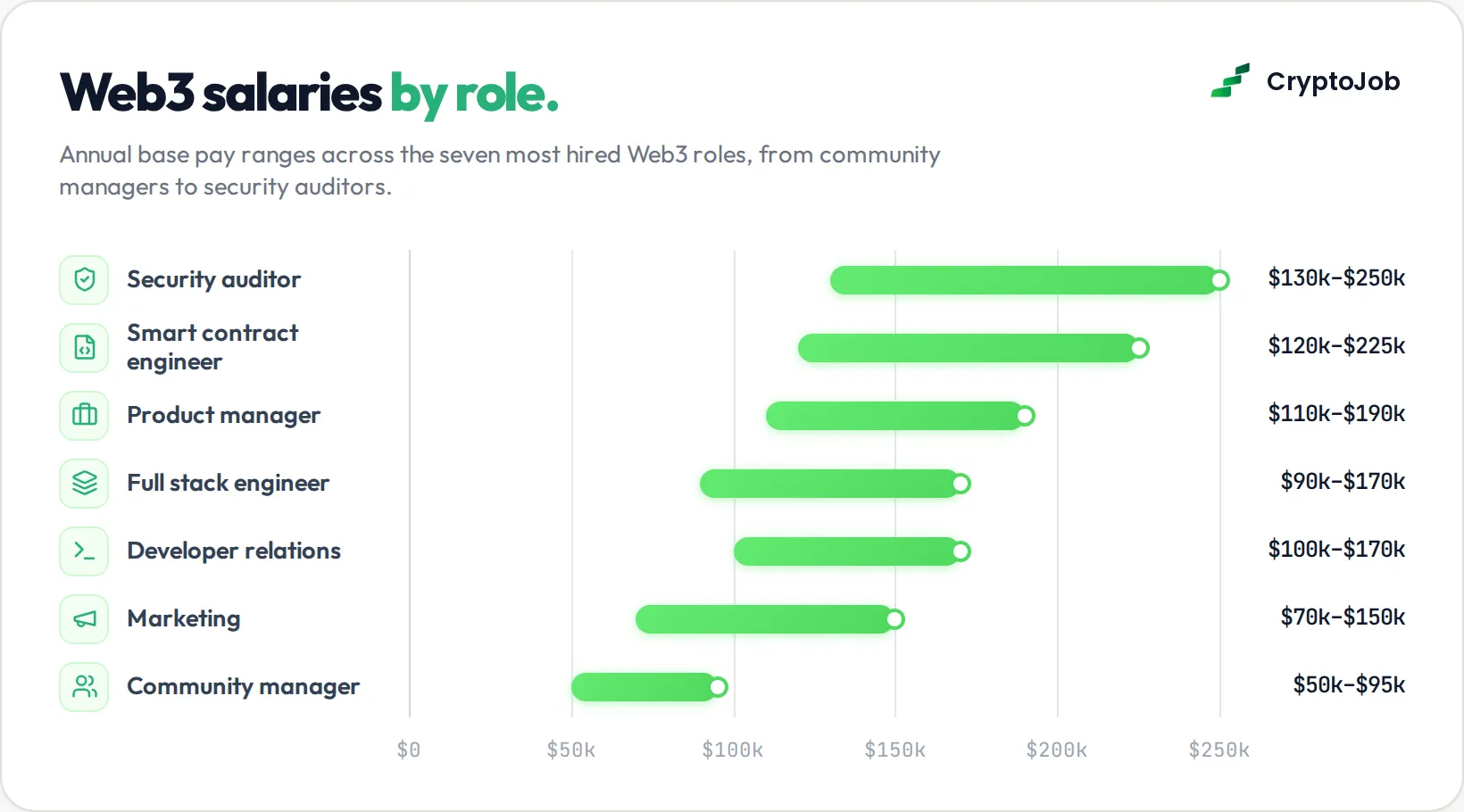
Salary data in crypto varies a lot by company stage, chain ecosystem and whether pay includes tokens. Treat these as realistic ranges for full-time remote roles at funded companies, not guarantees.
- Smart contract engineer: $120k to $225k, senior protocol roles can exceed $250k
- Security auditor: $130k to $250k, top contest performers earn more through bounties
- Full stack or frontend dev: $90k to $170k
- Product manager: $110k to $190k
- Developer relations: $100k to $170k
- Community manager: $50k to $95k
- Marketing and growth: $70k to $150k
Token allocations commonly add 10% to 50% on top of base at early-stage startups, but vesting schedules and token performance make the real value unpredictable. Ask about it directly in interviews.
Why does this belong in a resume guide? Because knowing the band for your target role tells you how senior to position yourself and which achievements to lead with.
What Do Good Crypto CV Examples Look Like?
Strong crypto CV examples share one habit: every line is specific enough to verify or question in an interview. Compare these before and after bullets.
Developer
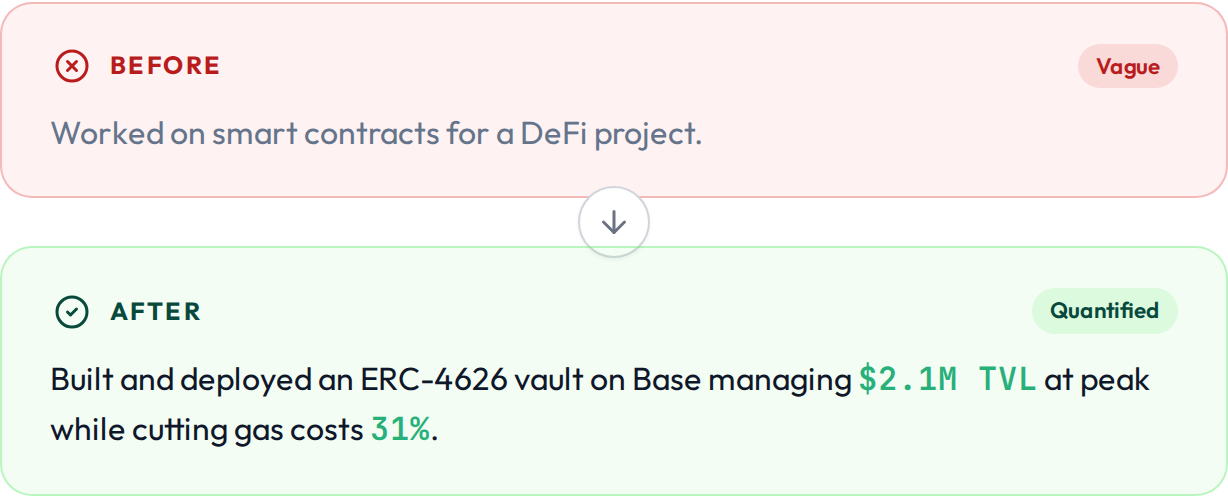
- Before: "Worked on smart contracts for a DeFi project"
- After: "Built and deployed an ERC-4626 vault on Base managing $2.1M TVL at peak, cut gas costs 31% vs the previous implementation"
Community
- Before: "Managed social media and community channels"
- After: "Ran X and Discord for an L2 gaming project, grew followers from 8k to 41k in 7 months and lifted event attendance 3x"
Career switcher
- Before: "Interested in transitioning to blockchain"
- After: "Backend engineer (5 yrs, payments) now contributing to Optimism repos: 14 merged PRs, built a fee-estimation tool with 400+ GitHub stars"
Notice none of these mention passion. The numbers do the persuading, and a hiring manager can click through and check.
If you have no professional web3 experience yet, manufacture verifiable proof in 2 to 4 weeks: fork and improve a small protocol, enter one audit contest, write two technical breakdowns or take on a bounty from a DAO. One real artifact beats ten courses on a resume.
What Mistakes Get Web3 Resumes Rejected?
No links. A crypto resume without a GitHub or portfolio link is a near-automatic pass for technical roles. Recruiters assume the worst about what they cannot see.
Buzzword soup. Listing 15 chains and 20 protocols with no evidence you used them reads as noise. Three technologies with proof beat twenty without.
Hiding the wins. Candidates bury hackathon prizes or DAO grants under a "projects" footnote. If it is your strongest proof of work, it goes in the top half of the page.
Ignoring the ATS. If the posting says "Solidity" and your resume says "smart contract languages," a keyword filter may drop you before a human looks. Mirror the job description's exact terms.
One resume for every job. A generic PDF sprayed at 50 postings converts worse than 10 tailored ones. Swap your summary and top three bullets for each application, it takes 15 minutes.
Anonymous with no explanation. Pseudonymous applications are accepted at many DAOs and some startups, but you still need a consistent identity with a track record attached: an ENS, a GitHub handle, published work.
Final Checklist Before You Hit Send
Run through this in two minutes: one page, links clickable, every bullet has a number, keywords match the posting, file named FirstName-LastName-Role.pdf and no typos in protocol names (writing "Etherium" ends interviews before they start).
Then put it to work. Browse web3 jobs on CoinTerminal, pick roles that match your proof of work and tailor your resume to each one before applying.
FAQ
How long should a web3 resume be?
One page for almost everyone. Only go to two pages with 10+ years of directly relevant experience, and even then put everything decisive on page one.
Do I need a degree to get a web3 job?
No. Most crypto companies hire on demonstrated skill: public code, on-chain contributions, audits, content or community results. A degree helps at larger exchanges and institutional firms but is rarely a hard requirement.
Should I put my wallet address or ENS on my resume?
Only if it strengthens your case, for example a wallet showing governance participation or an ENS tied to public contributions. Never link a wallet with sensitive personal financial history.
Can I apply to web3 jobs pseudonymously?
Often yes, especially at DAOs and smaller startups. You will need a consistent pseudonymous identity with verifiable work attached. Exchanges and regulated companies usually require legal identity for compliance.
How do I write a web3 resume with no experience?
Create proof first: contribute to an open source repo, enter a hackathon or audit contest, complete a DAO bounty or publish technical writing. List those as experience with results, then apply for junior and contributor roles.